Burlington’s mayor says the city is ‘back.’ Is it just a blip?
Jul 07, 2026 | 7:03 am ET
Description
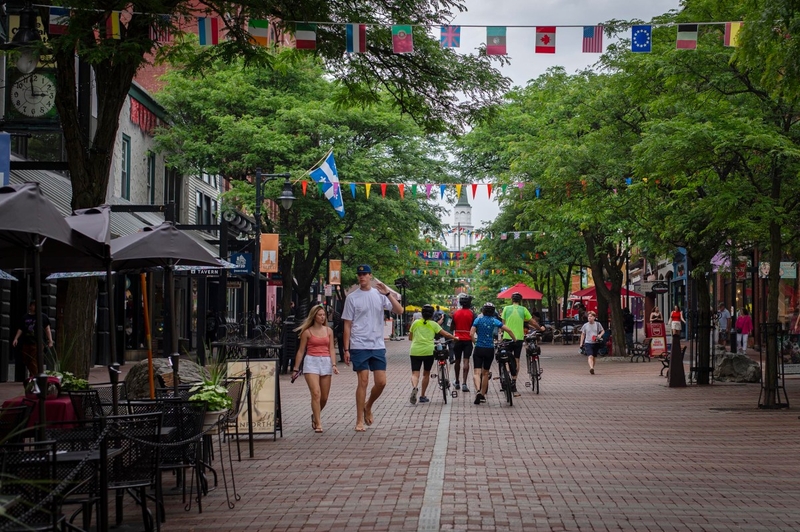
People walk along Church Street in Burlington on Tuesday, June 30, 2026. Photo by Glenn Russell/VTDigger
BURLINGTON — Mayor Emma Mulvaney-Stanak stood at a podium on Church Street, flanked by city employees, and declared that “Burlington is back.”
“There’s a growing sense that Burlington is turning a corner, that energy is back, the confidence is returning in this city, and that this city is moving forward,” Mulvaney-Stanak said at a press conference late last month.
While leaders in Burlington’s business community hope that’s true, it has yet to be seen if the state’s largest city will see the pre-pandemic levels of foot traffic and downtown business that it hopes for.
Burlington commerce leaders say that businesses downtown have been doing well in the past couple of months, but it’s hard to tell if that uptick signals a real trend.
“I can’t tell you whether what we’re seeing is just that temporary blip,” said Kelly Devine, executive director of the Burlington Business Association.
Businesses in the city’s downtown core have been rattled by national trends like rising inflation and higher labor costs as they try to recover from a decline in business during and following the Covid-19 pandemic. The city has also been scrutinized by some business owners and residents, who say officials aren’t doing enough to combat the presence of homeless people and drug use downtown, which they say deters people from visiting the city.
Gov. Phil Scott last year put a spotlight on what he called Burlington’s “crisis” with homelessness and public drug use. He partnered with the city in a plan to curb crime, surging resources for both policing and social services in the Queen City.
This year, the city appears to be on-track to report fewer crimes than last year, although police typically see an increase in crime during the summer months.
Mulvaney-Stanak’s claim that Burlington is making progress comes as the city heads into the summer months, when a string of public events help keep streets downtown busy with foot traffic.
The mayor’s press conference came a week after the city passed its $112.6 million budget for the fiscal year, which started earlier this month.
During the event, Mulvaney-Stanak highlighted some of the city’s event spending for the coming months.
Burlington hosted its downtown jazz festival during the first week of June, which the mayor said brought thousands of visitors for the five days of performances. The music festival was one of more than 100 events the city has planned for the summer, Mulvaney-Stanak said. And the city’s budget includes spending $1 million on the events and marketing, she said.
Mulvaney-Stanak also drummed up support for infrastructure development projects in town, such as Burlington’s Champlain Parkway, a roadway unveiled last week that connects Interstate 189 to Lakeside Avenue while avoiding Pine Street.
That project, along with the city’s redevelopment of Main Street, were “generational investments in Burlington’s future,” the mayor said.
The Main Street construction project began in February 2024 as an initiative to widen sidewalks and showcase public art. But as the project has dragged on for more than two years, businesses along the road have complained to city officials that construction has disrupted and caused their businesses hardship.
Mark Bouchett, who co-owns the store Homeport on Church Street and serves as a commissioner of the street’s marketplace, joined the mayor in praising city initiatives and commended other businesses downtown who have “persevered through these challenging times.”
“We trusted that our community, our city government and our neighbors in the surrounding towns would recognize that downtown Burlington and Church Street Marketplace were too valuable to leave to circumstance,” Bouchett said at the mayor’s press conference outside his store.
He was also glad, he said, that even during a tight budget year, the mayor was willing to put more city money toward policing.
Burlington’s new city budget provides the funds to add 10 uniformed police officers to the Burlington Police Department over the next year, Mulvaney-Stanak said. She said the city is also expanding its squad of unarmed employees including community support liaisons, who provide services to those struggling with mental health issues or homeless, and community service officers, who respond to quality of life service calls.
That investment is a sharp change in attitude since the city cut its maximum police force 30% by attrition in 2020 following pressure from activists in the wake of George Floyd’s death.
The city shouldn’t have an uncapped number of police officers, Mulvaney-Stanak said. “However, there is a reasonable amount of police officers we need to meet the needs of our community, and we’re well below that number right now,” she said.
Businesses in the city
Burlington’s recent uptick in sales and foot traffic comes during a time of year that’s typically very busy for the city, according to Devine, so it’s hard to tell if that change is notable. During May, the city marathon, graduation at the University of Vermont and the jazz festival all tend to attract people to the city, she said.
Looking ahead, Devine said that hotels are booking fewer rooms than usual for July and August. It’s hard to tell whether that dip is due to a statewide decline in Canadian tourism, or if numbers are lower across the board because a new hotel opened downtown last fall.
This year — besides recent months — Devine said that small restaurants and retailers have seen a dip in sales compared to past years.
Devine said she attributes many of the Queen City’s struggles to the effects of the pandemic. Like other cities around the country, Burlington has seen fewer people working in offices.
“We’re not renting out office space the way we once were,” Devine said.
State employees used to work out of an office downtown on St. Paul Street, but after the pandemic, the state decided to move out, she said. Other office buildings used to be completely full and now few employees actually come in to work, Devine added.
Businesses at the local level are also grappling with changes to the national economy, like rising inflation and high labor costs, Devine said.
Brad Minor, a real estate appraiser with the South Burlington firm Allen, Brooks and Minor, prepares a report every six months evaluating real estate in Chittenden County.
The current retail vacancy rate in Burlington’s downtown district is 7.7%, according to Minor, which is slightly above the 20-year average of 6.7%
But that change isn’t necessarily indicative of downtown being worse or better off, Minor said. Newly built retail space opening downtown may lead the vacancy rate to spike, he said, but that increase could come before businesses move into the new spaces, lowering the rate again.
In December of last year, the downtown retail vacancy rate was 9.7%, according to Minor. But that was after a new retail space opened on Bank Street, leaving 12,000 square feet that needed to be absorbed into the market.
Read the story on VTDigger here: Burlington’s mayor says the city is ‘back.’ Is it just a blip?.

Montpelier, VT