In Brooklyn, a Judge-Maker’s Steady Wins Raise Eyebrows
Sep 14, 2026 | 4:09 pm ET
Description
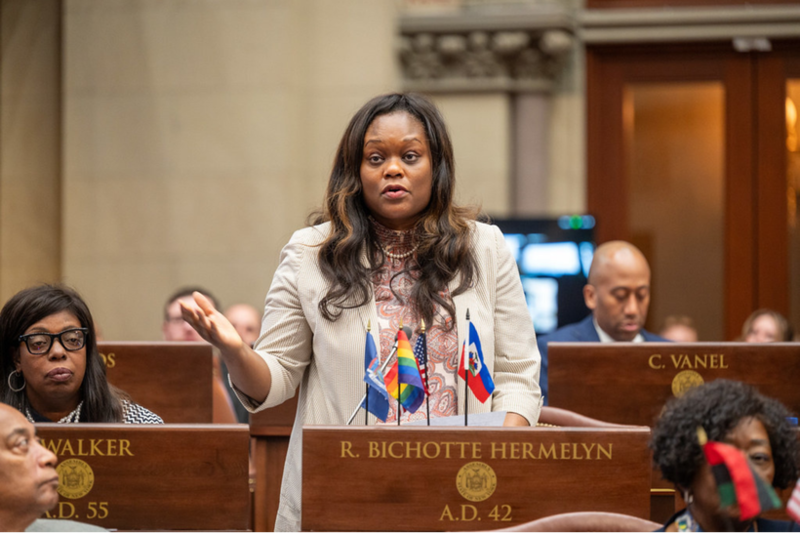
Assemblymember Rodneyse Bichotte Hermelyn, who leads the Brooklyn Democratic Party, has proposed an overhaul of party rules. / Photo: New York state Assembly Majority
On Monday afternoon, a Brooklyn political boss’s attempt to overhaul party bylaws was struck down by a local judge. She could still appeal the ruling — and some opponents say a little-known political consultant exemplifies what’s at stake.
Gregorio Mayers, dubbed a “Supreme-maker” for his role in getting clients seated on the Supreme Court, has done the same for the borough’s civil court judges, according to records reviewed by New York Focus.
Over the past two years, all six civil court nominees selected by members of the party’s county committee have employed Mayers as a consultant. In Brooklyn, the Democratic nomination all but assures their election.
The party chair, Assemblymember Rodneyse Bichotte Hermelyn, recently pushed through sweeping changes to party rules after rivals appeared to have lined up enough votes to replace her. The changes, which dramatically expand who can vote in an upcoming party leadership election, would also give the chair even more control over future judicial nominations, according to Tony Melone, president of the New Kings Democrats, a party faction aligned with individuals who are suing Bichotte Hermelyn over the rule changes.
“When one person controls these votes, and one consultant represents all the candidates who are chosen, there is extreme potential for corruption,” Melone said. “Every candidate will see they have to take this path, regardless of what they have to pay.”
On Saturday, Mayers told New York Focus that any suggestion that judicial candidates were “required or directed” to retain him in exchange for political support was “false.”
Brooklyn Supreme Court Justice Jill Epstein ruled on Monday that a vote passing the proposed rule amendments was “null and void” because district leaders unseated in June primary elections had been allowed to vote. The votes of those outgoing district leaders had allowed the amendments to narrowly pass.
Assemblymember Maritza Davila, who strongly opposes the rule changes, said she doesn’t know why Mayers’s clients have been so successful, but that Mayers and Bichotte Hermelyn were “very good friends,” and that Brooklyn judicial candidates have long felt obligated to hire such consultants.
“I don’t know how that works, but is there something that’s not right about it? Absolutely,” Davila said. In the past, she said, “I know some judges that have even put their houses up [to pay a consultant] to become judges … They’re all looking to become Supreme, and so when any seats come up, they’re willing to do whatever it takes to get there.”
A person close to another successful judicial candidate, who spoke on condition of anonymity to avoid retribution, said the candidate had told them that Bichotte-Hermelyn had insisted they hire Mayers.
Civil court and Supreme Court judgeships pay $220,800 and $237,300 per year, respectively, and party leaders in Brooklyn have a history of making demands of judicial candidates in exchange for the lucrative roles. In 2007, former party leader Clarence Norman was convicted of extorting two civil court candidates by pressuring them to pay favored campaign vendors in exchange for the party’s support.
Last week, New York Focus reached out to the Brooklyn Democratic Party for comment. Neither Bichotte Hermelyn nor anyone else from the party responded, but on Sunday — before this article’s publication — the party publicly released a lengthy statement referring to reporting in New York Focus and the New York Post as a “false narrative designed to undermine confidence in Brooklyn’s judiciary” and “to smear respected Black political consultants who have spent decades helping candidates and judges navigate the electoral process.”
The timing of the statement was unusual: Neither New York Focus nor the New York Post had published an article on Mayers, and the Post still has not. The statement said the outlets had ignored “repeated corrections, legal explanations, and requests for verification,” but the party has not sent New York Focus any communications.
Mayers, an attorney, professor, and one-time official in former Mayor Michael Bloomberg’s administration, noted that he has consulted for judicial candidates “for many years, beginning years before Rodneyse Bichotte Hermelyn became Brooklyn Democratic Party Chair.”
Candidates who have publicly disclosed making payments to Mayers have paid him or his firm at least $203,000 since Bichotte Hermelyn became chair in 2020; during the prior six years, campaigns paid Mayers or his firm at least $53,000.
He said clients have come through referrals from clergy, community leaders and others, and there has never been “an agreement or understanding that retaining me would result in a judicial nomination or political support.”
Mayers does not hold a formal position within the Brooklyn Democratic Party, according to his most recently filed conflict of interest disclosure form. This contrasts with the Bronx, where the connection between judicial campaign consultants and the party chair is much clearer. Political consultants working for that county’s Democratic leader, Senator Jamaal Bailey, are the same ones routinely hired by Bronx judicial candidates that win Bailey’s backing. But in Brooklyn, New York Focus could not locate any record of the party or chair making campaign payments to Mayers.
Prominent politicians, ranging from Governor Kathy Hochul to House Minority Leader Hakeem Jeffries, have publicly opposed Bichotte Hermelyn’s plan. But they face entrenched party leaders accustomed to handing out jobs and appointments.
State Supreme Court nominees are picked through an internal party process. Democratic nominees for civil court judgeships in New York City are normally elected by voters, but the six recent nominees in Brooklyn were instead chosen by a subset of the party’s county committee because the seats were created by the legislature after petitioning for primary elections had ended.
In 2025, three of the civil court judges tapped in this manner — Chidi Eze, Juliet Howard and Dagmar Plaza-Gonzalez — were all Mayers’s clients, according to an Instagram photo Mayers posted.
At the 2026 nominating meeting, video of the other three nominees’ acceptance speeches shows they thanked Mayers or his firm, GM Consulting.
“Thank you all for your quality service,” Xavier Carr, one of the nominees, said. “We wouldn’t be here today without your assistance.”
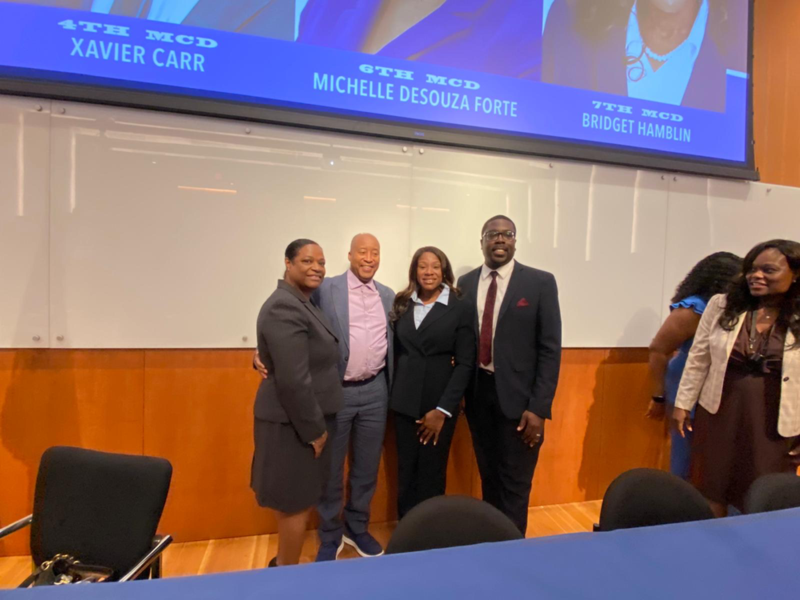
Of these six nominees, only two of them — Michelle DeSouza-Forte and Dagmar Plaza-Gonzalez — reported paying the firm through a campaign committee in 2025 or 2026. It’s not clear how much the four other Mayers clients paid GM Consulting this year.
Five of the six Mayers clients did not respond to attempts to reach them for comment; contact information for the sixth was not available.
Mayers has also had considerable recent success in helping clients seeking nomination for State Supreme Court judge, as Hell Gate first reported. In 2025, one Brooklyn Democratic nominee dubbed Mayers “Supreme-maker” during her acceptance speech. Mayers, who reportedly represented four of the nine candidates selected that year, told Hell Gate that his work consisted of advising his candidates on interviews, events, and campaigning.
Albany