At the border, a race that runs against the wall’s message of division
Aug 21, 2026 | 12:21 pm ET
Description
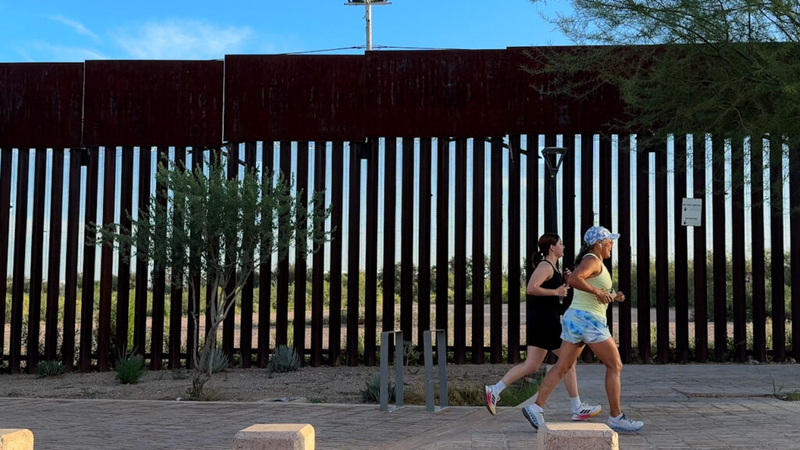
Two runners approach the finish line on Calle Internacional in Agua Prieta, Sonora, as part of the Friends Across Borders 5K run on Aug. 15, 2026. (Photo courtesy Genesis Lara)
As the sun rose Saturday morning, dozens of runners gathered in Douglas, Arizona and Agua Prieta, Sonora to race along a stretch of the U.S.-Mexico border. Although separated by the border barrier, gaps between the bollards allowed glimpses of runners picking up speed alongside each other– challenging the division that the towering structure was designed to impose.
The 5K race, which ultimately gathered all runners at the finish line in Agua Prieta, kicked off Friends Across Borders, a binational event meant to celebrate the close relationship between the two communities.
“The purpose of Friends Across Borders is to send a message so loud that everybody hears what is really happening in this border. And that is that we are friends, we are united, and we love to be together,” said Alex Boneo, co-founder of the Arizona Border Alliance, one of the event organizers.
The event included physical activities, faith-based and socioeconomic discussion on immigration, and a celebration of the people and cultures that integrate along the border.
In Arizona, Friends Across Borders is held exclusively in Douglas. But its message reverberates across the entire U.S.-Mexico border: While many portray it as a warzone in need of militarization, border residents know it as home – a place where friends and families work, live and come together across an international boundary.
“I think it’s important for people outside of the border region to realize the vitality of our community here – how we enjoy living on the border, that we’re not afraid, that it’s a place of encounter,” said Mark Adams, the U.S. coordinator for Frontera de Cristo, which helped organize the event.
Much of daily life in border communities defies the division imposed by U.S. policies. I’ve seen that reality firsthand through both my upbringing in Nogales and my work with the ACLU of Arizona, where we are engaging with communities living across the region to amplify the voices of the people who experience the border everyday.
In Naco, for example, several children regularly walk to Sonora after school to spend time with their grandparents while their parents are at work. After being deported to Nogales, Sonora, many people have decided to rebuild their lives there so they can remain close to family in the United States. In San Luis and Yuma, hundreds of people travel to Mexico regularly for medical and dental care that they otherwise wouldn’t be able to afford.
Border residents know that the border wall is often more of a political symbol, than an actual division. People on either side of the border continue to move across the international boundary to visit family and friends, shop, pursue educational opportunities, open businesses, and come together to address shared problems.
But policymakers continue to misunderstand the region. Political discourse too often centers on border militarization and rigid immigration policies, disregarding the lived experiences of border residents and the deep interconnectedness between the two countries. Decades of militarization have not stopped migration; instead, they have pushed people toward more dangerous and inhumane routes in search of better lives.
Even the few politicians who take the time to visit border communities often spend only a few hours there, engaging primarily with federal agencies that offer a narrow view of a complex and multifaceted region.
Events like Friends Across Borders offer people from outside the border region an opportunity to experience that reality for themselves – an invitation that Boneo and Adams happily extend to both the public and policymakers. Visit the border, engage with the locals who call it home, and see the region beyond the fear-driven narrative that too often dominates political discourse.
“We really want to call the attention of those that have never been on the border, that make the rules for the border, and that just have no idea [how it works],” Boneo said. “[Friends Across Borders] is a big, loud scream saying, ‘Take a look at who we are and what we have and what we’re capable [of] because we are capable of coming together.”
Phoenix, AZ