Blakeman Sought Matching Funds for Thousands of Ineligible Donations
Sep 29, 2026 | 12:23 pm ET
Description
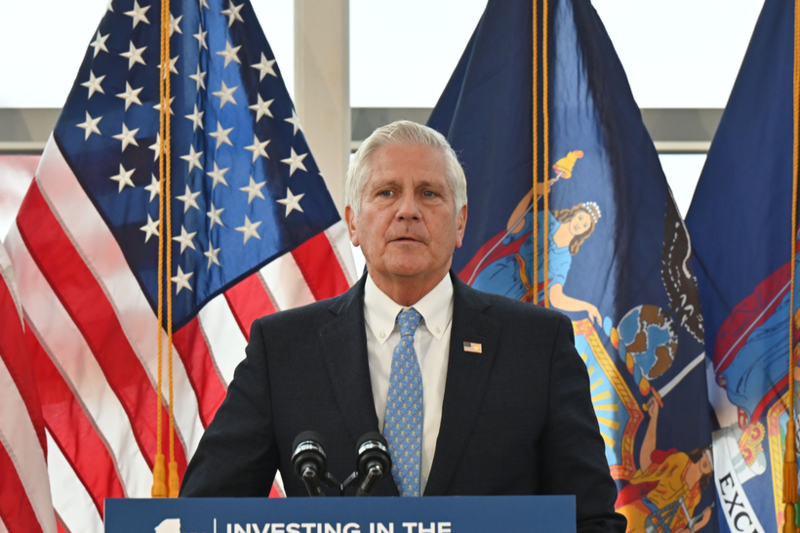
Photo courtesy of New York Focus
Republican gubernatorial candidate Bruce Blakeman requested public matching funds for more than 2,600 donations that don’t qualify for the state’s campaign finance program, according to a New York Focus analysis.
Blakeman, currently the Nassau County executive, is seeking to unseat New York Governor Kathy Hochul, a Democrat who has led the state since 2021. Hochul is the heavy favorite, but some polling shows Blakeman within striking distance.
Blakeman is relying on New York’s matching funds program to boost his campaign. The taxpayer-funded program, which was championed by good government groups and launched in 2022, allows candidates to get $6 in public money for every $1 of eligible contributions from supporters. It was meant to give underdog candidates a better chance of competing against richer campaigns. Hochul’s campaign opted out of the program.
To be eligible for matching funds, contributions must come from New Yorkers who have not donated more than $1,050 to the candidate, and must be at least $5. Only the first $250 from each donor is eligible.
Have a tip about New York elections?
Reach out at [email protected].
But thousands of donations that the Blakeman campaign marked as eligible, worth over $860,000 in public funds if approved, violated those rules.
All requests for matching funds are ultimately approved or rejected by the public campaign finance board. A spokesperson for the board said that it checks all claims for matching funds to ensure they are eligible, but did not answer questions about Blakeman’s contributions.
Blakeman campaign spokesperson Madison Spanodemos said the errors have been corrected, and that the campaign filed amended reports “to accurately reflect the millions in matchable contributions from New Yorkers.”
That doesn’t appear to be true. Blakeman’s campaign has amended many of his finance reports several times, but the most recent versions still include match requests for thousands of ineligible donations. The campaign did not respond to multiple requests for clarification.
Spanodemos blamed the errors on the governor. “Kathy Hochul’s illegal attempt to block Bruce Blakeman from receiving public matching funds created reporting complications,” she said.
In March, the public campaign finance board voted 4-3 to deny Blakeman’s campaign matching funds, due to his running mate failing to submit the proper paperwork. Blakeman sued to overturn the decision and blamed it on Hochul, who appointed several of the board’s members. In May, a court ruled in Blakeman’s favor, allowing him to start receiving public money.
The campaign requested matching funds for over 1,900 contributions from donors outside New York, including more than 400 from Florida and Texas, a $9,000 contribution from cryptocurrency mogul Brock Pierce, who listed a Puerto Rico address, and nearly 200 contributions of $1 from states including Kansas, Oklahoma, and West Virginia. Blakeman’s campaign filings wrongly stated that these donations were from “in-district” donors.
Blakeman’s fundraising website lists some of the rules of the matching funds program, but does not include the rule that only donations from New Yorkers’ donations are eligible for matching funds.
The website notes that only donors who have given less than $1,050 are eligible for matches, but the campaign still requested matching funds for over 500 donations by New Yorkers who gave more than that amount. Those requests included a $5,205 gift from former Republican Representative Nan Hayworth and over $9,000 from Anthony Scaramucci, former White House communications director under President Donald Trump.
“The Blakeman campaign needs to get their act together,” said Alex Camarda, a policy analyst at the nonpartisan good government group Reinvent Albany. “These are basic things that any campaign should understand.”
Kathleen McGrath, the elections board spokesperson, noted that bipartisan staff audit all claims before sending money to campaigns. “If matching funds are paid out for claims that are later deemed to be ineligible, the [board] has several ways to recover those funds,” she noted.
The ineligible donations made up about 10 percent of the contributions the campaign submitted for matching funds. Blakeman’s campaign has received nearly $2 million in public matching funds, according to his campaign’s July report, but it’s not clear whether any of the ineligible donations were matched as part of that haul.
Albany