Bethlehem’s landfill is set to close. What happens next for residents is murky.
Oct 15, 2026 | 5:00 am ET
Description
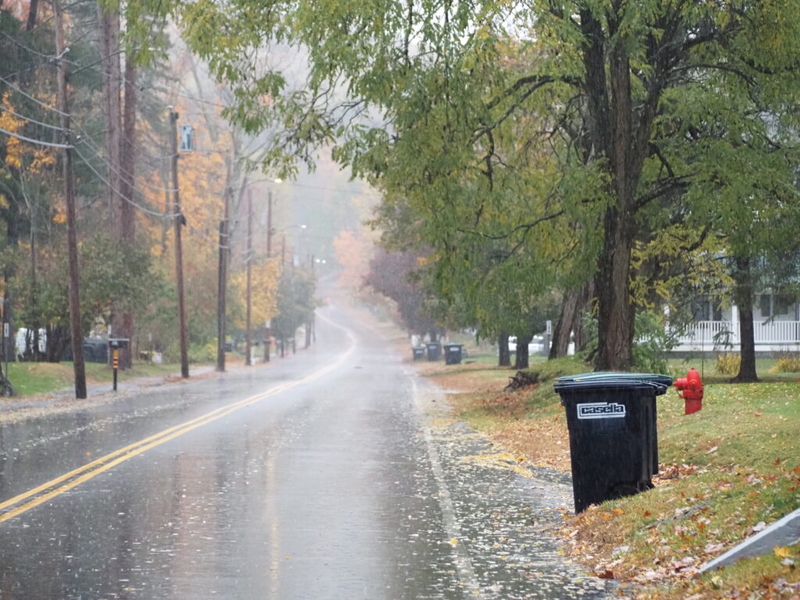
On a rainy Tuesday, Oct. 13, Casella-branded trash and recycling bins line Agassiz Street in Bethlehem. Casella Waste Services provides free curbside waste pickup to residents of the town as part of a host-community agreement that will expire in December, when the company's Bethlehem landfill is slated to close. Transfer Station Committee members said the benefit was not worth the cost of hosting the landfill, and added they were optimistic about the town's ability to take on trash handling duties in Casella's wake. (Photo by Molly Rains/New Hampshire Bulletin)
With Casella Waste Services’ landfill in Bethlehem slated to close at the end of this year, town officials are preparing for a post-landfill future. But with the closure arriving sooner than anticipated, those preparations have been shaded by persistent trash-related tension.
The end of operations at the landfill also marks the end of a settlement agreement between Casella and Bethlehem, under which Casella has provided curbside waste pickup and disposal services to residents. Free service will no longer be available to residents once the landfill closes, a change officials said called for the town to develop alternative, permanent systems for handling waste.
Members of the Bethlehem Transfer Station Committee, tasked with making those plans, said they were ready to distance Bethlehem from the landfill within its borders. The site has been plagued by environmental violations and concerns among some of its neighbors; the closure is the result of previous zoning decisions, voted on by residents, to prohibit further expansion at the site . But some other residents are disappointed to see the operation draw to a close, and apprehensive about the costs associated with taking on the task of managing waste for the town’s approximately 2,500 residents.
As Bethlehem scrambles to move into a new phase at the end of this year, some long-running debates are again taking center stage.
“It’s tough. It’s a sore subject. It’s been a sore subject for a lot of years,” said select board member Casey MacDonald, speaking Tuesday night outside the Bethlehem Public Library on Main Street. “And now, it’s like, oh, we’re here — but we’re not quite there yet.”
What is changing?
Casella Waste Services announced at the beginning of October that Dec. 31 would be the last day the landfill accepts municipal solid waste.
That is earlier than the company’s previous estimates. As recently as this summer, town officials heard estimated closing dates in 2027 from Casella, Bethlehem Select Board member Nancy Strand said in a phone interview Wednesday. Casella Vice President of Communications Jeff Weld said in a Wednesday email that the company had been discussing closure timeframes with community representatives for the past year.
The announcement wasn’t too much of a surprise, Strand and other officials said.
“It’s kind of a shock, but we knew it was going to happen eventually,” said MacDonald.
Once the landfill reaches capacity, Casella must follow a closure protocol followed by ongoing environmental monitoring at the site.
When the landfill is no longer accepting waste, the agreement that requires Casella to retrieve residents’ trash will no longer be active, Strand and Weld said. Weld also identified annual fees paid to the town, “community donations,” and an annual household hazardous waste drop-off day as among the other Casella-run programs that would end at that time. Casella also expects the amount of property taxes paid to the town to drop, he added.
The immediate result of the end of curbside pickup and residential waste drop-off at the landfill, Strand said, is that Bethlehem will need a plan in place to collect and sort waste, then transport it to another facility for final disposition.
That’s where the Transfer Station Committee comes in.
Transfer station dreaming
The Bethlehem Transfer Station Committee envisions a future municipal waste collection station for a town-owned parcel on Route 116.
Unlike most towns, with established procedures for dealing with their solid waste, Strand views Bethlehem as facing an opportunity to start “from scratch.” She hopes the facility will provide benefits to the community that go beyond fulfilling their responsibility to shepherd waste to a landfill.
“We, as a small town, can, I believe, create a really kick-ass transfer station,” she said at a June meeting of the Transfer Station Committee.
At the transfer station, the standard collection, sorting, and sendoff of trash and recycling would be a given, the committee said. (Trash will be sent to the Mount Carberry landfill in Berlin.) Other features outlined for the site include a food waste collection system, to enable residents to compost and reduce the waste that must be sent to a landfill, as well as a “free store,” where residents can exchange items they no longer want but that are not necessarily ready for the landfill.
The station will cost about $1 million, according to the committee. Residents have funded a capital reserve account with about $300,000 for the project. The remainder of the cost, the committee and select board say, will come from a federal grant in the form of congressionally directed spending from Sen. Jeanne Shaheen, with about $750,000 earmarked for the project.
But the process of the grant’s release to the town has been slow. MacDonald said the funds were dependent on permitting reviews by the U.S. Department of Agriculture, which is administering the funds.
On Wednesday, Strand said communications earlier this week from the USDA indicated the town would get the “green light” in the coming weeks. That would clear the town’s engineering firm, Concord-based Aries Engineering, to begin work on the site and issue requests for proposals for the structural work.
But with funds not yet available to the town, and the Casella landfill’s closure likely happening sooner than planned, Bethlehem must find a way to fill the gap. Strand estimated that the permanent transfer station would be ready in summer or fall 2027; in the meantime, the town plans to operate a temporary transfer station at the town garage, with rolling dumpsters collecting materials for transport.
Funding these measures is another challenge. The Transfer Station Committee has recommended implementing a pay-as-you-throw system, in which residents must purchase specially marked trash bags to dispose of waste, to help fund the trash management system going forward. But all the same, taking on the town’s trash will have a budget impact, Strand said.
“We have to pay the tipping fees at Mount Carberry, we have to invest in the pay-as-you-throw bags,” she said. Other costs will include staff at the transfer station: a manager, plus at least one part-time attendant. “There’s no question that taxpayers will see a change,” Strand said. “…We’re just trying to make it as minimal as possible.”
A legacy of waste troubles
The new anticipated costs of waste management have not been welcomed by all residents. The fact that curbside waste pickup is not guaranteed to continue has also been troubling to some, MacDonald said.
The town has solicited bids from multiple companies for waste hauling, Strand said, including Casella. Though Weld confirmed that free curbside pickup would end, he did not rule out the possibility that Casella would continue to offer the service to residents for a cost — though the company has not yet said what that cost would be.
Some residents discussed putting a warrant article before voters last year to explore changing the town’s prohibition on expansion or reopening negotiations with Casella, MacDonald said. But no article was ultimately put forward last year, and though the conversations have continued this year, he said he wondered if the upcoming March 2027 town meeting would be “too late” for such a move.
“NCES has the physical space to expand and continue providing disposal capacity for Bethlehem and the more than 200 New Hampshire communities that rely on the facility. However, expansion would require a change in local zoning, which has not occurred, as well as applicable regulatory approvals,” Weld said, referring to Bethlehem’s prohibition on expansion at the site.
Resident Daniel Noyes said he hadn’t felt positive about the closure announcement. Mostly, he said, he and others he knew were confused about the status of the town’s plans for its trash, and wished for more communication from the Transfer Station Committee. On Tuesday night, he had attempted to attend a meeting of the committee, which was ultimately canceled for lack of a quorum. Noyes said he was disappointed not to be able to ask questions.
“Everyone’s got a different story of what they think is happening,” he said.
Even with operations drawing down, Bethlehem will not soon forget the waste pile within its borders, Strand said.
“The landfill will be there forever, you know?” she said. “That’s a giant mountain over there.”
Her hope is that the town can endure the transition ahead and overcome the trash-related disputes that have divided residents for decades.
“Most people, I think, in our town are just tired of the fight, tired of the divisions that it creates, tired of the same old arguments, both pro and against,” Strand said. “You know, we’re just — we just want to move on.”
Concord, NH