Benson: Economic opportunity is the unfinished work of the Civil Rights movement
Oct 14, 2026 | 5:00 am ET
Description
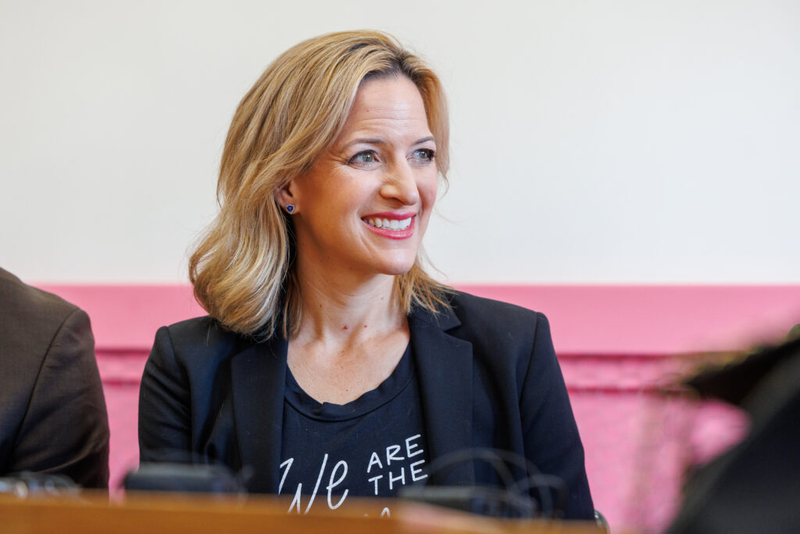
Michigan Secretary of State Jocelyn Benson kicks off her general election campaign for governor in a roundtable with small business owners at Good Cakes and Bakes in Detroit, Mich., on Aug. 5, 2026. (Photo by Andrew Roth/Michigan Advance)
Jocelyn Benson has been Michigan’s Secretary of State since the start of 2019. But before that, she was, as she describes, “a student of the Civil Rights movement,” moving to Montgomery, Alabama after college to volunteer with civil rights organizations investigating hate groups. After graduating from law school, she worked at the NAACP Legal Defense Fund and clerked with Judge Damon Keith, a notable federal judge and civil rights champion in Detroit. She went on to teach at and eventually serve as the dean of Wayne State University Law School prior to serving as Secretary of State.
Benson, the Democratic nominee for governor facing off against Republican nominee John James, sat down with Michigan Advance to discuss how her civil rights background would shape her approach to the office if elected on Nov. 3.
This interview has been edited for length and clarity.
Michigan Advance: How does your background inform how you’ve both tackled your current role the last eight years, and how you plan to tackle the role of governor?
Jocelyn Benson: The heart of it is what can we learn from those who came before us and fought similar battles, and also what responsibility do we have to continue on that work, and what’s the unfinished business of that work? The evolution of that is realizing that the unfinished work is not just protecting democracy, which very much still is the fight today, but also continuing to expand that to ensure educational quality and economic justice. That is all tied up in improving our schools, as not just necessary to the future of our state and economy, but the unfinished work of the Civil Rights movement, growing wealth, particularly in communities that have been left out of that opportunity, ensuring we’re working to eradicate poverty in partnership with mayors. That’s going to be what you see a lot of me as governor trying to say, where is that injustice that needs to be tackled, and what can we do to really show up for communities that have often been left out of access to opportunity for far too long. We have a moral responsibility to each other to ensure that everyone has access to real opportunity economically, educationally, and otherwise.
MA: What do you see as the role of the governor in enforcing civil rights law and in improving civil rights in Michigan compared to the attorney general, secretary of state, the courts, the Legislature or local officials?
JB: Every single position has a role to play. The governor is the opportunity to set the tone and the expectation for everyone else to say this is our job, and I, as the CEO of the state of Michigan, am going to demand and hold all public officials to the expectation that we stand up for justice and that we stand up for marginalized communities and those who have been left out of opportunity, because our state does not grow and thrive, we do not become an economic engine if anyone is left out of that opportunity. For me, as governor, my first act will be signing a Voting Rights Act for the state of Michigan to restore the federal protections that were taken away in the recent Supreme Court decision. That’s how I also expect to set the tone. If folks want my support for things, they’re going to have to show me that they’re also working to promote equality of opportunity for every community in the state.
MA: In terms of ICE and rights of immigrants in Michigan, how do you think your approach to that, in terms of gubernatorial responsibility, will differ from Gov. Whitmer’s?
JB: I think you can look to how I’ve operated as secretary of state, where I’ve been unafraid to stand up to the president when he tramples on our rights, and particularly when he violates the Constitution. In alignment with what Gov. Walz has done and others, to say, ‘I’ll see you in court if you try to violate the law’ — that’s my approach. Obviously, I want to have good relations with everyone that I work with, but at the same time, when anyone is violating the law, when anyone is trampling on the rights of residents of the state, my duty and responsibility is to fight for them. As governor, you have to use every tool in your toolbox to protect the communities of the state, whether it’s the bully pulpit or the legal processes, but also finding ways that we can stand up to the growth of detention facilities in the state, especially when there’s no transparency about what’s happening in them. As governor, finding ways to both implicitly and explicitly, directly and indirectly, identify ways to promote transparency in those facilities, so that we can empower others to seek accountability where they may have the legal ability to do so. It’s looking through the lens of a moral responsibility to all of the people of Michigan to keep them safe.
MA: With that legal element, how do you think your background in civil rights law sets you up to use that wide range of tools?
JB: I understand how the law has been used both to hurt and oppress, and also empower and provide opportunity. And I’m squarely someone who got into public service and became a lawyer because I wanted to ensure the law was used to promote and inspire and uplift and empower, as opposed to divide or suppress or disempower. As someone who’s taken an oath to not just uphold and defend the Constitution, but also as an attorney to ensure the law is followed, that provides me I think with a unique responsibility and understanding and about how to stand up to those who may try to skirt the law.
MA: When it comes to the rollback of civil rights for LGBTQ+ people and specifically the transgender community, where do you see the role of the governor on these civil rights questions, especially trans kids in Michigan?
JB: I am someone who will always fight for civil rights. That is the core of who I am in recognizing the importance of whether it’s fair housing or fair employment or access to justice or access to opportunity. It is a non-negotiable for me to ensure all communities are safe and that rights are protected. What I’ve also seen as one of the most effective ways to do that, as someone who’s worked in sports, is in partnership with folks in the schools, coaches and others who oftentimes really can get to the right decision for the community without the interference of a governor. I look at this as someone who was a female athlete and worked in sports. Coaches often know best about what’s best for the particular community, and so allowing them to be in the driver’s seat for this is important to me. You’ll see it in my approach to educational policy as well. You need to sometimes just allow the teachers in the room to be empowered to make the right decision on the front lines beyond what a politician in Lansing might think is best. The bottom line for me, and you’ve seen this for me as secretary of state, is I’ll always use every tool in my toolbox to keep communities safe and make sure folks aren’t marginalized. That’s why I was proud to ensure our licensing policies also reflect the needs of the community, because that’s a very clear administrative process where past secretaries created more burdens, and I was able to alleviate them. My approach, because this is one issue in this moment, but there will be others, is just always involving the community as sort of part of what democracy is supposed to be.
Benson, James tackle affordability, federal relations at first gubernatorial debate
MA: This is another issue where the federal government has really taken a strong stance. How do you manage dynamics with elected officials on any level who have policies that you just staunchly disagree with?
JB: We have a core set of values, and when those values are threatened, and the law or the constitutional protections that I am charged with enforcing are violated, that gives you all the fuel you need to stand up to anyone, and that has been what I’ve seen as secretary of state. I told my team, ‘The truth is on our side, history is on our side, and the law and the Constitution are on our side.’ I’ll go into battle every day with those in my pocket, and so I think when it comes to any issue, economic growth, development, bringing jobs to Michigan, I’ll always work with anyone to get that done, but I’ll be unafraid to stand up to anyone who would trample on the freedoms of Michiganders, especially to further their own power grabs and abuse of authority.
MA: The Southern Poverty Law Center has come under fire from the Trump administration and from the GOP. What do you make of these kinds of attacks on a civil rights group like that, especially one that you’ve worked so closely with on their board?
JB: It’s not lost on me that a tactic of oppressive governments is to attack civil rights organizations. We’ve seen it in the 1960s in the Civil Rights movement, especially some of the most effective ones. But that said, my interaction with the organization was primarily in the late 90s, long before any of these allegations came to fruition, and it was as a volunteer in investigating hate crimes. I think you can’t deny the very clear work that many civil rights organizations, including this one, have done to contribute to advancing the cause of social justice today. I think you have to see this in particular as an effort by the Trump administration not just to attack that work, but to also distract from its failed economic policies.
MA: What do you hope is the future of developing civil rights in Michigan?
JB: Economic justice and opportunity. Full stop. More jobs, better-paying jobs, costs going down, wages going up. That is something that’s particularly affecting communities that have been left out of the opportunity to create wealth for generations, even more than anyone else. Economic growth power is the unfinished work of the Civil Rights movement, tied with educational opportunity. Making sure every public school and every ZIP code is providing a quality education for their kids with wraparound services to address any specific needs of that locality, community or ZIP code, and ensuring that well-paying jobs are waiting for everyone on the other side of that public school system, and that if you want to start and grow your small business, you have access to capital and support to do that. The future of civil rights to me in Michigan is economic opportunity for all, tied with educational excellence for all, and continuing to protect democracy. Those three pillars of the Civil Rights movement still hold true today.
Lansing, MI