Barrett highlights innovation and national security at MSU mobility summit
Aug 11, 2026 | 5:08 pm ET

Description
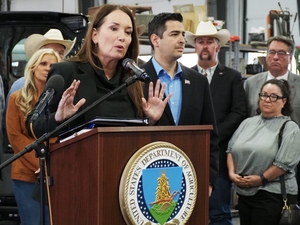
U.S. Rep. Tom Barrett (R-Charlotte) introduces a panel at the Michigan State University Research Foundation's 2026 Mobility Summit centered on mobility technology in national defense. Aug. 11, 2026 | Photo by Kyle Davidson/Michigan Advance
As researchers, entrepreneurs and executives gathered in East Lansing to discuss developments in transportation technology, U.S. Rep. Tom Barrett (R-Charlotte) dropped in to share some brief remarks on how these advancements tie in to national defense.
At the Michigan State University Research Foundation’s 2026 Mobility Summit on Tuesday, Barrett introduced a panel focused on mobility technology in the defense sector, pointing to Michigan’s role as the “arsenal of democracy” during World War II, as the state shifted its manufacturing base to support the war effort by producing vehicles, weapons and other necessary items.
Now, MSU is one of the forces pushing that technology forward, with Barrett noting he’d helped secure $10 million in funding for a collaboration between the university and the U.S. Army Ground Vehicle Systems Center researching autonomous ground vehicles for use in combat. Barrett also pointed to the U.S. Secretary of the Army’s recent announcement that the Camp Grayling Joint Maneuver Training Center would open its testing range to private industry to speed innovation on drone technology.
“Someday I’m going to tell my grandkids that we used to fly inside the helicopters because it feels like increasingly more and more we have these autonomous unmanned types of vehicles that are really dominating the defense space,” said Barrett, a retired army helicopter pilot.
With those developments in the defense sector will also come threats that the U.S. needs to be aware of and respond to, Barrett noted.
Among those threats are concerns over where the hardware and software powering autonomous tech like self-driving cars and drones are developed.
Speaking with reporters after his introduction, Barrett said he had significant national security concerns around drones and ground vehicles manufactured in China, noting that they could be used to transmit data like topographical maps of farmland or sensitive information from crime scenes back to the rival nation.

“We have to be very guarded, you know, the Chinese are an adversary,” Barrett said. “We don’t want to buy their technology cheap, become dependent on it, and then have all of our critical national security information going over there to be exploited by them. It’s something that I take very seriously.”
In June, Barrett introduced a bill alongside U.S. Rep. Pat Harrigan (R-North Carolina) to transition law enforcement agencies away from using drones manufactured abroad and support a buy-back program through the Department of Justice to purchase drones manufactured in adversarial nations.
Barrett noted that this is just one piece of the puzzle and that other lawmakers were looking into other concerns, like ground vehicles.
U.S. Sens. Elissa Slotkin (D-Holly) and Bernie Moreno (R-Ohio) introduced legislation at the end of April to ban Chinese-made vehicles equipped with wireless communication capabilities from being sold or operated in the United States. The bill passed out of the U.S. Senate Commerce Committee by unanimous vote.
In addition to pushing for advancements in drone technology, the U.S. also needs to look into counter-drone technology, Barrett said, noting this would also be a part of the work being done at Camp Grayling.
Lansing, MI