The ballot takes shape, as state officials certify a handful of third-party hopefuls for Nov. 3
Sep 05, 2026 | 5:30 am ET
Description
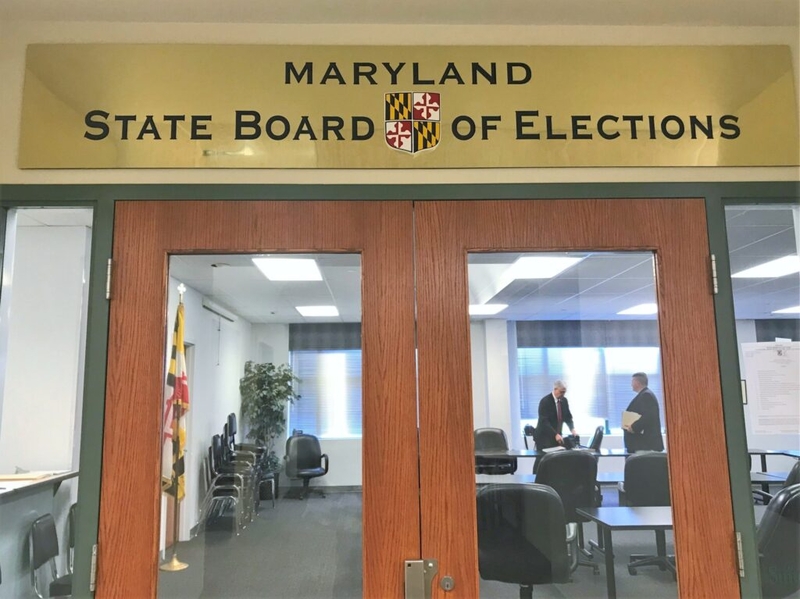
The Maryland State Board of Elections office in Annapolis. (File photo by Danielle E. Gaines/Maryland Matters)
Sam Husseini’s name will appear on the Nov. 3 ballot as a Green Party candidate for Maryland’s 4th District seat in Congress, after state election officials certified his candidacy this week.
It wasn’t easy.
Like the handful of other third-party candidates whose candidacies were accepted Monday, Husseini had to overcome a “huge hurdle” to get on the general election ballot, that candidates in the two major parties don’t have to deal with. And he will continue to deal with challenges that include limited campaign funds, lack of exposure and scant party support.
“We don’t have the right machinery that the establishment parties do,” Husseini said. “So it’s a matter of translating that discontent that I think exists in the public to organize itself so that it forces a change at the ballot box.”
The Maryland Board of Elections finalized ballots and certified all third-party candidates Monday for the Nov. 3 general election, more than two months after state-run primaries for the Democratic and Republican parties picked the candidates for those parties.
Of the 17 independents and third-party candidates who were listed at the time of the June 23 primary as having filed a notice of intent to run for office, just five were able to make the official ballot Monday, mostly Green Party candidates and a few Working Class Party candidates.
Write-in candidates have until Oct. 15 to file their candidacy paperwork, but their names will not appear on any ballots.
Third-party candidates know the odds, but they won’t give up the fight
Green Party and Working Class Party candidates had until early July to submit a Declaration of Intent and have an established campaign committee to be approved to run.
For Republicans and Democrats, they were able to advance to the Nov. 3 ballot after winning their primaries. Third-party candidates have to hold their own nominating processes — but first they have to be accepted as a party by the state.
Under Maryland law, third parties that did not receive 1% of the total votes cast for the highest office in the previous general election have to 10,000 valid voter signatures to be ballot certified for the next election.
The Green Party met this qualification during the 2024 presidential election, when candidate Jill Stein received 1% of the Maryland vote, and reserved its spot for a party nominee this year.
The Working Class Party was not so lucky. Cathy White and Cathy Permut, the party’s gubernatorial running mates, said they collected more than 12,000 signatures to secure their spot on the final ballot, according to the party’s campaign website.
Green Party gubernatorial candidate Andy Ellis said these disparities between rules for principal party candidates and third-party candidates leave a subsect of voters and candidates out of the competition.
Matthew Crenson, professor emeritus in political science at Johns Hopkins University, agreed.
“You’re simply not a part of the game,” said Crenson, who has an expertise in Maryland politics.
Maryland voters can only participate in primary elections if they are registered with either major political party. Voters who do not select a party when registering are marked as “unaffiliated.”
Getting on the ballot is just part of the battle: Third-party or unaffiliated candidates are often excluded from high-profile campaign debates. A debate between incumbent Gov. Wes Moore (D) and Republican challenger Dan Cox on Maryland Public Television is set for Oct. 6. Current MPT policy requires candidates to obtain 10% in a public poll in order to qualify for the debate, meaning third-party candidates are typically left out of the conversation.
Ellis and other third-party candidates are working to require that broadcasters allow all ballot-qualified parties to be included in the debate. A House bill in this year’s legislative session that would have required that all certified candidates be included in televised debates died in a House committee.
Ellis said the exclusion of third-party candidates contributes to their lack of exposure leading up to elections. But he said third-party votes are especially important for the upcoming election, which he deemed “the epitome of the failure of the two-party system.”
He noted that the governor’s campaign this fall is a rematch of the 2022 race between Cox and Moore. Dissatisfaction with both principal party candidates, Ellis said, will sway voters toward their other options this fall.
“That’s a really good opportunity for people to say ‘I’m frustrated with this system, I want something different and I’m going to make a vote that can be registered for that,’” he said.
Crenson said that when people decide to be affiliated with a third-party, it’s likely they do so because they believe major parties are corrupt and no longer align with the previously held values.
But he noted it’s also common for voters to feel a third-party vote is a symbolic gesture with no true influence. Voters take into account that their vote wouldn’t be enough to close the gap between the major party candidates’ victory and defeat.
Ultimately, they end up voting for a major-party candidate, at the risk of having a “throw-away vote.”
“Although, you may get a kind of moral righteousness … voting on the basis of pure principle, rather than political pragmatism,” Crenson said.
Maryland restrictions make it especially difficult for these candidates, and give the public an impression that the candidates aren’t true participants in the election, Crenson added.
Maryland Supreme Court says redistricting ballot question can go to voters
Democrats account for about half of the registered voters in Maryland, with Republicans making up about one-quarter and the other quarter made largely of unaffiliated voters and small numbers of third-party voters. In June, the most recent month for which numbers are available, the 4.3 million registered voters in the state included 6,169 Greens, 4,985 Working Class Party members, and 999,221 voters who were not affiliated with any party.
Husseini, a senior analyst for the nonprofit Institute for Public Accuracy, said he had to take a brief leave of absence from his day job in order to campaign for his position, but he’s enjoyed the process of campaigning and interacting with voters. He said he decided to run after Green Party activists pushed him to consider it. He’s campaigning against a two-party system because he feels Maryland residents are tired of not seeing change surrounding topics including state spending and “repressive” entities, like Immigrations and Customs Enforcement.
“There’s an incredible hunger out there,” Husseini said. “It’s just simply, you know, showing people the right levers to pull to affect that change.”
The third-party candidates certified this week include White and Permut, and Greens: Ellis and his running mate, Owen Silverman Andrews, Husseini, 6th District candidate Moshe Landman and 8th District Nancy Wallace.
It takes long canvassing hours and typically more than 10,000 signatures – to account for any signatures that may be deemed invalid – to get third parties on the ballot. Which is why, despite the long odds, Ellis sees certification as a victory in itself.
“Whenever we actually get to see our names on the ballot, we know that it’s the work of a grassroots group who put us there,” Ellis said. “We’re proud of that and excited about that.”
Annapolis, MD