Audit: MN Department of Human Services could’ve done more to investigate autism kickbacks
Mar 17, 2026 | 5:33 pm ET
Description
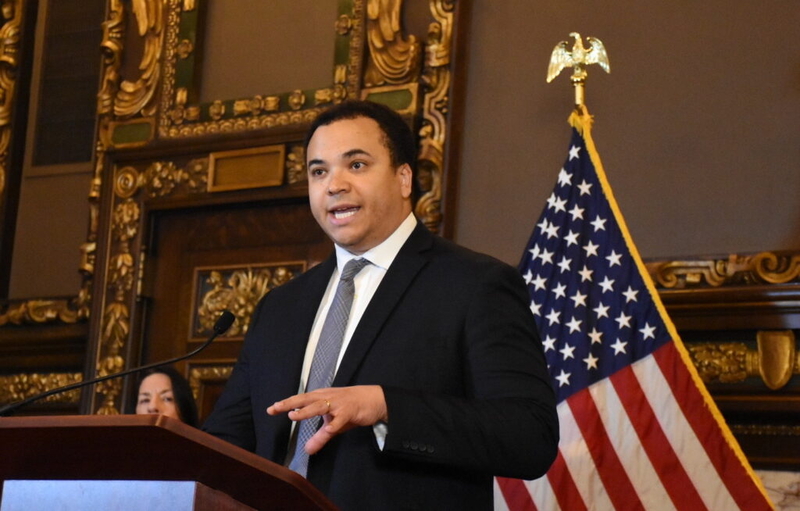
Minnesota Department of Human Services Inspector General James Clark spoke at a press conference announcing Gov. Tim Walz's human services proposal Tuesday March 10, 2026. (Photo by Alyssa Chen/Minnesota Reformer)
The Minnesota Department of Human Services has said that until a 2025 change in the law, the agency was limited in how it investigated so-called kickback schemes in human services, which is when a provider pays someone to sign up for their service.
That interpretation of the law was incorrect in at least three cases, the Office of Legislative Auditor argued in a new report.
The OLA “special review” stemmed from a person, not identified in the report, who was concerned that the DHS hadn’t properly addressed complaints about a Medicaid program called Early Intensive Developmental and Behavioral Intervention, which is intended to provide treatment to young people with autism.
Autism intervention services in the state have seen an explosion of growth in recent years, fueling concerns about fraud. The Reformer previously reported that the number of providers — who diagnose and treat people with autism spectrum disorder — increased 700% from 2018 to 2023, climbing from 41 providers to 328. That number continued to increase to over 500 in 2024, according to the audit report. And the number of people receiving early autism services has more than tripled since 2020, from nearly 1,400 in 2020 to over 5,600 in 2024, according to the report.
Nationwide, Medicaid’s autism spending has also exploded in recent years, The Wall Street Journal recently reported, with the number of companies offering autism treatment nearly doubling between 2019 and 2023, and spending rising even faster.
The OLA report found that in 29 cases from July 2017 to February 2024, the department’s Office of Inspector General properly handled complaints by investigating or closing the complaint.
However, in three cases, all involving kickback allegations, the auditors said the department should have investigated complaints instead of closing them. In those cases, DHS said that it didn’t have the authority to investigate complaints that are solely based on kickbacks and no other evidence of fraud.
Kickbacks are a key aspect of the alleged fraud schemes of two individuals who have been charged with defrauding the autism program. For example, federal prosecutors alleged in September that Asha Farhan Hassan, 28, paid monthly kickbacks ranging from $300 to $1,500 each month to the parents who enrolled their children with her organization. She then collected thousands in fees from the state for each child per month. Hassan pleaded guilty for her role in the $14 million scheme in December.
Auditors called the department’s legal interpretation of its own authority “overly cautious,” and argued in the report that DHS has had the authority to investigate kickbacks since the 90s through a federal anti-kickback law, long before a 2025 change in Minnesota state law that made kickbacks in Medicaid and other publicly funded programs explicitly illegal.
Department of Human Services Commissioner Shireen Gandhi said Tuesday that “it’s very rare” for a situation to involve only a kickback allegation and no other evidence of fraud.
“In those instances, our inspector general’s office referred those to federal authorities but did not believe that, alone, DHS would be able to successfully refer those to law enforcement,” Gandhi said at a press conference. She later clarified that, though the inspector general’s office has referred kickback cases to federal authorities, the three cases in the OLA report were not referred but are being monitored by DHS.
Gandhi added that the department has been pursuing legislation since 2019 to get kickbacks into statute.
Though the 2025 state anti-kickback law makes kickbacks illegal, it doesn’t give the department the explicit authority to suspend payments during investigations.
Auditors pointed to the lack of reference to kickbacks in the definition of fraud in DHS’s administrative rules, which they said resulted from an error in a 1995 rulemaking amendment that could have been remedied by the department. The way the administrative rules are written makes it harder for DHS to suspend payments to providers suspected of kickbacks, the auditors said.
The auditors recommended that the department amend its rules or that the Legislature take action to make sure DHS can act on kickback allegations. DHS Inspector General James Clark said in his written response to the audit that the agency will propose legislation, which could take effect in August, instead of rulemaking, which could take over a year. The department’s proposed legislation adds kickbacks to the statutory definition of fraud, among other changes.
Gandhi also pointed out that though the OLA believes that the department has authority to act on kickbacks, “many of the actions we take are challenged (by providers) in court,” where state law holds more weight than administrative rules, making a legislative change more appealing.
A February report from Optum, a contractor hired by the Department of Human Services to audit 14 Medicaid services for fraud, found that the state could have saved $703 million on autism treatment services had policy language been clearer, though any potential policy fixes are currently hidden underneath redactions.
Kickbacks are not unique to autism services — for example, they also appear common in Integrated Community Supports, another Medicaid service deemed vulnerable to fraud. Providers have paid Medicaid recipients’ rent in exchange for them signing up for services. In that program, disabled people, along with their legal advocates, have said that the state’s interventions on fraud have left them without needed services or housing.

Saint Paul, MN