Arizona’s criminal case against Kalshi permanently blocked by federal judge
May 05, 2026 | 2:34 pm ET
Description
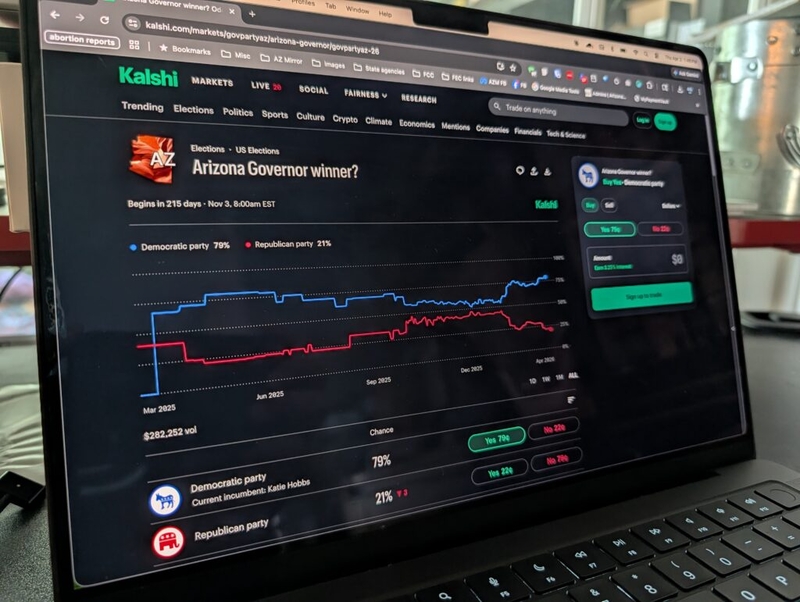
A federal judge has permanently blocked Arizona Attorney General Kris Mayes from prosecuting the online prediction market company Kalshi for violating state gambling laws. (Photo by Jim Small/Arizona Mirror)
A federal judge has permanently blocked Arizona Attorney General Kris Mayes from prosecuting Kalshi, halting the state’s unprecedented attempt to criminally charge an online prediction market company with violating state gambling laws.
Even though regulating gambling is “among the most rudimentary exercises of state police power,” Judge Michael Liburdi concluded that federal law preempts the state from enforcing those laws against Kalshi and other prediction market companies because they are exclusively regulated by the Commodity Futures Trading Commission.
“Every time Congress has revisited the federal-state allocation of authority in this area, it has chosen to expand federal control,” Liburdi wrote in an order granting a preliminary injunction that the CFTC sought. “It has done so while expressing unease about the costs of state-by-state regulation.”
In March, Mayes announced she had indicted Kalshi with 20 misdemeanors. She alleged the firm broke Arizona law prohibiting the operation of an unlicensed wagering business and similarly broke the law by allowing bets on Arizona elections.
The New York-based company has been center stage in an ongoing battle over how to regulate prediction markets, which allow for bets on a variety of topics, from sports to politics to the war in Iran. The prediction markets have also been accused of insider trading, as unknown people have made large sums of money off real world events.
In 2024, Kalshi won a landmark case in federal court when the U.S. Court of Appeals for the D.C. Circuit ruled that the Commodity Futures Trading Commission couldn’t block its election wagering under federal law. As a result, the company now operates as a “designated contract market” that is regulated by the CFTC.
Mayes argued that Kalshi’s authority to operate under federal law doesn’t preempt Arizona’s criminal laws, setting up a federalism clash that could reverberate nationwide, as more than a dozen states similarly outlaw gambling on elections.
But Liburdi said the congressional record is clear that Kalshi and other prediction market companies are solely regulated by the CFTC, and that trumps the state gambling laws in Arizona and elsewhere. Were that not the case, he said, there it would be impossible for those businesses to comply with 50 different regulators.
“The result would be the inconsistent regulatory patchwork that Congress intended to avoid. Because Arizona’s gambling laws stand as an obstacle to federal regulation, those laws are preempted,” he wrote.
In granting the preliminary injunction, Liburdi turned an earlier temporary restraining order issued in mid-April into a permanent end to the state’s prosecution of Kalshi.
It’s unclear whether the state will appeal the order; a spokesman for Mayes said the Attorney General’s Office “continues to evaluate our legal options related to the case” but hasn’t decided its next steps.
Phoenix, AZ