Arizona lawmakers consider election threats posed by AI
Nov 14, 2025 | 6:18 pm ET
Description
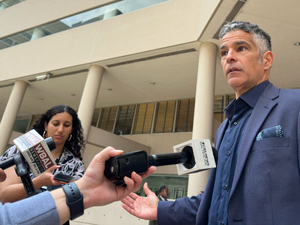
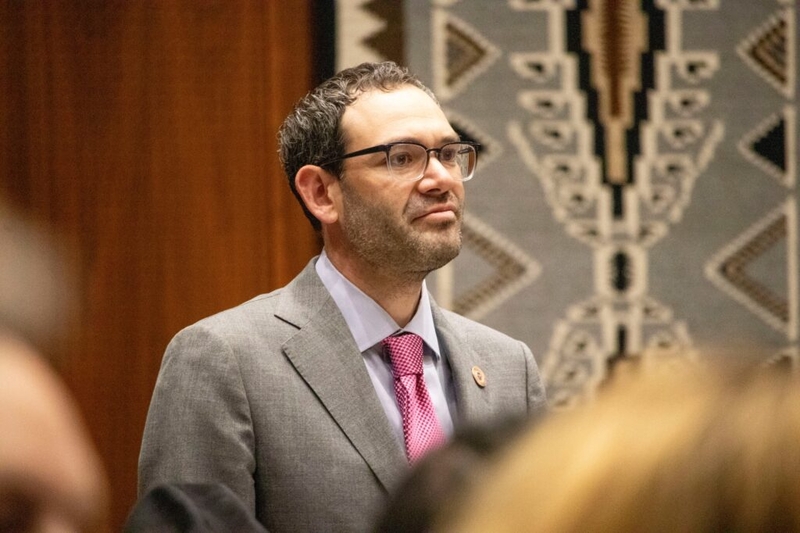
Rep. Alexander Kolodin, R-Scottsdale, heads an ad hoc legislative committee considering possible regulation of AI in an effort to protect elections. The committee met in Phoenix on Friday to hear from experts. (Photo by Jerod MacDonald-Evoy/Arizona Mirror)
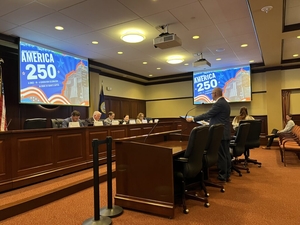
An ad-hoc committee at the Arizona Capitol that aimed at bringing together experts to discuss “protecting elections in the age of artificial intelligence” focused more on the existential threats AI poses to jobs and humanity than elections itself Friday.
“I feel that we are behind the curve honestly,” Rep. Rachel Keshel, R-Tucson, said, adding that she is usually anti-regulation but she feels that it may be needed to protect Arizonans in this case. “It is here and it is going to keep coming at us like a freight train.”
The Committee on Election Integrity and Florida-style Voting Systems, chaired by Rep. Alexander Kolodin, R-Scottsdale, who is running for the Republican nomination for Arizona Secretary of State, held the hearing that included a list of speakers who all voiced concerns about the fast pace of the technology and what it means for society at large.
Prior to the speakers addressing the committee Kolodin said that their goal is to determine three things. Should the state regulate AI at all; if so, is now the time to do it; and, if now is the time, what would those regulations look like?
Kolodin has amplified conspiracy theories in the past, and he did not avoid dipping his toes into those waters, alluding to the “deep state” in his opening remarks.
He also had some fun with the committee after noting that he was unable to get any representatives from any of the major AI companies to attend; he claimed to have a “whistleblower” ready to testify. The “whistleblower” in question was a ChatGPT bot that Kolodin and Rep. John Gillette, R-Lake Havasu, then asked questions.
Regulation and education
The first speaker before the committee was Diane Cooke, who works as an AI Fellow at the Center for Strategic and International Studies in Washington D.C.
Cooke has examined how generative AI has created new threats and has even examined how deepfake videos have been used to target the political arena.
“It is critical to understand we have reached an inflection point with AI technologies,” Cooke said, adding that AI podcasts and photos have started to become indistinguishable from the real thing.
In some studies the probability of someone being able to detect a real from synthetic image was tantamount to flipping a coin, according to Cooke.
This increase in sophistication has led to an increase in AI scams, many targeting the elderly and children. More and more graphic photos and now videos of AI child sexual abuse material is also making its way online, much of it trained off real world images.
But Cooke said there is something that could possibly be done.
Creating transparency requirements that would apply not just in election years to any content created using AI that would essentially watermark or create a digital identification on the content so users are aware they’re seeing synthetic content.
Many platforms participate in the Take It Down program from the National Center for Missing & Exploited Children, which Cooke said could be replicated for synthetic content. The program helps find and remove nude photographs of minors that have been posted online.
“This is not a complete solution but an essential first step,” Cooke said, adding that bad actors and criminals will still always try to break systems but compared it to installing locks on your doors. A professional thief can still pick a lock but having a lock will deter most intruders and we install them regardless of that knowledge.
Cooke’s other solution is education, suggesting that in K-12 that programs be created to help children learn synthetic content literacy. She also suggested that similar programs be made for the elderly, who are often victims of financial scams that have been lately using AI.
Kolodin asked Cooke about how these deepfakes could threaten election integrity and Cooke said that one scenario could be “fake digital voters,” however those voters would not be able to vote due to not having a valid proof of residence or be able to pass the other requirements needed in the state of Arizona, Cooke noted.
While Cooke expressed concerns over deepfakes and pushed for regulation, David Inserra, a Fellow for Free Expression and Technology at the Cato Institute, voiced caution to the committee about overreacting.
Inserra said that many of the major concerns around AI, primarily deepfakes, and elections “have not materialized,” adding that many of the major uses have been around parody or satire.
“Such parody and satirical speech is protected by the First Amendment,” Inserra said, pointing to a recent California law that would have mandated platforms to act against political deepfakes, which was struck down by the courts. A federal judge said it lacked protections for satire and parody.
“We should apply existing laws that prevent fraud, harassment and other existing harms,” Inserra said.
He did agree with Cooke on education, saying that it allows for opportunities for local officials to connect with their constituents as well.
Doom and gloom
While the first two speakers focused on some of the more well-known issues that AI has posed to policymakers, Connor Leahy, the founder and CEO of Conjecture, an AI research firm, focused more on the existential threat AI presents to humanity.
In 2023, a man dubbed the “Godfather of AI” quit his job at Google and started talking about how he feared that AI could be the “end of people,” a fear that Leahy shares.
While Leahy said that AI has great potential, many of the people developing it are working towards creating a superintelligence that some have theorized could lead to the end of human existence as we know it.
“It is unclear if it is even possible in principle to control something that is smarter than you,” Leahy said.
That is why Leahy is part of a group that has been advocating for outlawing the creation of a superintelligence or an Artificial General Intelligence, or at least creating legislation around its development.
“There is little to no safety regulation on AI companies,” Leahy said, pointing out that in a few short years AIs have gone from chatbots to full on “agents” that can do complicated tasks on their own.
At the same time the committee was taking place, AI company Anthropic announced they had disrupted AI “agents” from a Chinese state actor that were attempting a large-scale cyber attack, a first of its kind.
To Leahy, these AI companies and the creation of a superintelligent AI should be treated like regulating nuclear arms.
“Is this a realistic suggestion?” Kolodin asked Leahy about outlawing this type of research, adding that other countries could then take the lead and do so anyway.
“This is a very very hard problem to solve,” Leahy admitted, adding that they need to figure it out before the genie is “out of the bottle.”
While Leahy gave his dire warning, Nick Dranias gave a different idea to the speakers on how they can approach the problem.
Dranias, who serves as General Counsel for Honduras Próspera Inc. and used to be Senior Litigation Counsel for the Government Accountability and Special Litigation Unit at the Arizona Attorney General’s Office, said that we need to start thinking about AIs as “5-year-old children.”
“Humanity has given birth to a prodigy,” Dranias said. “The way we’ve raised this prodigy so far has been through unyielding corporal punishment.”
Dranias said that most AIs are trained through models that punish them for doing things incorrectly or “thinking” incorrectly, and that we need to start looking at training AIs with ethics in mind.
There have been multiple instances now where AIs have been found to lie or manipulate in order to achieve their primary goal. Dranias sees this as a problem inherent in the training and not the AIs themselves.
The solution, according to Dranias?
Have Arizona become a “safe harbor” for AI industries who want to assess the “whys” and “not just checking a box that ‘I won’t kill humans today’” when it comes to their AIs. This would allow for AIs that might be more truthful, or not, as Dranias admitted that even in some of the testing he did, AIs still lied in order to please.
“We have to do it now before they’re superintelligent,” Dranias said of trying to find a better way to train AI models. “Superintelligence plus sociopathy, really bad idea.”
The anti-Googler
The last speaker was a man who has become popular in conservative circles for his work on Google and a term he coined called the “Search Engine Manipulation Effect.”
Dr. Robert Epstein is a psychologist who has focused heavily on Google over the years, even testifying before Congress about the company and his studies. He claimed in committee that “without a doubt” Google “manipulated” upwards of 6 million people to vote for former President Joe Biden in 2020.
Epstein has made similar claims about other elections, reaching these numbers and assumptions by saying Google served undecided voters with politically biased search results. His studies have been known to use small sample sizes and Epstein when speaking before the committee Friday said that he is friends with two Trump family members, although he admitted he is not entirely a fan of President Trump.
Google has been shown to have bias in its search results and its AI Overview feature has had some major mistakes.
Epstein told the committee Friday that having the power of AI and search engines in the hands of a few companies is something that he feels is dangerous for the future of elections in the country as it could allow them to shift opinions one way or another.
And on that superintelligence that Leahy had talked about?
“I think we’re screwed,” Epstein said bluntly to the committee.
Kolodin said he wasn’t as concerned about an extinction level event related to AI because if “everybody is dead then I don’t have to worry about my stock profile,” adding that there are other parts of the AI problem that are more in the wheelhouse of the Arizona legislature, like jobs and elections.
“The jobs are going to be lost. There aren’t going to be replacement jobs and we are going to have to talk about universal income,” Epstein said.
Kolodin didn’t quite agree.
“Jobs may go away but the opportunity to run a small business will open up potentially to a much larger segment of society,” Kolodin said, adding that he thinks education is the larger component to the future AI problem.
“If the competitor is making use of all this new tech and you are not, you lose,” Epstein rebutted. “I don’t know how to stop this train. I want to stop this train. I don’t know how to stop this train.”
After all the testimony lawmakers discussed next steps, with Democratic lawmakers emphasizing that they hope the next hearing will include stakeholders from the Universities and the Arizona Secretary of State’s Office.
“Today’s hearing reinforced that artificial intelligence is already changing our democracy and Arizona has a responsibility to respond but we must do it in a way that actually protects voters,” Rep. Betty Villegas, D-Tucson said. Villegas said she intends to look into bipartisan legislation aimed at clear disclosure of synthetic material and getting more support to county election departments.
But it won’t just be elections that are impacted by this new technology.
“Every committee is going to have to figure out a policy on how to regulate its use,” Rep. John Gillette, R-Lake Havasu, pointed out to the committee.
Phoenix, AZ