Are you shopping as you read this? Black Friday moves to different days, ways to buy
Nov 26, 2026 | 7:00 pm ET

Description
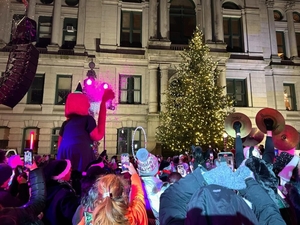
Shoppers will be spending for the holidays, but the traditional Black Friday scrums won't be as much a part of the season, which has stretched out over a longer period and moved to online and other platforms. (Photo by Getty Images)
Black Friday might not be the “shopping extravaganza” it once was, but that doesn’t mean people won’t be spending for the holidays like always — and then some, with total sales expected to top $1 trillion this year.
The National Retail Federation predicted in October that retail sales during the November and December holiday season will grow 4.2% more than the 2025 rates. Total spending is set to hit $1.013 trillion compared to last year’s $972 billion.
But with additional holidays like Small Business Saturday and Cyber Monday, and weeklong deals at online shopping platforms like Amazon, the sales have moved past the exclusivity of a single day as the years go on, economic experts say.
University of Maryland marketing professor Jie Zhang said retailers have begun introducing sales earlier each year. Tariffs, rising gas prices and inflation continue to drive up the cost of living, making consumers less willing to buy and retailers less willing to discount.
Zhang, who specialized in retail management, said this year’s average discounts are projected to be similar to last year’s, which were already scaled back after hits to the nation’s economy.
“[Retailers] just simply could not afford to offer really deep discounts anymore because many of them absorbed a substantial part of tariffs … unfortunately, this year they’re not seeing much relief,” she said. “Because of that … some retailers might feel the pressure to actually raise prices and then offer discounts. The prices consumers end up paying, even with the discounts, are certainly higher than they have ever been.”
While the NRF is predicting sales will increase this holiday season, consumers shouldn’t take the growth rate at face value, said Henry Boyd, a clinical marketing professor at the University of Maryland who has a focus in consumer spending. The higher totals don’t factor in higher prices and costs of goods due to inflation and tariffs.
“You’re going to probably buy less stuff, but the stuff you buy is more expensive,” Boyd said in an interview last week.
The Maryland Retailers Alliance noted in a November press release that the outcome for Maryland retailers might be more of a mixed bag. According to the organization’s annual member survey, about 64% of participating businesses experienced lower sales in September and October compared to the previous year. The other 36% said they expect their sales to decline this holiday season.
Alliance President Cailey Locklair said these numbers could largely be influenced by the small businesses that make up a sizable portion of Maryland retailers. Small businesses tend to be more cautious about their forecasts, as online shopping and larger retailers become and tend to be more popular during sales events.
Consumers are also becoming more comfortable using artificial intelligence as a way to surf the internet for the best deals, which has the power to change consumer habits and increase the holiday spending activity, Boyd noted.
“We take it for granted: information at your fingertips,” he said. “It used to be the hardest part was figuring out where is the deal. You can do that now instantly.”
The national foundation’s additional late-October report notes that online shopping continues to rank as the top method, but the percentage of individuals planning to shop online has begun to decrease, with only 52% of consumers – compared to last year’s 56% – saying they plan to do so.
“It’s online fatigue. So much of our lives now are lived online,” Locklair said. “For a lot of people, it’s not just shopping; it’s an experience. It’s a whole-day adventure.”
Consumer behavior isn’t the only thing that drives the holiday season. Retailers are beginning to prioritize different marketing strategies during the busiest months for their income, Zhang said.
In addition to the holiday no longer being limited to a singular day of shopping, she said large retailers are starting to stagger sales to draw consumers in. This is where a retailer hikes up their prices, offers a sale for a short time period and gets rid of it before reintroducing a similar sale, giving the illusion of better discounts.
“For retailers, the end-of-the-year holiday shopping season is the single most important shopping season for their business,” Zhang said. “Because of that, competition amongst retailers has become more and more fierce over the years.”
But Boyd said that even with an influx of ways to shop online or grab the best discounts using AI platforms, shoppers still tend to appreciate the social experience holidays like Black Friday provide.
Even if people aren’t in a line wrapped around the store early Friday morning, people won’t be ditching the brick and mortar stores, he added.
“It’s like a form of entertainment,” Boyd said. “For a lot of folks, the magic lies … with your family, you’re with your friends… you look at a couple things, you grab something to eat, and those are the memories.”
Annapolis, MD