Analyses find old Assembly map would have protected Wisconsin Republicans from ‘blue tsunami’
Nov 24, 2026 | 4:30 am ET
Description
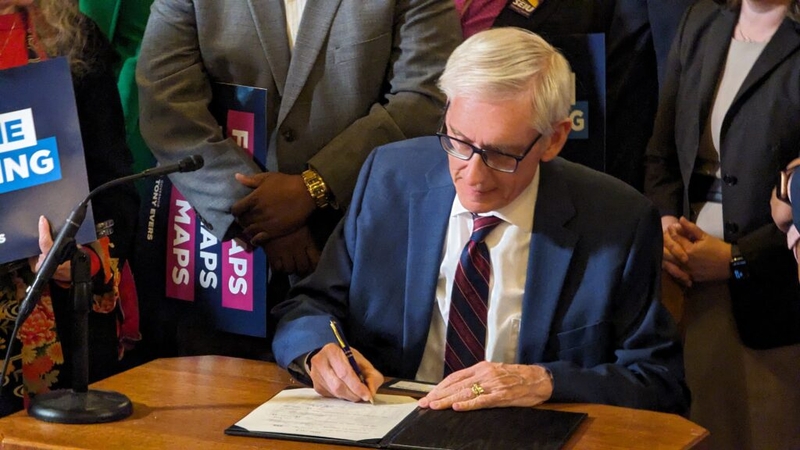
Gov. Tony Evers signs new legislative maps that were adopted in early 2024 after the Wisconsin Supreme Court found previous, gerrymandered state maps to be unconstitutional. (Photo by Baylor Spears/Wisconsin Examiner)
Two analyses released Monday found the old Assembly map would have protected Wisconsin Republicans’ control from the “blue tsunami” that swept every statewide election and the state Senate.
This year, Democrats won majorities in the state Senate, taking 18 seats out of 33, and in the Assembly, winning 53 seats out of 99. Next year the first with Democratic majorities will take office since the 2009-10 legislative session.
Law Forward Director of Litigation Doug Poland and Jack Deschler of the Election Law Clinic at Harvard Law School, co-authored one analysis that described two events that broke Republicans’ winning streak in the state: the “blue wave” of 2026, and three years earlier, the overturning of the previous legislative maps in 2023.
“The redrawn districts were a far more critical force in breaking the Republican stranglehold than the blue wave was,” Poland and Deschler wrote.
Under maps used in 2022, Democrats battled to prevent a Republican two-thirds supermajority in Wisconsin — even as Gov. Tony Evers won over half the statewide vote in his reelection campaign. Republicans won 64 of the 99 seats in the Assembly in 2022.
In the 2023 Clarke v. WEC lawsuit, the state Supreme Court ruled that the Wisconsin state legislative maps were an unconstitutional gerrymander and ordered that they be redrawn. Evers proposed maps that Republican lawmakers passed and Evers signed ahead of the 2024 elections.
Under the new maps, Democrats were able to compete in the last two election cycles. In 2024, Democrats won an additional 10 seats in the state Assembly and four seats in the Senate. In 2026, they won an additional eight seats in the Assembly and three in the Senate.
Poland and Deschler said that without the state Supreme Court’s 2023 decision “the will of the majority of Wisconsin voters would still not be reflected in their Legislature.” The analysis found that Democrats would have flipped just three Assembly seats without the new maps.
John Johnson, a fellow with Marquette Law School, came to a similar conclusion in his own analysis published Monday. Despite Gov.-elect David Crowley winning statewide, under the 2022 maps Democrats would not have been able to win a majority of Assembly districts, probably getting majorities in only 45.
“Crowley’s 54% of the vote adds up to a majority of 54 seats in the current map, and those exact same votes cast in the exact same places only comprise a majority in 45 of the seats used in 2022,” Johnson told the Wisconsin Examiner Monday.
He said his analysis relied on data from voting wards across the state rather than simply the statewide vote that was used in the Poland-Deschler paper.
“Would Crowley’s 8-point victory — the largest of any candidate for president or governor since Barack Obama in 2008 — have been large enough to break the Republican gerrymander used in 2022?” Johnson wrote in his analysis. “No, and it would not even have been particularly close.”
In the Law Forward analysis, Poland and Deschler highlighted how incoming lawmakers can enact new laws to “prevent any political party from denigrating democracy in this fashion.”
“Wisconsin’s experience from 2011-2026 demonstrates the need for fundamental and sweeping reform in Wisconsin, as well as nationally, to ban the partisan gerrymandering of state legislative districts to prevent such efforts in the future,” Poland and Deschler wrote.
Law Forward general counsel Jeff Mandell previously told the Examiner that Democratic lawmakers should advance a nonpartisan, independent system for drawing congressional and legislative maps. Two Democratic lawmakers — Sen. Kelda Roys (D-Madison) and Sen. Mark Spreitzer (D-Beloit) — also told the Examiner that they are committed to implementing a fair maps process. Spreitzer has expressed interest in a constitutional amendment to implement a process for drawing maps fairly.
Johnson noted in his analysis that removing the job of drawing maps from lawmakers is a “laudable goal,” but he said achieving this goal will require resolving questions about what is fair.
“Some would say a fair map should be drawn without even considering partisan data,” Johnson wrote. “This is the perspective underlying Iowa’s nonpartisan mapmaking process. A map drawn this way in Wisconsin will almost certainly tilt Republican, although by nowhere near as much as the 2022 gerrymander.”
Others, Johnson wrote, would argue that “a map is only ‘fair’ if it reliably delivers a majority of the seats to the party winning a majority of the vote. Something like this is explicitly required by the constitutional amendment establishing Michigan’s independent redistricting commission.”
He identified a third alternative, however: “Still others might want a mapmaking process that prioritizes creating competitive seats that either party could win.”
Madison, WI