Amid doubts about expanding St. Mary’s Home for Children comes an idea to give youth a voice
Mar 06, 2024 | 6:50 pm ET
Description
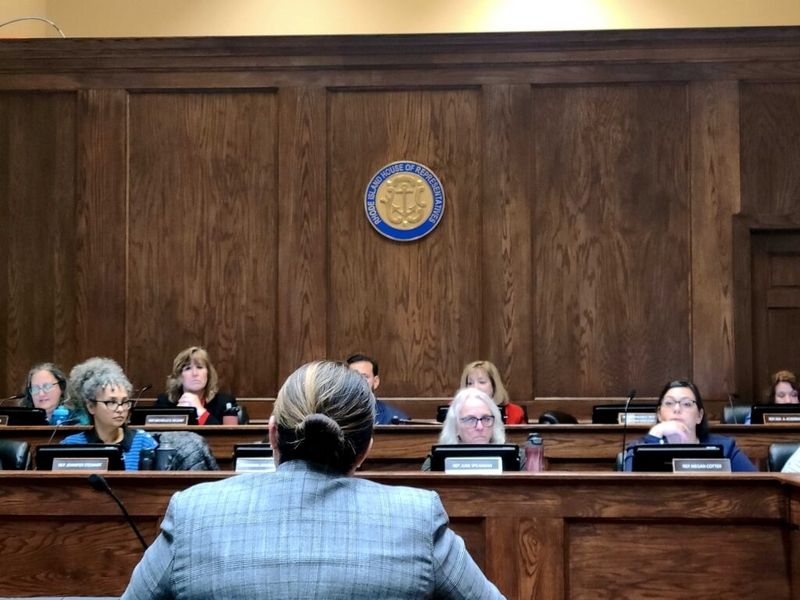
Kara Foley, the public education and Information coordinator for the Rhode Island Office of the Child Advocate, testifies on behalf of Acting Child Advocate Katelyn Medeiros, who could not attend the hearing of the House Committee on Health and Human Services at the State House on Tuesday, March 5, 2024. Foley discussed possible revisions to a bill introduced by Rep. Thomas Noret, a Coventry Democrat, that would help children in state-contracted care facilities contact the Child Advocate's office more easily. (Alexander Castro/Rhode Island Current)
The chair of the Rhode Island Senate Finance Committee expressed doubts at a hearing Tuesday night about spending $11 million to expand the troubled St. Mary’s Home for Children.
One floor below in the State House, the House Committee on Health and Human Services reviewed an alternative and much cheaper solution to improving the environment for children in state-contracted care: locked suggestion boxes.
‘We trusted them to care for our neediest, most vulnerable children. And they failed.’
The two approaches quietly played tug of war during concurrent hearings in which the North Providence residential facility served as a connecting thread.
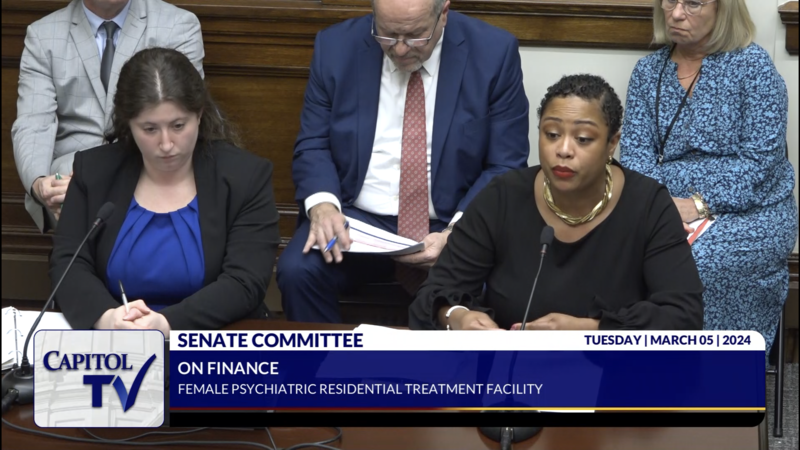
At a Senate Committee on Finance hearing, Ashley Deckert, director of the Department of Children, Youth and Families (DCYF), continued to push for the expansion of St. Mary’s to help resolve the state’s shortage of beds for DCYF placements by adding 12 vacancies for girls’ psychiatric treatment. With a tentative price tag of $11 million, it’s apparently a hard sell for some senators, especially since St. Mary’s Home can’t even take new patients at the moment — it’s been subject to an intake hold since November 2023.
Finance Committee Chairman Sen. Lou DiPalma, a Middletown Democrat, argued against the expansion. “We’re not sugarcoating anything here,” he said. “I’m not quite certain of the future of St. Mary’s…I’m going to suggest we not spend another penny on St. Mary’s until we know the future.”
Meanwhile, downstairs at a meeting of the House Committee on Health and Human Services, Rep. Thomas Noret, a Coventry Democrat, detailed his intent behind Bill H7824. The bill Noret sponsored calls for DCYF to install secured suggestion boxes, both physical and digital, in state-contracted youth facilities, which includes treatment centers, group homes and shelters. Juvenile residents would be able to submit comments, worries or questions to the Office of the Child Advocate (OCA), the agency charged with oversight of DCYF.
The boxes’ contents would only be available to the Child Advocate’s office, who would check the boxes every two weeks. Children who have access to the internet would also be able to access a digital lockbox — essentially a dedicated email address — via a QR code on the physical lockbox’s signage or through the Child Advocate’s website. According to the OCA, the bill would affect 15 provider agencies with more than 85 physical locations statewide, as well as 27 out-of-state facilities.
St. Mary’s Home for Children has had legislators concerned after the January release of an egregious report on abuses there. The report was the bitter fruit of a months-long investigation by the Child Advocate’s office, which began after the near fatal overdose of a teen housed at the North Providence facility. At a Jan. 23 meeting of the House Committee on Oversight, in which both DCYF and the Child Advocate testified about St. Mary’s numerous problems and potential solutions, Democrats and Republicans were aligned in their outrage.
Investigation inspires lock-and-key strategy
Noret said in a phone interview Monday that his lockbox bill was definitely inspired by the troubles at St. Mary’s. In fact, he wasn’t sure what word best described the situation.
“We’ll call it an incident, right? Or several incidents, right? Investigation: How about we call it ‘St. Mary’s investigation?’”
Five Democrats join two Republicans — House Minority Leader Mike Chippendale and Rep. Sherry Roberts of West Greenwich — in sponsoring Noret’s slightly bipartisan bill.
Noret, a former police officer who said he’s often introduced legislation related to child welfare, admitted the bill was drafted before he received enough input from the Child Advocate’s office. He readily acknowledged the bill will need some retooling — but that’s typical in “the backroom, making-sausage-type-of-stuff” that is the legislative process, he said.
“We hold all bills for further study. That’s the first thing out of the box,” Noret said on the phone. “And people are like, ‘This is ridiculous, this bill needs to move forward.’ No, this bill doesn’t need to move forward. We need to make the best bill possible. So we want input from all parties involved.”
At Tuesday’s hearing, Kara Foley, the public education and information coordinator for the Child Advocate, testified on behalf of Acting Child Advocate Katelyn Medeiros, who could not attend. Medeiros’ office wanted to see some changes made that could heighten the bill’s likelihood of success.
“The OCA is supportive of this concept which centers youth voice and provides a tangible mechanism for feedback from our youth directly,” Medeiros wrote in her testimony, which Foley read to the committee. “While the OCA is supportive of this concept, we anticipate challenges in our office’s ability to fulfill this mandate.”
Three of the OCA’s current 10 full-time positions, also known as FTEs or “full-time equivalents,” would be expected to fulfill these duties. With “an ever-increasing workload” for her office, Medeiros wrote that more staffing would be needed to adhere to the bill requirements. Collecting physical lockbox contents every 14 days could be a big ask for these three staffers. A digital lockbox would likely ease some of these concerns. The Child Advocate noted contractual changes between DCYF and providers might also be needed.
The bill also stipulates that the Child Advocate would prepare a yearly report on the suggestion boxes for the General Assembly. Noret also tried to preempt the possibility of staff retribution: The bill would forbid surveillance recordings of the lockboxes.
“Let’s face it: We need to do something that’s going to be a little bit more private for somebody,” Noret said on the phone. “All of a sudden you see somebody go to the box. Now you grab that kid and say, ‘What did you put in the box? I want to know what you put in the box.’ Now that kid’s a target.”
Allison Mahoney, the founder and managing attorney of ALM Law, a firm specializing in child welfare, called the bill “a step in the right direction” in an email.
“Young people who are placed in congregate care facilities are extremely isolated and are often left without anywhere to turn when they are harmed or at risk of harm in these placements,” Mahoney wrote. “Of course, this legislation will only work if young people can trust that their comments and concerns are placed in the right hands and that meaningful action is taken to address the problems.”
What about out-of-state placements?
Rep. Jennifer Stewart, a Pawtucket Democrat, asked Foley how kids currently share their concerns with the Child Advocate. Foley replied that it’s mostly by phone, or during meetings, at court appearances or during “drop-in” visits the OCA conducts at residential facilities.
Rep. Barbara Ann Fenton-Fung, a Cranston Republican, wondered how frequently the Child Advocate checks in with children being cared for out-of-state: “How often are you there physically supervising?”
“It depends,” Foley said, noting staffing and cost challenges.
Fenton-Fung followed up and asked: “Do you think it’s at least once a year, or is it more?”
Foley was unsure, so she turned to OCA attorney Diana Robbins, who was sitting in the audience. Robbins confirmed it was about once a year.
Fenton-Fung thought out-of-state placements would especially benefit from suggestion boxes, but was unconvinced more staffing would be needed to collect these distant responses.
“I don’t think you need another FTE [full time equivalent] to do that, I’ll be very honest with you,” Fenton-Fung said.
The Child Advocate also provided written testimony supporting two other bills at the committee hearing, both led by Rep. Julie Casimiro, a North Kingstown Democrat who is First Vice Chair of the House Committee on Oversight. H7362 would define caseload limits for DCYF workers, while H7823 would require routine assessments of DCYF facilitated by outside agencies — either “an in-state academic institution or in-state consulting firm,” according to the bill text. Lacking either, an “independent third party” could conduct the assessment.
DCYF head says expansion needed
At the Senate Finance meeting, DCYF director Deckert replied to Sen. DiPalma’s suggestion to pause state spending by emphasizing the need for more beds at St. Mary’s. She said she has been meeting with the new leadership there once a week.
“It almost reminds me of a family. If we wrap St. Mary’s with the support and the resources and the intensity that we’re attempting to do, I really do believe that they can be ready to take the first girl into their intake in April of 2025 [at the new facility],” Deckert said.
Sen. Jonathon Acosta, a Central Falls Democrat, was skeptical: “You just outlined the amount of resources that your department is putting into supporting this entity that is not a state entity, that went through a no-bid process to receive this contract from the state. And so I want to ask, rather directly, why not bring this in-house? Why did the administration make this decision to try to prop up a failing non-government entity that is not doing its job or hasn’t been doing its job correctly?”
Residential treatment facilities are not typically state-run, and are instead contracted to providers whose expertise exceeds what the department can provide, Deckert said. Hypothetically, though, the state could run such a facility, she added.
“Could we, in theory, do something like that? Sure,” Deckert replied to Acosta. “But as it stands, the nature of the work that we do — it’s not unlike any other state in that these are services that are historically contracted out for providers to complete.”
Providence, RI