All three candidates for governor promise tax relief. How feasible are their plans?
Oct 19, 2026 | 4:07 am ET
Description
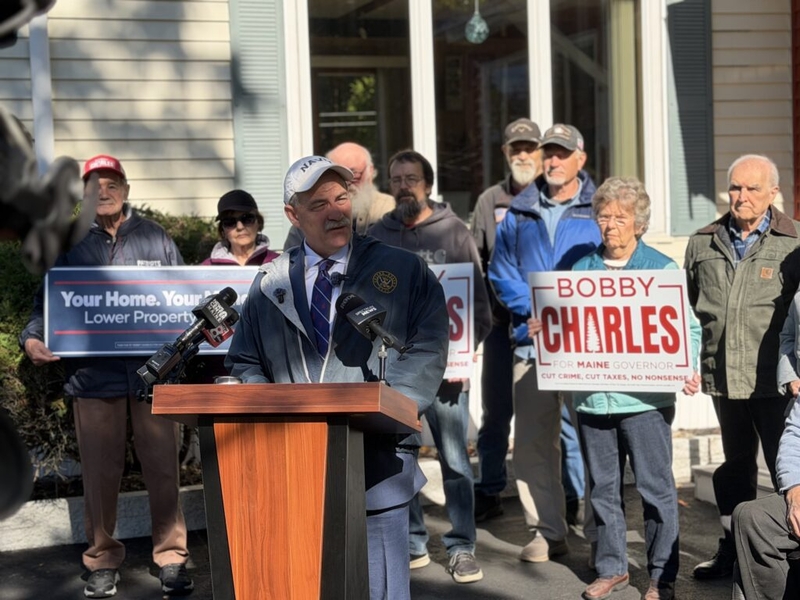
Republican gubernatorial candidate Bobby Charles unveiled his plan to cut property taxes at an Oct. 6 press conference outside a supporter's house in Lisbon. (Photo by Eesha Pendharkar/Maine Morning Star)
All three candidates for Maine governor are promising property tax relief through an expanded homestead exemption, but questions remain about how their proposals would be funded and how much relief they would deliver to homeowners.
Mainers’ property taxes increased by 22.7% from 2019 to 2024, whereas the average home value went up by 74%, the highest rate in the country, according to a national analysis.
Republican nominee Bobby Charles was the latest candidate to unveil his plan, which proposes the most sweeping change. He said if elected he would increase the homestead exemption, which the state subtracts from property values before calculating taxes, from $25,000 to $100,000 over the next few years.
“Property tax relief is essential,” Charles said at a press conference earlier this month at a supporter’s house in Lisbon. “It’s actually central to the ability of anybody to afford anything, and that ultimately is how we get affordability back.”
While he’s the only candidate promising such a high exemption to all homeowners, the idea is not unique to the Leeds resident. Democrat Hannah Pingree has promised to double the homestead exemption, while independent Rick Bennett said he would increase the homestead exemption for homeowners 65 and older to half the median home value in the state.
“I think there is a fair amount of overlap here with three different candidates trying to tackle this in slightly different ways but all trying to get at the same thing,” said James Myall, a policy analyst at the Maine Center for Economic Policy.
“Increasing the homestead exemption has the advantage of making it so that people with wealthier homes end up paying a larger share of that in taxes than people with less wealthy homes.”
Despite vow of bipartisanship, gubernatorial candidates spar in first televised debate
Charles has focused much of his campaign on lowering taxes. During the event in Lisbon, he explained that he would raise the homestead exemption in two steps: increasing the exemption to $50,000 during his first budget and eventually raising it to $100,000.
Property taxes in Maine account for more than 50% of local revenue, the fourth highest rate in the nation, according to a report by the Maine Legislature’s property tax relief task force this January. That’s why it’s important for all gubernatorial candidates hoping to lower taxes to ensure towns are reimbursed by the state for what they lose in property tax cuts.
Currently, municipalities are reimbursed 76% of tax revenue lost to this exemption; in fiscal year 2025, the state reimbursed municipalities just over $85 million. Charles plans to increase that to a 100% reimbursement, which his campaign estimated would cost the state $285 million annually with a $100,000 exemption.
“Potentially the level of increase that he’s suggesting could help a fair number of folks,” Myall said about Charles’ plan. “I think the part where maybe it’s a little trickier is how he’s proposing to pay for it.”
Charles has blamed unchecked government spending, fraud and “unfunded mandates” for recent spending increases and the projected $1.3 billion budget gap.
“We have so much waste, so much largesse … so much duplication, and so much fraud in this government budget that we have got to start over again,” he said last week.
He said he would offset lower property taxes by eliminating 100 mostly vacant state government jobs, promising there would be no layoffs. On the campaign trail, he has also vowed to audit two of the largest state agencies: the health and education departments.
Myall explained that the money from empty state government positions is currently reallocated to other services in the budget, so “it just feels like there’s still some questions to answer, I think on where this money is coming from.”
Charles’ campaign said that until departments are audited it is not possible to predict how much money can be reallocated to property tax relief.
“Everyone likes the idea of the government being more efficient but generally what tends to happen is like when people come in, they find there’s not actually that much to cut,” Myall said.
“Even with Elon Musk’s effort in the federal government, they cut plenty of programs, but I don’t think they actually uncovered large, widespread amounts of actual abuse in those programs.”
Other tax relief plans
In addition to focusing on the homestead exemption, Bennett and Pingree have proposed increasing the property tax fairness credit, which helps low- and moderate-income homeowners and renters.
Bennett’s plan would apply the credit directly to property tax bills, rather than requiring families to wait until they file their returns.
Pingree has proposed taxing second homes owned by non-Maine residents at a higher rate, which she said during a debate last Thursday would “both deliver tax relief but also ensure that we can invest in the infrastructure that desperately needs it.”
The proposal will likely require a constitutional amendment, which Myall said, “might not be an impossible ask since there is bipartisan agreement on some of this.”
However, Pingree’s Republican and independent opponents dismissed the idea.
“It really doesn’t deal with the underlying issue, we need to get spending in check, and we need to have meaningful property tax relief soon to Maine people,” Bennett said during the second debate. “The proposal she has pushes the can down the road some more, and I don’t think it’s viable.”
Augusta, ME