Alaska Supreme Court to rule on question of bias in ballot measure language
Aug 26, 2026 | 4:01 pm ET
Description
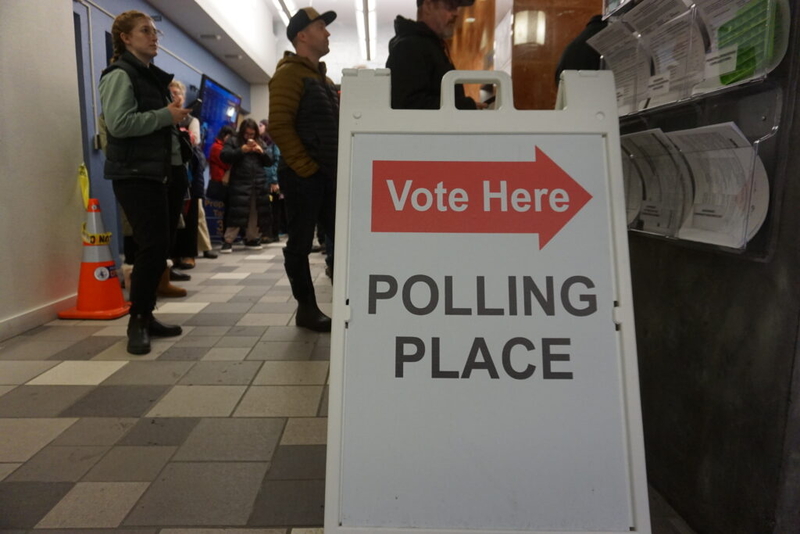
Voters at Anchorage City Hall wait in line to cast their ballots on Nov. 4, 2024, the day before Election Day. City hall, in downtown Anchorage, was one of the designated early voting sites in the state's largest city. (Photo by Yereth Rosen/Alaska Beacon)
The Alaska Supreme Court heard oral arguments on Tuesday on legal challenges brought by two groups on opposing sides of the state’s current ranked choice voting election system. The two groups of plaintiffs brought lawsuits against the Alaska Division of Elections challenging the language of a ballot measure, set to go before voters in November, abolishing the voting method along with other changes.
Ballot Measure 2, which will appear on the ballot as 24ESEG, would overhaul the state’s elections system via three major components: repeal ranked choice voting; rescind the nonpartisan, open primary system; and repeal campaign disclosure rules enacted by voters in 2020.
A Superior Court ruled in June that the state’s ballot summary was “true and impartial,” siding with the Alaska Division of Elections, overseen by Lt. Gov. Nancy Dahlstrom.
Plaintiffs have appealed that decision to the Alaska Supreme Court, which is expected to issue a fast-tracked ruling before a division deadline of Sept. 2 to print general election ballots.
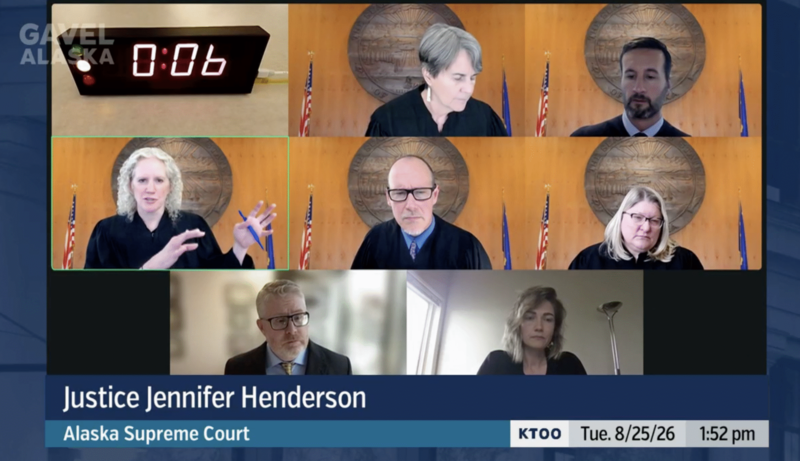
One group of plaintiffs are represented by attorney Scott Kendall, an author of the 2020 ballot measure implementing Alaska’s ranked choice voting and open primary system. They argued that the current ballot measure language is unclear, partisan and omits serious implications of the repeal effort.
The other group of plaintiffs, drafters of the measure, is called the “Repeal Now” campaign. The measure’s primary sponsors are Republican gubernatorial candidate Bernadette Wilson, along with former Anchorage library director Judy Eledge and former Alaska House Rep. Ken McCarty of Eagle River.
In court, attorneys representing Repeal Now argued against the lawsuits being combined and for a series of language changes, including changing of the term “repeal,” which they say is not easily understood by voters, and the term “true source” of campaign disclosures as “inflammatory partisan suasion.”
Under Alaska law, the division is required to prepare a ballot measure with a “true and impartial” summary of the proposed law. It must be “free from misleading tendency, whether the amplification, of omission, or of fallacy, and … must contain no partisan coloring.”
In the June ruling, a Superior Court judge found the division fulfilled its legal obligation and “if ballot summary language is true and impartial, the Court will not invalidate the language just because better language could be written.”
On Tuesday, the division, represented by attorney Laura Fox with the Alaska Department of Law, argued that the ballot language could be edited thousands of ways, but the division fulfilled its legal duty and prepared the ballot with a “true and impartial” summary and title.
“This case is not an editing exercise,” Fox argued. “We’re not assembled here as a big team of editors trying to polish a piece of writing by committee, as fun as that might be. Instead, the question here is just whether the summary clears the basic hurdle of being true and impartial. Because it does, the court should affirm.”
The Alaska Supreme Court justices will either uphold the lower court’s decision or order the division to revise the language. They’re expected to issue a ruling before Sept. 2 and then follow sometime later with an extended legal opinion.
Timeline of ballot measure and legal challenges
Alaska voters narrowly rejected a similar initiative to repeal ranked choice voting in 2024. Proponents quickly restarted the campaign in 2025, collecting more than 34,000 signatures to again place the question on the ballot in 2026. The division first published the ballot language last December.
A group of plaintiffs represented by Kendall filed a lawsuit challenging the ballot language in January. Plaintiffs include Anchorage Republican Sen. Cathy Giessel, AFL-CIO union president Joelle Hall, and former member of the Juneau Borough Assembly and vice president of Ocean Conservancy ‘Wáahlaal Gidaak Barbara Blake. They argued the ballot language was biased and inaccurate.
The division subsequently revised the ballot language in February with significant changes to the title and summary. The plaintiffs dropped the lawsuit without prejudice, according to court documents.
In mid-February, the Repeal Now group filed a lawsuit challenging the new language, arguing “opponents got their preferred language” adding the term “repeal” three times, and the summary was not “true and impartial.”
In March, the division again revised the title of the ballot measure, adding the phrase “ending ranked-choice general elections.”
Giessel and fellow plaintiffs filed a new lawsuit, and the two suits were consolidated by the Superior Court judge in April.
Both groups of plaintiffs filed suggested ballot language with the court, and the state filed a motion defending their ballot language.
Court arguments
On Tuesday, Kendall argued before the Supreme Court that the ballot language should be a clear map for voters to understand what the measure does.
“But the state’s language here isn’t a map. It’s effectively an obstacle course where a voter can only understand Ballot Measure 2 by doing independent research outside the four corners of the ballot language. The state’s language is unclear, contains partisan suasion, and omits details that would give voters significant pause,” he said.
In particular, Kendall raised concerns the ballot measure does not clarify that if passed, nonpartisan or Independent voters would be excluded from voting in party primaries, unless registered with that party.
“It fails to make clear that Ballot Measure 2 specifically empowers political parties at the stroke of a pen to make it illegal for undeclared and nonpartisans to vote in the primary election,” he said. “I think voters need to be put on notice, especially the two-thirds of voters that don’t belong to either party, that you may not be able to vote in the primary election at all.”
Kendall also argued the language related to campaign finance disclosure rules was inadequate, and fails to give details of the implications.
If passed, the measure would repeal campaign disclosure rules and limits enacted by the ballot measure passed in 2020, including rules that individuals and entities who contribute more than $2,000 to candidates or campaigns must disclose the true source, as defined by law.
Attorney Julie Pack, representing the group of plaintiffs with the Repeal Now campaign and supporting the ballot measure, argued against the use of the term “repeal” because she said campaigners collecting signatures for the ballot measure found voters were not familiar with the term.
“Many people do not use that word on a daily basis. It’s not common parlance. It is for lawyers. It’s not for people who are not lawyers, and it’s not a term that is readily understood,” she said.
Justices pushed back, pointing out the term is in the name of their organization.
“My organization named itself before they canvassed, got all the signatures, talked to over 31,000 Alaskans, and understood that repeal is not a word that lots of people understand,” she replied. “So my client named itself before it learned that repeal is a term that’s mildly to moderately sophisticated.”
“There is no need to use words that are sophisticated,” she added. “When ‘redo,’ ‘remove,’ ‘undo,’ ‘get rid of’ are perfectly fine, and they would protect Alaskan voters’ right to know what they’re voting on.”
Pack also raised concerns with the term “true source” related to campaign finance disclosures, and argued the measure would maintain “open primaries.”
Arguing on behalf of the Division of Elections, Fox urged the justices to reject the plaintiffs arguments and affirm the lower court’s decision that the division met its legal obligations and should print the ballot measure as is.
Juneau