As $2.7B interchange project advances, federal officials praise SC for clearing up congestion
Aug 26, 2026 | 4:17 pm ET
Description
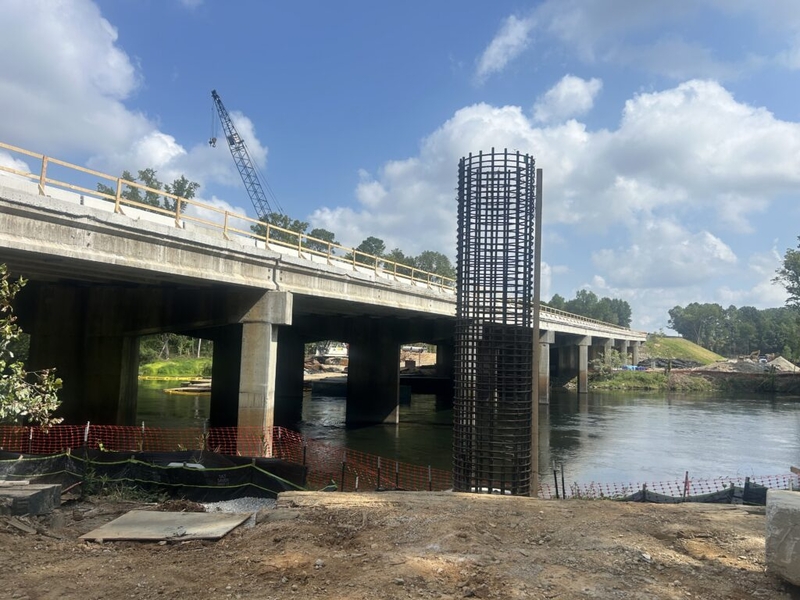
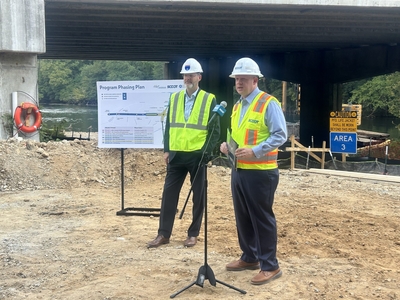
Construction on a new bridge over the Saluda River is underway beside Interstate 20 in Lexington, S.C., on Wednesday, Aug. 26, 2026. (Photo by Skylar Laird/SC Daily Gazette)
LEXINGTON — A major Columbia-area interchange project to unsnarl a notorious bottleneck is a prime example of the work states should be doing to improve roadways, a federal highway official said Wednesday.
Known among locals as “malfunction junction,” Carolina Crossroads is one of the biggest road projects in state history, said Secretary of Transportation Justin Powell. The $2.7 billion improvements are expected to wrap up in 2034, according to the transportation agency.
Roughly 90% of that money will come from the federal government, Powell said. The remaining 10% will come from the state’s coffers.
Focused on increasing safety and decreasing traffic, the project is what President Donald Trump wants to see under the Freedom to Drive Initiative launched in April, said Sean McMaster, who oversees the Federal Highway Administration (and is no relation to South Carolina’s governor).
“This is the exact type of project that we want to help and support and invest in,” McMaster said.
The program doesn’t come with specific funding. Rather, the federal Department of Transportation asked governors to pick out the worst chokepoints for congestion in their states and outline what they’re doing to fix it.
The federal agency then offers solutions to high-traffic areas, as well as technical support in getting projects done, McMaster said. The idea is that extra expertise will allow states to finish improvements that may seem daunting, especially in places that get federal funding, he said.
“Where you have that federal work, you should have federal support,” McMaster said.
Completing the Carolina Crossroads construction is vital not just to local commuters who take that route to work or school every day but to national companies that drive shipments across South Carolina, McMaster said. An estimated 134,000 people drive through the corridor every day, according to the Department of Transportation.
Price increases in construction across the country have caused the cost of the project to increase by about $1 billion. Facing delays, the agency changed the order of construction to speed up the process, Powell said.
Federal and state help will “continue to make it a priority for us” to finish the crossroads and ensure everything gets done, he said.
“We have been able to make tremendous progress,” Powell said.
What is the project?
The Carolina Crossroads project long predates the federal program. Construction began in 2021, and the project is on the third of five phases.
The first phase involved building a new interchange where Interstate 126 meets Colonial Life Boulevard, removing the Interstate 26 interchange and Bush River Road and lengthening the exit ramp off I-26 onto Sunset Boulevard.
The next step was to make improvements to interchanges on Interstate 20 and remove an unnecessary ramp, making it easier for drivers to get on and off the interstate.
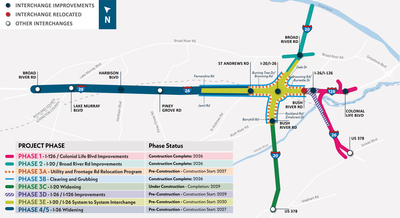
Workers are in the process of replacing two interstate bridges, where I-20 crosses the Saluda River and a railroad track. This week, work will begin to construct new bridges on I-26 over the river and railroad, along with replacing parts of I-126.
The “big boy” of the project is a complete overhaul of the interchange where I-20 and I-26 meet, Powell said.
That will involve redoing the roads where drivers get on and off the interstate, ending the need to get across multiple lanes of traffic, which makes the area especially prone to accidents, he said.
By the end of the project, workers will have widened both I-20 and I-26 from three lanes to four for 14 miles and extended the roads’ shoulders, giving emergency vehicles more space to maneuver around traffic when responding to accidents.
Carolina Crossroads is an especially challenging undertaking, Powell said. Not only is it expensive and time-consuming, but the agency must deal with multiple major arteries, railroad crossings, bridges and a large number of utility lines, he said.
The interchange has been a thorn in drivers’ sides for decades, Powell said. He heard complaints about the area when he first got his driver’s license, he said.
Support, both monetary and otherwise, from the federal government and state politicians made the difference in actually getting the work done, he said.
In 2017, state legislators raised the gas tax by 12 cents per gallon over six years, putting the additional money toward fixing deteriorating roads and bridges.
A law passed this year is meant to speed up the construction process by allowing the transportation department to take over environmental permitting from the federal government and build “choice lanes,” where drivers can opt to pay a toll and bypass congestion.
“We are tackling some of the biggest, hardest projects that South Carolina has and making a difference on it right now,” Powell said.
Columbia