Alaska should turn AI time savings into mentor time
Aug 25, 2026 | 6:14 pm ET
Description
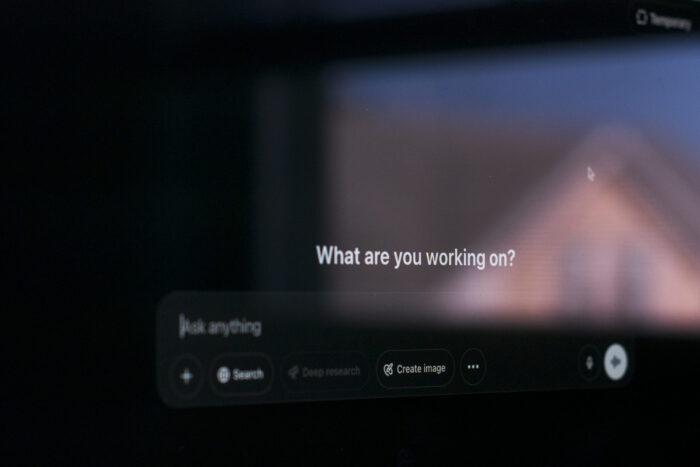
A computer screen reflects a window, and shows the default prompt when opening ChatGPT, a popular generative AI application often credited with igniting the AI boom since its release in 2022. (Photo by Alexander Castro/Rhode Island Current)
Alaska has a workforce problem that artificial intelligence could either ease or worsen. The state needs more people who can become skilled, dependable workers. AI can remove routine work and make experienced employees more productive. But if employers simply eliminate the junior tasks that once taught people how the work actually functions, they may save time today while weakening the supply of capable workers tomorrow.
That risk matters in a state already investing heavily in apprenticeship. Alaska’s Registered Apprenticeship program reports thousands of active apprentices and more than 1,000 apprenticeable occupations, while the state’s State Training and Employment Program supports employer-linked training, including on-the-job training and registered apprenticeship.
The lesson from those programs should shape workplace AI adoption far beyond the traditional trades: People develop judgment through real work under experienced supervision.
The latest labor evidence makes the case for designing AI adoption around coached judgment rather than simply removing junior work more urgent. The Stanford Digital Economy Lab’s August 2026 Canaries update found that the employment shortfall for workers ages 22–25 in highly AI-exposed occupations widened from 15% in the July 2025 data vintage to 19% by June 2026.
Employers should respond by automating preparation, not apprenticeship.
Consider the kinds of tasks AI can now handle quickly: drafting a first report, summarizing records, preparing a customer response, assembling research, classifying routine cases or producing a preliminary analysis. Those tasks may look like drudgery, but they also used to give newer workers repeated exposure to the ordinary cases that teach them what normal looks like.
Once that preparation is automated, junior roles should move toward verification and exceptions. A newer employee can check whether an AI-generated summary matches the source record, investigate discrepancies, compare an unusual case with prior examples, test an assumption, explain why a recommendation is uncertain and prepare the question that requires a senior decision.
That is more valuable work than copying information from one system to another. It can also build competence faster, if experienced workers still coach it.
Alaska employers should therefore adopt a simple mentor-time rule: When an AI workflow saves experienced employees time, reserve a defined share of those saved hours for coaching newer workers. Use that time for case reviews, feedback on failed outputs, explanation of difficult judgments and supervised decisions.
The approach fits Alaska particularly well. In a large, geographically dispersed state, employers cannot always solve a talent gap by hiring an experienced replacement from across town. Health care, public administration, natural-resource industries, transportation, professional services and technology all depend on transferring practical knowledge from people who have seen unusual situations to people who have not yet seen them.
Employers should also add one metric to their AI scorecards: time to independent competence. Measure how long it takes a new worker to spot a bad AI output, handle common exceptions, explain a recommendation and complete routine decisions with limited supervision.
That metric changes the economics of automation. A workflow that saves 20 percent of junior hours but makes the remaining employees slower to develop may create a hidden liability. A workflow that removes clerical preparation while giving beginners more exposure to review, exceptions and coached judgment may build stronger employees in less time.
Alaska already understands the logic of apprenticeship. The state should carry that logic into AI-exposed office and professional work.
Use AI to shorten the distance between beginner and expert. Let machines handle more preparation. Give people more responsibility for verification, exceptions, communication and judgment. Then spend part of the time automation saves on the human coaching that keeps Alaska’s workforce growing.
Juneau