Alaska publishes draft rules for new program intended to bury carbon dioxide, key to gas pipeline
Nov 28, 2025 | 10:10 pm ET
Description
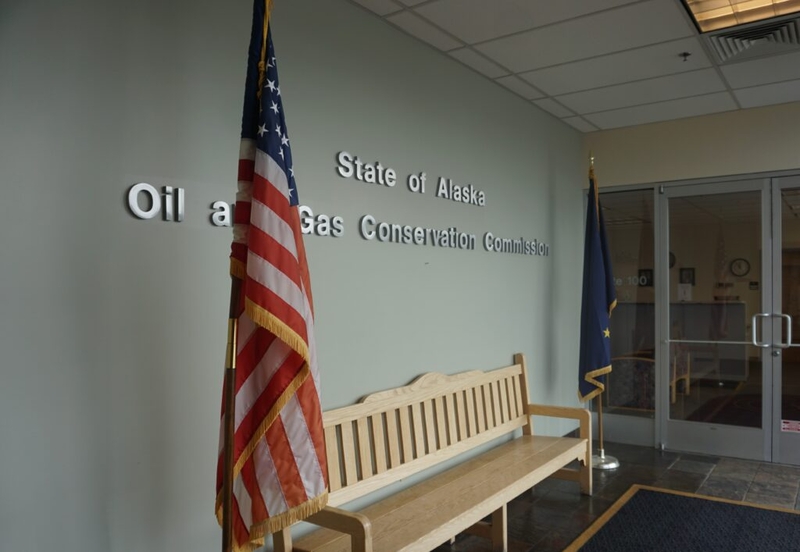
The entrance to the Alaska Oil and Gas Conservation Commission office in Anchorage is seen on March 23, 2023. (Photo by Yereth Rosen/Alaska Beacon)
The state of Alaska is close to finalizing rules for a program that would allow companies to bury carbon dioxide deep underground, a process known as sequestration.
While sequestration can reduce carbon dioxide emissions by heavy industry, it also would be a boon to the proposed trans-Alaska natural gas pipeline. Many sources of natural gas on the North Slope are mixed with large amounts of carbon dioxide, and that carbon must be separated from the natural gas before shipment.
Venting that carbon dioxide to the atmosphere would notably increase global greenhouse gas emissions, accelerating climate change.
On Tuesday, the Alaska Oil and Gas Conservation Commission announced that it had completed draft regulations for the state’s “carbon storage and underground injection” program, which will involve the state taking over regulation of carbon dioxide wells from the U.S. Environmental Protection Agency.
The Alaska Legislature passed — and Gov. Mike Dunleavy signed — a law in 2023 that allows the takeover. The initial phases of the project were funded by the Biden administration under a federal grant. Subsequent years would be funded through user fees.
Six other states — Arizona, Louisiana, North Dakota, Texas West Virginia and Wyoming — have already assumed regulatory authority over “class VI wells” used to inject carbon dioxide; state control has tended to permit faster action on carbon sequestration projects.
Alaska’s proposed regulation changes cover 105 pages of technically dense language. One important change: A carbon dioxide well wouldn’t be permitted to contaminate drinking water aquifers, and wells would be tested and monitored for assurance.
The proposed regulations include clauses that require insurance or bonds to cover the costs of accidents and a requirement that carbon dioxide wells be firmly capped when abandoned.
The AOGCC has scheduled a public hearing on the draft rules for 10 a.m. Jan. 13 at its office in Anchorage. Members of the public interested in participating interested in participating remotely by Microsoft Teams at that meeting should send an email to [email protected] at least two days before the meeting. Written comments may also be emailed to that address, and no advance notice is required for people testifying in person or calling in at (907) 202-7104, conference ID number 535 814 25#.
When the new regulations are finalized, more work remains for the state. Alaska will have to formally draft its takeover application to the EPA, which will involve another public comment period.
That application will be submitted to the EPA “ASAP after public process,” according to the state’s published timeline, and actually assuming authority over EPA-regulated carbon wells would take another 12-18 months, the state expects.
Correction: This article has been updated to correct the proposed rules’ effect on drinking water wells, to correct the number of other states that have already enacted similar programs, to clarify the program’s future funding source and that no advance notice is needed for in-person testimony or calling in by phone.
Juneau