Alaska lawmakers approve ban on polystyrene foam food containers
May 20, 2026 | 11:49 pm ET
Description
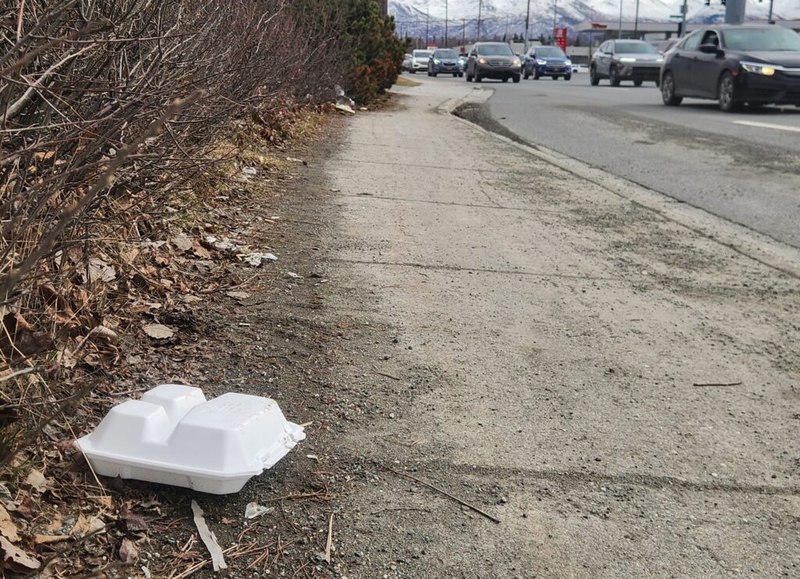
A discarded polystyrene foam food container lies along the sidewalk on April 26, 2026, near the intersection of Northern Lights Boulevard and the Seward Highway in Midtown Anchorage. A bill passed by state lawmakers aims to cut down on plastics pollution by barring restaurant use of polystrene food containers starting Jan. 1. (Photo by Yereth Rosen/Alaska Beacon)
Restaurants in Alaska will have to stop serving food in disposable polystyrene foam containers, under a bill passed by the Legislature and awaiting Gov. Mike Dunleavy’s signature.
The measure, House Bill 25, prohibits food establishments from using containers made of Styrofoam and similar plastic foam materials starting on Jan. 1. The bill applies to restaurants and to state agencies’ food operations, but it does not apply to containers sold in stores.
The prime sponsor, Rep. Andy Josephson, D-Anchorage, said he was inspired to introduce the bill after attending meetings of the National Caucus of Environmental Legislators and learning how other states are trying to curb plastic pollution.
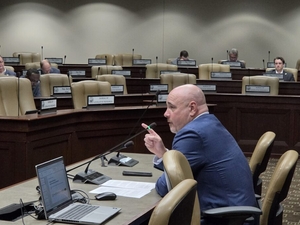
There are several reasons to ban containers made from Styrofoam and other polystyrene, Josephson said at a May 11 hearing of the Senate Labor and Commerce Committee. The materials are linked to cancers such as leukemia and lymphoma and other health problems, like endocrine disruption. They cannot be recycled. And they crumble into tiny pieces that spread into the environment, including Alaska’s marine environment, he said.
The bill’s ban would be “historic,” Josephson said. “It would send a strong message that Alaska, with its massive coastlines, greater than the rest of the country, intends to clean up,” he said at the hearing.
Sen. Scott Kawasaki, D-Fairbanks, summarized the environmental concerns when he spoke in favor of the bill on the Senate floor on Monday. “Styrofoam never breaks down. It always floats away. And it can float through air and water,” he said.
Some Alaska municipalities already have such bans, Josephson and Kawasaki said, naming Bethel, Cordova and Seward as examples.
The bill went through several refinements after it was first introduced before the start of the 2025 session.
Lawmakers made some changes to ease the transition to non-polystyrene materials. The final bill allows restaurants to continue using polystyrene containers that had been stockpiled prior to the effective date of Jan. 1, 2027. Another change grants municipalities the option of allowing the containers.
The local-option change was important to Sen. Rob Yundt, R-Wasilla, and helped him overcome his earlier reluctance to support the bill. He and his wife own a restaurant and the ban “very well might cost us a little bit of money,” Yundt said in floor comments on Monday, when the bill won final passage in the Senate. “But I can tell you it’s common sense. It’s long overdue.”
Environmental groups praised the bill. Among the risks of polystyrene pollution cited by those groups is the damage to fish and wildlife, which mistake tiny bits of plastic for food.
“Alaska is on the frontlines of the global plastics crisis, and lawmakers are stepping up with meaningful solutions,” Christy Leavitt, senior campaign director at Oceana, said in a statement released Wednesday. “We are grateful to Rep. Andy Josephson as the bill’s sponsor and the support from legislators across party lines. By passing HB 25, Alaska is taking an important step to reduce harmful plastic pollution, protect ocean wildlife, and safeguard the health of Alaska’s communities.”
Other organizations that were prominent supporters were Alaska Community Action on Toxics and the Alaska Environment and Research Policy Center; the latter group conducted a study that found microplastics such in all 39 Southcentral Alaska water bodies it tested.
A national trade organization representing manufacturers of polystyrene materials opposed the bill.
Lindsay Stovall, director of state and regulatory affairs for the American Chemistry Council, described her organization’s objections in written comments and in committee testimony. She said the bill would impose costs on consumers, businesses and state agencies.
“While we support efforts to reduce plastic waste, we believe the legislation would increase costs, create implementation challenges, and fail to achieve its intended environmental objectives,” she said in testimony to the Senate Labor and Commerce Committee on May 15.
An analysis commissioned by her organization found that the Alaska Department of Corrections, for example, would have to spend an extra $1.8 million to switch to paper alternatives or $2.6 million to switch to degradable options, Stovall said.
However, the analysis of the bill conducted by the state Department of Revenue found that it would impose no additional costs on any state agency.
The Alaska Department of Environmental Conservation, which would oversee the ban, “can integrate compliance into existing processes without the need for regulatory development or significant additional staff workload,” and would be able to use previously allocated resources, according to the Department of Revenue’s fiscal analysis.
The bill does not apply to food-service items purchased in stores for home use or to storage containers such as those used to ship fish. The bill also contains an exemption for disaster emergencies.
Juneau