Alabama Legislature passes bills banning NDAs against sexual abuse survivors
Jan 22, 2026 | 3:59 pm ET
Description
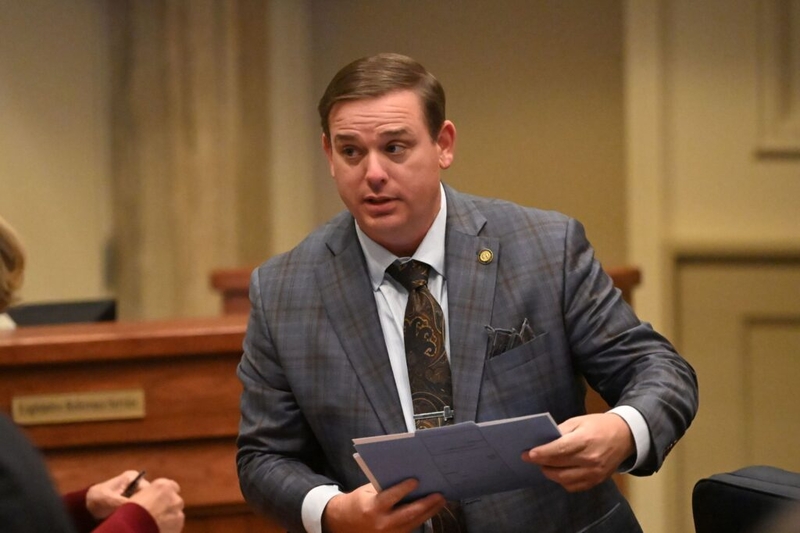
Sen. Matt Woods, R-Jasper, speaks to a colleague on the floor of the Alabama Senate on Jan. 14, 2026 at the Alabama Statehouse in Montgomery, Alabama. The Senate Wednesday passed a bill sponsored by Woods that prohibits civil courts from issuing nondisclosure agreements against survivors of sexual assault. (Brian Lyman/Alabama Reflector)
The Alabama Legislature passed two bills this week prohibiting civil courts from issuing nondisclosure agreements against survivors of sexual assault.
SB 30, sponsored by Sen. Matt Woods, R-Jasper, and HB 93, sponsored by Rep. David Faulkner, R-Mountain Brook, intend to protect survivors and further the healing process following sexual assault and abuse.
“We need to allow victims of this terrible act to heal. The only way they can heal is to be able to disclose what’s happened to them, talk about it, and move on with the healing process,” Woods said in an interview.
The Senate passed its bill 29-0 on Wednesday. The House passed its bill 98-0 on Thursday. Both bills move to their next chambers.
The bill is named Trey’s Law, after the late Trey Carlock. Carlock was sexually abused at a Christian sports camp, Kanakuk, in Missouri by its director Pete Newman, who is serving three life sentences in Missouri prison. Carlock died by suicide in 2019 at 28 years old, after a civil case against the ministry involving Carlock’s and other victims’ abuse resurfaced his trauma, according to Trey’s Law website.
“Some of Trey’s cousins actually reside in Walker County, and I have some affiliations with them. They reached out to me to make me aware of what his sister Elizabeth is doing nationwide to bring attention to Trey’s law,” Woods said.
According to the Trey’s Law website, victims of sexual assault often wait to speak up about their abuse due to fear and shame. Due to waiting, there is often nothing to be done within the statute of limitations, which often leads to NDAs finalizing their silence.
A settlement from Kanakuk in Carlock’s civil suit included an NDA, according to the website, effectively silencing Carlock and “covering up what Kanakuk knew about Newman and when.”
“To quote Trey’s sister Elizabeth, ‘The use of NDAs in settlement agreements is essentially lawful hush money. It’s institutional abuse on top of sexual abuse. NDAs are a legal mechanism that were created to protect trade secrets, not trauma secrets,’” Woods said during debate on the Senate floor Wednesday.
Sen. Greg Albritton, R-Atmore, voted for the bill but cautioned that it may have unintended consequences for churches and nonprofit organizations.
“That non-disclosure statement is a lifeline very often, for the institution to continue efforts in trying to do good,” Albritton said. “But they paid the price, and they paid the money. The non-disclosure allowed them to continue in operation in some ways.”
Sen. Vivian Davis Figures, D-Mobile, said that protecting churches and nonprofits is not what matters.
“I think we need to be more concerned about our children than some entity or institution,” Figures said. “More times than not, it’s been proven that these entities and institutions knew what was going on and didn’t do anything about it.”
The bill was Woods’ first since being elected to the Senate in a special election last summer. Senate President Pro Tem Garlan Gudger, R-Cullman, congratulated him.
“I just wanted to tell you, for that particular bill, that was kind of a tough bill to go through. I know there’s a lot of national attention to it, and so thank you for being here,” Gudger said.
Rep. Juandalynn Givan, D-Birmingham, said Thursday while she supported the bill, she had some concerns with the language in the bill for NDAs.
“I guess for me, the alarm comes when you called it specifically an NDA. I think that you should have modified if it’s just NDAs, fine, but then when you get into the subject matter of other types of agreements, then it makes it a little difficult,” Givan said.
Woods said in an interview he hopes Alabama can be one of the first states to pass the law. Similar legislation has passed in Texas, Missouri, Tennessee and California.
“Alabama needs to be a place that’s leading in this, and I believe today was a step in the right direction,” Woods said.
Andrea Tinker contributed to this report.
Montgomery