Alabama coastal restoration project could inform Louisiana work on lower insurance rates
Oct 14, 2026 | 5:00 am ET
Description
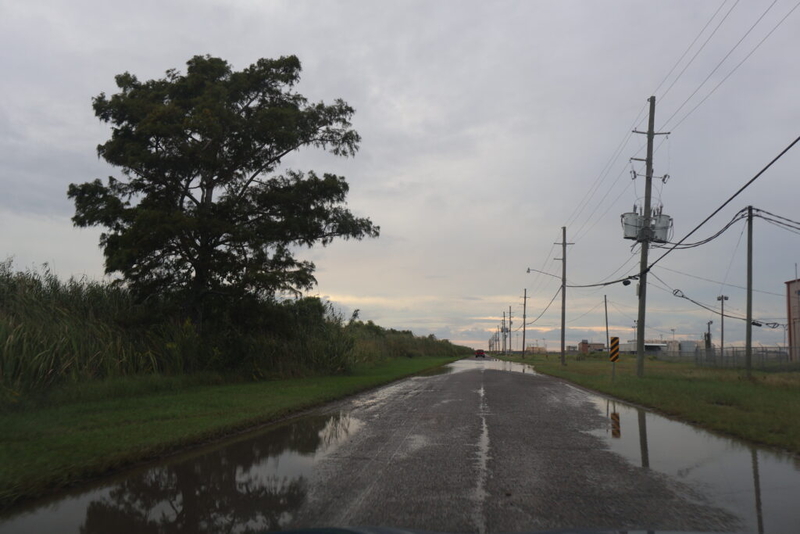
A partially flooded road in Venice, Louisiana. A new report looks at how coastal restoration can be connected to lower flood insurance rates and risk. (Photo by Elise Plunk/Louisiana Illuminator
A flood reduction project on an island off Alabama’s coast is helping Louisiana researchers understand how coastal restoration can decrease both risk and insurance prices in other Gulf Coast communities.
The report from The Water Institute, a Baton Rouge-based research and policy group, shows that while coastal restoration reduces the risk of flooding for nearby homes and businesses, more policy work is needed to better reflect that lower risk in insurance prices.
The Water Institute worked on a pilot marsh restoration project on the north side of Dauphin Island in partnership with Munich Reinsurance America Inc., a New Jersey company that covers risk for insurance policy issuers, and Moffatt & Nichol, a Baton Rouge engineering firm.
The Graveline Bay marsh restoration project rebuilt 60 acres of marsh habitat, measurably reduced the wave heights during major and minor flood events across the island and lowered overall still water levels, according to the report.
“I think it’s exciting that we’re able to see this measurable impact,” said Renee Collini, the Water Institute’s Community Resilience Center director and primary investigator on the report. Her work focuses on navigating federal, state and local governments to help Gulf Coast communities support climate resilience planning and action.
Another goal of the Dauphin Island pilot project was to see if the project could be replicated in other areas such as Louisiana, where the need for coastal restoration and insurance cost relief are also acute, according to Collini.
“When marshes are implemented, one of their benefits is that they reduce flood risk,” she said. “This is us working to help find sustainable ways to connect risk mitigation to risk pricing.”
A “consistent” decrease in wave heights after the Graveline Bay marsh was rebuilt translated to a lower risk of flooding for nearby homes and businesses, with the reduction ranging from 9% to 18%, the report found. But while the flood risk decreased, insurance prices didn’t always reflect the reduction.
The federal-government backed National Flood Insurance Program is often the only option on the market for home and business coverage in flood-prone areas. The Federal Emergency Management Agency uses the program’s disaster risk rating system to set insurance rates for policy holders.
Its latest version, known as Risk Rating 2.0, has been widely criticized as not fully reflecting efforts local governments and communities have taken to reduce flood vulnerability, such as home elevation, roof upgrades and coastal restoration projects.
Collini said the Dauphin Island project is a “first step” in connecting coastal restoration work to consistently lower insurance prices.
“(We’re) trying to move forward in a way where we don’t ignore that things are risky, but we are also not ignoring when we do work to make it less risky,” she said.
Collini said the Water Institute is “actively working with partners in Louisiana” to choose areas in state where a similar project can help local communities better understand how nearby coastal restoration has reduced flood risk — and if it can be carried over to decreased insurance prices.
“For Alabama, 60 acres is a big restoration, but that’s not a big restoration in Louisiana,” she said. “There are much bigger projects, and so it’s exciting to think about the kind of impact they could be having.”
Baton Rouge, LA