Alabama Bureau of Pardons and Paroles to open rehab facility for women
Nov 03, 2025 | 8:01 am ET
Description
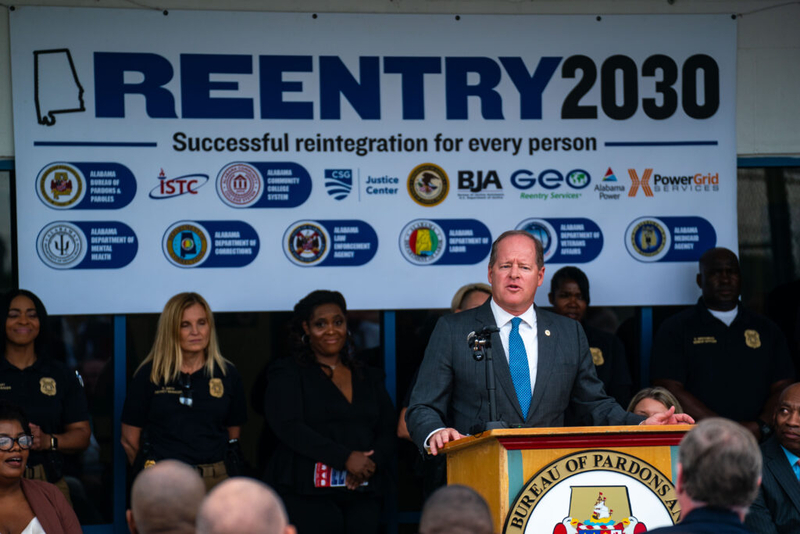
Alabama Bureau of Pardons and Paroles Director Cam Ward speaks during Reentry 2030 event at the Perry County Correctional Facility in Uniontown, Ala., on Friday, Oct. 6, 2023. ABPP plans to open another rehabilitation facility for women in Thomasville. (Will McLelland for Alabama Reflector)
The Alabama Bureau of Pardons and Paroles plans to offer a residential rehabilitation facility for women like the Perry County Probation and Parole Reentry Education Program (PREP) Center.
Crews are preparing a site in Thomasville expected to host an initial cohort of 20 women on parole. The facility, known as the Central Alabama Re-Entry (CARE) Center, is expected to open next spring.
“The CARE Center is going to do nothing but cater to women who have come out on parole and probation,” said Cam Ward, director of the Alabama Bureau of Pardons and Paroles (ABPP), in an interview on Wednesday. “We will provide drug treatment, mental health treatment, and job training.”
The center comes from SB 5, sponsored by Sen. Linda Coleman-Madison, D-Birmingham and passed in 2023, that directed the bureau to open at least one women’s facility “for the housing of parolees and probationers ordered to serve a period of confinement.”
ABPP currently has a single residential facility that serves men after getting parole The parole board will require some to remain at the Perry County site for 90 days if they believe they are at a higher risk to reoffend.
The Perry County site has generated solid results, according to Ward and administrators of the facility. More than 400 people have completed programs at PREP without a single individual return to prison. ABPP hopes to build on the success of the men’s rehabilitation facility to adapt the model to an entirely different group.
“When we get this center open in Thomasville, you just wait and see,” Coleman-Madison said in an interview on Thursday. “If you think these numbers are outstanding, the women are going to blow it out of the water because all they need is a chance.”
The centers aim to provide some stability and job training to help ensure people do not reoffend.
“This is a multi-layered problem; it is not only one or the other one, but I tend to think that housing is a key first step,” said Pilar Larroulet, an assistant professor at the School of Criminal Justice at Rutgers-Newark University. “How will you find a job if you don’t have an address to give? How will you regain custody of your kids if you do not have anywhere to take them? The discussion about housing has become more important.”
The residential facilities also provide mental health treatment and substance abuse counseling to address some of the determinants of recidivism.
“This connection with services is the missing piece many times for successful reintegration,” Larroulet said.
The women’s rehabilitation facility will serve smaller groups of people, at least to start, due in part to logistics and demographics. According to the monthly statistical report from August taken from the Alabama Department of Corrections website, about 2,700 women were in ADOC custody versus almost 26,000 men.
The recidivism rate for women is also less than that for men. According to a study from the Bureau of Justice Statistics published in 2018, about 44% of men who had been incarcerated in prison in 24 states were rearrested after the first year versus 34% of women in a similar situation. After three years, about 31% of men who had been in prison were rearrested versus 29% for women during the same time.
The residential facility, and the services that are offered, are more critical for women than men, according to Stephanie C. Kennedy, policy director at the Council on Criminal Justice, an independent, nonpartisan think tank that focuses on criminal justice issues.
“They don’t have a safe place to land in order to get everything done, so they are going back to an abusive parent, they are going back to an abusive partner, and that complicates everything,” Kennedy said. “Women’s experience of trauma is much more interpersonal, more likely to include sexual violence, intimate partner violence, so when we are thinking about reentry, we need to be using a trauma-informed lens.”
Women who have been incarcerated are more likely to be affected by substance abuse, are less likely to be economically stable and experience higher rates of homelessness, less of a job history and lower rates of education attainment than men incarcerated in prison.
“Women, over two years post release, are five and a half times more likely to have an overdose fatality than women in the community,” she said. “And for men it is 3.3. There is just much higher risk.”
Women are also more likely to be the caregivers than men, whether that be parents or their children.
“When they are leaving confinement, they are having to do all the things that we ask everyone to do, find a job, get an address, but they are also needing to reunify, to work a case plan for child welfare, to navigate the transition back to caretaking from a parent or a sibling, or a friend to get their children back,” Kennedy said.
ABPP will offer about the same services at the women’s rehabilitation facility as men with additional programming to include family reunification and job training tailored to what women would prefer.
“For example, CDL, commercial driver’s license, I would have never known this, but someone explained this to me, it is much more popular among the women than it is among the men,” Ward said.
Montgomery