Afterschool demand outpaces supply, advocates say, even as state scores high in access
Jun 04, 2026 | 5:17 pm ET
Description
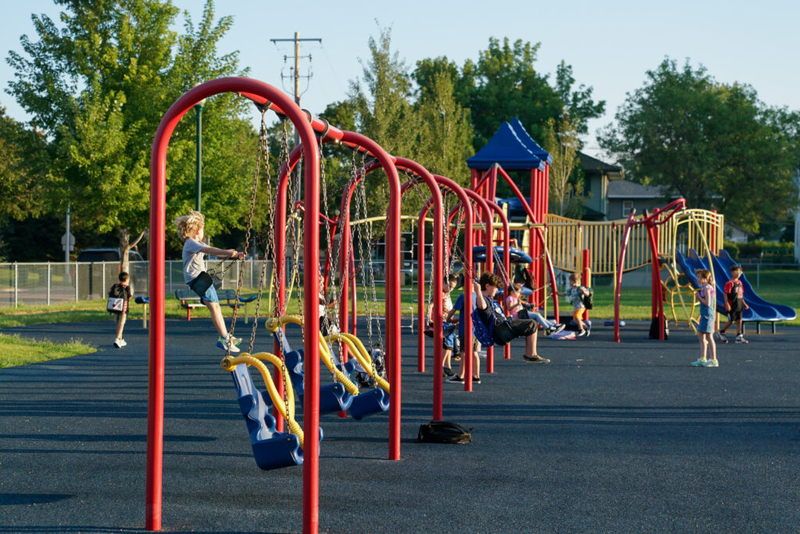
Students in the Sioux Falls School District play on a playground. (Courtesy of Sioux Falls School District)
South Dakota parents who want afterschool care for their kids have better access to it than they do in nearly any other state, according to a national nonprofit organization, and the kids in those afterschool programs spend an outsized number of hours taking part.
Even so, about two-thirds of the South Dakota kids who could be in afterschool care aren’t.
Childcare advocates in South Dakota say the state’s rankings in the national report highlight both a growing need for programming outside of school hours and that programming’s value to taxpayers.
Drops in absenteeism and improvements in academic performance for kids in an expanded afterschool program in Sioux Falls are promising, said Billy Mawhiney, director of the South Dakota Afterschool Network, but “the demand is still outgrowing the supply.”
“Yes, we’re doing great things, and this is still happening,” Mawhiney said. “We still have more work to do.”
The network’s own report, titled “Practical Pathways for Supporting Working Families Through Out-of-School Time,” was released last week.
Child care is “essential for working families” in South Dakota, the report says, because about 78% of kids in the state live in homes where all available parents work.
What’s needed, it concludes, is more access to afterschool care, particularly in rural areas, as well as more mapping on where gaps in care may be and a coalition of pro-childcare lawmakers willing to stump for steady government funding.
South Dakota’s standing
The network leaned on data from a state-by-state “America After 3 p.m.” report from the Washington, D.C.-based Afterschool Alliance to build its own report and recommendations for the future of childcare in South Dakota.
The D.C. group surveyed families and providers in every state. It found that around 22,000 of the 64,000 kids whose parents want after school or summer care in South Dakota are getting it, that the average cost of that care is $3,300 per year per kid, and that pay of less than $15 an hour for staff members contributes to high turnover at afterschool programs. The barriers to uptake were tied to the expense and access to quality programming.
But the report also found that South Dakota fares better than most states in some ways. Weighing several factors, the nonprofit ranked the state third nationwide in afterschool program participation, behind Washington, D.C., and Hawaii. The state ranked fifth in access to programming, behind Washington, D.C., Kansas, New Mexico and Alaska.
In Washington, D.C., the report says, high rankings for participation and access are both tied to municipal investment in afterschool programming. In Hawai’i, the scores are linked to the use of federal and state grants to expand programming and participation.
Influence of four-day weeks
South Dakota’s high ranking in participation wasn’t tied as closely to the raw number of kids participating. By that metric, South Dakota is above average, with 14% of the kids whose parents want afterschool programming participating in it at the time parents were surveyed. But the nonprofit’s methodology for participation also factors in the “dosage rate,” meaning the number of hours per week that kids are in afterschool care. In South Dakota, that figure is 7.7 hours a week. The national average is 5.3.
That’s a unique path to a top 10 participation score, according to Nikki Yamashiro, research director for the Afterschool Alliance. But the dosage rate is meaningful, she said, as it offers nuance and acts as a nod to the significance of the amount of time kids spend with experienced caregivers.
“When we think about ranking for participation, it’s not just someone who goes one hour a week,” Yamashiro said. “We wanted to include that in our calculation. Because South Dakota has such a high average for number of hours a week that kids participate compared to the other states, that’s what bumps it up.”
That high number may be tied in part to four-day school weeks, the report says, based on the interviews with South Dakota afterschool advocates that helped guide its findings.
For the 2024-25 school year, 45 of the state’s 159 public school districts had four-day weeks, according to the state Department of Education. That trend has pushed some school districts to open their doors to Friday afterschool programs run by outside entities. That, in turn, may have helped push the number of hours kids spend in afterschool programs.
Survey finds many South Dakota parents unable to enroll children in afterschool programs
The “America After 3 p.m.” report’s addendum on high-performing states cited the Burke School District, which got a $211,000 grant from the Governor’s Office of Economic Development in 2024 to help launch an afterschool program that runs for a full-day on Fridays, when school is out.
Kelsea Sutton, a banker who helped her county secure the startup grant, said the program is now self-sustaining and funded by parents’ tuition fees.
“The school provides a free satellite location,” for the nonprofit child care center that staffs the afterschool program, Sutton said, “which has been essential to the partnership.”
“It would not work if the school hadn’t been a good partner,” she said.
Sutton noted that communities like hers didn’t have much choice but to expand out-of-school programming. The same has been true for childcare in smaller communities, she said, where businesses, cities and schools have cobbled together options to keep families working.
Out-of-school care in Burke still costs more than many parents can afford, she said, and the staff still don’t make enough money.
“What’s been going on for a really long time is that working moms are figuring it out in their communities, and just busting their asses to fundraise, go to board meetings, hire staff at poverty wages, all so that people can get to work,” Sutton said. “That’s what is continuing to happen.”
Success story in Sioux Falls
“America After 3 p.m.” links South Dakota’s high ranking for access to efforts by group’s like Mawhinney’s to map programs and connect parents to them. But it also pointed to a reworked afterschool program in the state’s largest city that’s grown the number of kids getting care.
For years, the Sioux Falls School District operated an in-house afterschool program that competed with outside providers. Many of those providers would collect kids from the playground and truck them to their own buildings for afterschool care, making space in facilities used for younger kids all day long.
In 2023, the school district disbanded its program and brought the largest of those nonprofit care providers into all 22 of its elementary schools. The afterschool programs, now called Community Learning Centers, are staffed by the providers, who no longer need to pay for transportation or find space in their own facilities for older kids.
‘We can’t exist without child care’: Rural towns use state funding to open local centers
The school district offers its buildings, maintains a small team to manage enrollment and billing and shares information on individual student needs and in-school performance with the providers.
The model expanded into middle schools in 2024. Middle school students nationwide are less likely to have access to afterschool care, the national report says.
Additional funding also expanded access.
Families can get subsidies for afterschool care from the state Department of Social Services if they make up to 209% of the federal poverty guidelines. For the Sioux Falls program, families with incomes up to 300% of the federal poverty guidelines are eligible for scholarships, funded through a combination of funding from federal 21st Century Community Learning Centers grants and money from the Sioux Falls Area Community Foundation.
The federal funding also pays for additional tutoring time for students who struggle academically.
But there’s only so much scholarship money, said Rebecca Wimmer, coordinator of community partnerships and afterschool programs for the Sioux Falls School District. Schools that serve more lower-income families tend to have openings in their afterschool programs — even as other schools have waiting lists.
“We max out our budget every year, as far as scholarships go,” Wimmer said. “If we had more resources, we could certainly enroll more kids.”
The current federal grants expire next year. The school district and its partner providers have separately applied for more, Wimmer said, but don’t know if they’ll get it.
Hope for funding, and a corrections connection
Because the schools hold both afterschool participation data and data on academic performance, Wimmer’s team has been able to crunch numbers and show improvements in those areas for the kids who stick around after the closing bell.
Particularly when tutoring is directed in the areas where teachers say kids need it most, Wimmer said, “what we’re seeing is that these best practices are actually resulting in differences.”
Wimmer hopes the district’s data encourages more collaborative models across the state, and can help draw in funding from municipal and philanthropic sources.
Mawhiney, the afterschool network’s director, also sees the data as a way to reopen the funding conversation at the state level. Chronic absenteeism and low academic engagements are some of the most reliable markers for kids who wind up involved in the criminal justice system, he said.
The state’s decision to invest $650 million in a new men’s prison in Sioux Falls was wise for public safety, Mawhiney said, but he’d like to see the state invest in programs that help prevent kids from growing up and going there.
“If we’re going to be honest, the kids that are in that category, where we’ll be covering that cost of incarceration later, are the kids who are not getting that afterschool care,” said Mawhiney.
State Sen. Tim Reed, R-Brookings, sponsored a trio of bills in 2025 meant to expand access to childcare. One of them passed both the state Senate and House of Representatives, but failed to override a veto from Gov. Larry Rhoden. The others didn’t make it that far.
Reed didn’t attempt to revive those bills this year, but said the need for both early childhood education and afterschool care remains. The next time the issue comes up, Reed said, he and the other lawmakers who support state funding need to point to data from Sioux Falls as proof of a return on investment.
“It is the place to go, to talk about this in an upstream kind of way,” Reed said. “And then you actually start talking about it in terms of kids doing better in school.”

Pierre, SD