After years of delays, commission advances northern Maine transmission and wind project
Aug 25, 2026 | 4:57 pm ET
Description
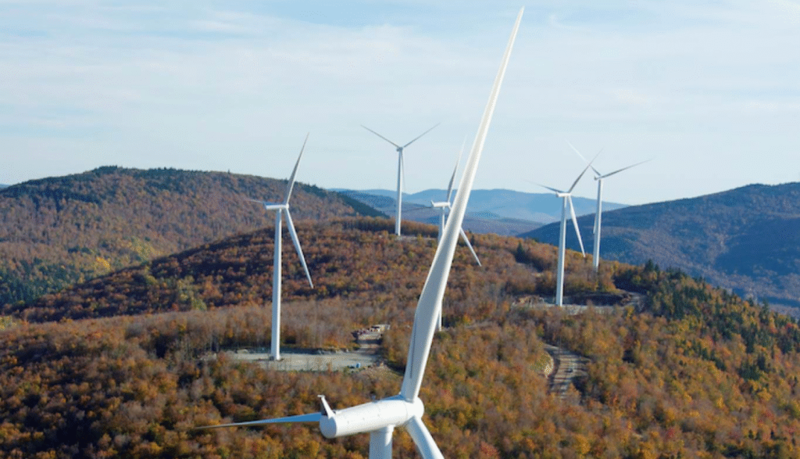
The Record Hill wind farm in Roxbury, Maine. (Photo via U.S. Department of Energy)
The Maine Public Utilities Commission will finally move forward with plans for a new transmission line to northern Maine and an 800 megawatt wind project.
At a regular meeting Tuesday, commissioners selected Avangrid, the parent company of Central Maine Power, to build the transmission line and Clearway Energy Group to build the onshore wind project.
The bid selection marks a major milestone for the Northern Maine Renewable Energy Development Program, which has struggled to move projects forward.
“Developing new energy resources and transmission in Northern Maine can help deliver more affordable and reliable power, strengthen our grid, reduce Maine’s exposure to energy cost volatility and create thousands of jobs and new economic opportunities in rural communities,” Gov. Janet Mills said in a statement. “This is a historic opportunity to put Maine’s energy resources to work for ratepayers while supporting investment and economic development in Northern Maine.”
Northern Maine has long been considered a promising location for wind development, but progress has been hampered by the local grid. Aroostook and Washington counties are not connected with the rest of the Maine and New England grid, and the area gets most of its energy from New Brunswick, Canada.
That disconnect means that renewable energy in northern Maine is limited in how much energy can be sent to other areas, because of the limits of transmission lines. And that has created substantial obstacles in developing energy projects, said Public Utilities Commissioner Patrick Scully.
“As a consequence, northern Maine and its residents have been deprived of meaningful economic development opportunities, including jobs, tax revenues and investment in local communities,” Scully said.
This isn’t the commission’s first attempt to address those challenges. The commission initially requested proposals in 2021, but ultimately ended the procurement process in 2023 without finalizing any deals.
The commission issued a new request for proposals in December, this time working with Connecticut, Massachusetts, Rhode Island and Vermont, to share the costs of building the transmission infrastructure across the five states.
And that collaboration has been a real success, Scully said.
Maine tries again to unlock wind energy — but this time it has help
“It has demonstrated that separate sovereign governments can work together to plan for and procure significant transmission and generation investments, and most surprisingly, to agree on how to share the costs and benefits of those investments — I’ve not seen anything like this in the United States,” Scully said.
Commission Chair Philip Bartlett said the multi-state partnership means that Maine’s share of the costs for the transmission line will be less than 11%. And the selected proposal from Avangrid minimizes the risks to ratepayers and maximizes the benefits.
“A big advantage of this proposal is that it utilizes existing transmission corridors to the maximum practical extent, and the developer has secured nearly all rights of way for the project,” Bartlett said. “It has also demonstrated the strongest viability within a commercially reasonable time frame.”
The commission also agreed to award 600 megawatts of the project’s power to Maine ratepayers. That leaves roughly 400 megawatts of available capacity on the transmission line, Bartlett said. The commission will issue additional requests for proposals to fully utilize the transmission line.
Over the life of the project, the transmission and generation will provide roughly $400 million in net benefits for Maine ratepayers, Bartlett said. And the two projects are expected to create over 2,500 full-time jobs during construction and more than $2.4 billion in economic output.
Onshore wind production is particularly useful in this case, said Commissioner Carolyn Gilbert, because northern Maine tends to be windy during the winter months when energy prices are high, and the region turns to oil for energy needs because of natural gas constraints.
Gilbert said the commission’s analysis shows that the project will reduce oil use by more than 10% once online, improving reliability and reducing both emissions and costs.
“Together, the projects will provide benefits to Maine customers, both on and off our electric bills,” she said. “The projects will provide significant economic benefits in northern Maine and throughout the state in terms of property tax revenue, jobs and other downstream impacts.”
The advance of the renewable energy projects was applauded by economic and environmental groups for the multiple ways they would benefit the region.
Michael Duguay, commissioner of the Maine Department of Economic and Community Development, echoed Mills’ praise of the project.
“Maine’s economic future depends on having energy that is affordable, reliable, and available to businesses and communities,” Duguay said in a statement. “By connecting these resources to the regional grid, Maine can capture greater value from its energy assets and support the businesses and communities that drive our economy.”
Aroostook County already hosts wind projects in Mars Hill and Oakfield, which have been praised for bringing economic benefits to the surrounding communities, Johanna Johnston, executive director of the Southern Aroostook Development Corporation, said in a statement.
“Projects of this scale can bring significant economic activity, infrastructure investment and new opportunities to our region,” Johnston said. “As they move forward, it will be important to ensure that the communities impacted see meaningful long-term benefits while recognizing the unique energy needs and infrastructure that exist across Aroostook County.”
A coalition of environmental groups — including the Natural Resources Council of Maine, Maine Audubon, Maine Conservation Alliance, Conservation Law Foundation and Acadia Center — released a joint statement that noted some of the benefits but stopped short of endorsing the projects, saying they plan to listen to the concerns of local communities and analyze their impact to surrounding ecosystems.
“With careful siting, thoughtful design and responsible operation, the clean energy projects identified today will deliver reliable, affordable electricity to Mainers while reducing the pollution that is threatening our health and fueling changes to our climate that are already being felt across the state,” the groups stated.
The commission will now finalize the Power Purchase Agreement with Clearway for the wind project. Meanwhile, a voluntary agreement between Avangrid and the states will be finalized and then submitted to the Federal Energy Regulator Commission for final review.
Augusta, ME