18 changes suggested for state funding, local property taxes for K-12 schools
Oct 20, 2026 | 4:15 pm ET
Description
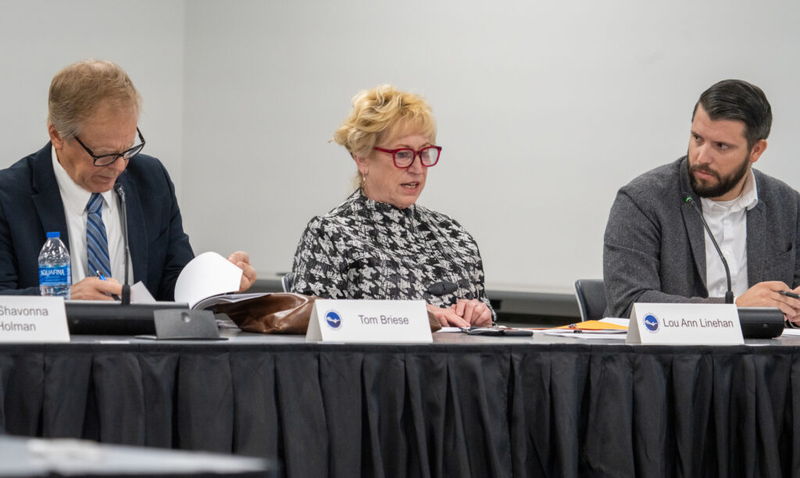
Former state Sen. Lou Ann Linehan of Elkhorn, center, speaks at a meeting of Nebraska's School Financing Review Commission on Oct. 20, 2026, at the Nebraska Department of Education in Lincoln. At left is Tom Briese, a former state treasurer and former state senator from Albion. At right is Grant Latimer, a policy adviser to Nebraska Gov. Jim Pillen. (Photo by Zach Wendling/Nebraska Examiner)
LINCOLN — Among recommendations to increase state funding for Nebraska’s 244 school districts was one adopted Tuesday to increase per-student aid by at least 4% annually.
A draft of the 16-page report from Nebraska’s School Financing Review Commission offers 18 recommendations, most of which would tweak the Tax Equity and Educational Opportunities Support Act, known as TEEOSA. The formula distributes state aid to school districts statewide. This includes the annual bump of at least 4% in foundation aid per student, from $1,500 to $1,560 for the 2027-28 school year.
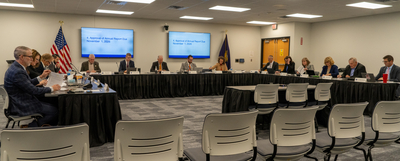
In addition to the recommendations, a portion of Tuesday’s discussion featured a guideline to policymakers that state support for K-12 schools be maintained at 51% alongside local property taxes.
“I applaud the work of the commission and what’s being presented here, but we have to be much more ambitious in what we propose here somewhere,” said Commissioner Tom Briese, Nebraska’s former state treasurer (2023-25) and a former state senator from Albion (2017-23).
The recommendations head to the 49-member Legislature. Lawmakers will have final say on whether to adopt any of the suggestions.
‘Not in the cards’
Briese and others suggested that the 51% state contribution was the bare minimum. In Briese’s view, that number should be “substantially higher,” as high as the state taking on 100% of K-12 operational expenses to offset the largest source of local property taxes.
“That’s not in the cards at this date, but I’m pretty confident there’s several folks in here that’d like to see something far above 51%,” Briese said.
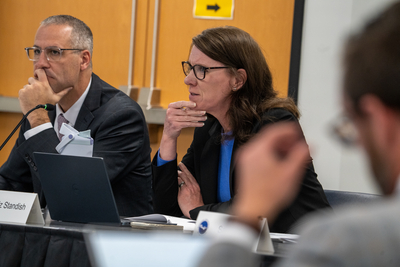
State Sen. Dave Murman of Glenvil, chair of the Legislature’s Education Committee, said he, too, was thankful for but not satisfied with the recommendations. He is one of three non-voting lawmakers serving on the commission.
Associate Superintendent Liz Standish of Lincoln Public Schools said the commission had not discussed the state-local mix in a year. She said she felt uncomfortable stating in the report that the number should be increased until the commission deliberated further.
What’s the right state-local mix?
Standish said “huge progress has been made” with state funding support, which districts appreciate. But she encouraged commissioners to utilize new data that Nebraska Department of Education staff helped compile and consider the state-local percentage next year.
“All I’m asking for is let’s reflect on where we are with this new data set that we’ve studied over the course of the last year and then, as a commission, have time for deliberative conversation about, OK, what do we think the right mix in Nebraska might be?” Standish said.
Former state Sen. Lou Ann Linehan of Elkhorn, who chaired the Legislature’s Revenue Committee for six years, said it was OK for the commission to say commissioners disagreed.
“I think to turn in a report of this diverse of a group and say we all agree on everything … if I were a senator, I would find that doubtful,” Linehan said. “I’d be calling each of you and saying, ‘Did you agree with this?’”
Reaching consensus
Superintendent John Schwartz of Millard Public Schools, the commission vice chair, suggested that instead of saying “no consensus,” the commission could phrase it more positively. He suggested adding that “additional processing is needed to see if a consensus on what the state funding level target should be.”
Linehan said it was pretty clear the commission is divided and that the lack of consensus isn’t a secret, “nor should it be a secret.” She said money appropriated to public schools should keep going to public schools.
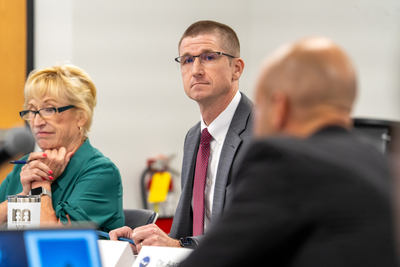
The commission ultimately amended the report to state: “While the commission agrees that the state’s contribution should be maintained at a minimum of 51%, there is currently no consensus regarding the appropriate level of state funding beyond that threshold.”
One notable school district, Omaha Public Schools, has opposed increased reliance on state funding, a point of contention in Nebraska’s 2024 special session focused on property taxes.
Shavonna Holman, who sits on the OPS board and the commission, was not present Tuesday.
Increased aid to school districts
Lawmakers, with Gov. Jim Pillen’s backing, created the commission in 2025 to improve Nebraska state funding for K-12 schools with the goal of also mitigating property tax increases.
Eight of the commission’s proposed adjustments would amend caps for local spending, such as providing three-year averages for enrollment calculations and changing factors for limited English proficiency and poverty considerations.
Other recommendations would tweak factors in TEEOSA, such as calculating poverty, limited English proficiency, technological needs and basic year-over-year funding.
If adopted, schools would be allowed to carry forward unused property tax authority under their base cap, such as if they increased spending by less than 3% when the base cap was 3%. But the recommendations call for wiping out built-up taxing authority over the past three years if it came from an override vote and was not used in that same year.
“Collectively, these changes reflect measured changes to the existing revenue cap which better align with the intent of the legislation while preserving local control. These changes also make adjustments to reflect the impact data on the operation of the cap since its inception,” the report states.
If all of the recommendations had been adopted before the 2026-27 school year, the commission estimated nearly $55.5 million more aid to local school districts.
In total, 232 school districts would have seen an increase in aid, up to 43.32%, while 12 would have received a slight decrease, between 0.42% and 14.11%.
TEEOSA would have risen to $1.15 billion in state aid being distributed to school districts.
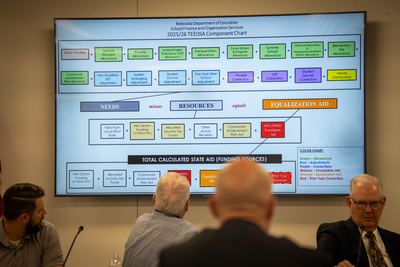
For 2026-27, TEEOSA consists of calculating a school district’s “resources” — six different sources, including an estimated property tax calculation based on district valuations — minus a district’s “needs” — 18 categories, including poverty, transportation, summer school, limited English proficiency and student growth.
All school districts receive foundation aid, but districts only receive additional “equalization aid” if their needs are greater than their resources. Only 44 of 244 districts were equalized this year.
Property taxes and the state budget
As of current state budget projections, lawmakers will need to close a $209 million deficit through mid-2027 by May of next year. At the same time, lawmakers must address that hole and the $847 million that would grow if left unchecked by mid-2029.
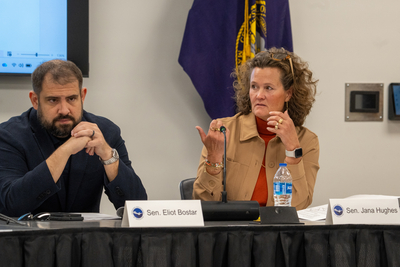
State Sen. Eliot Bostar of Lincoln, who will introduce the revenue side of changes that the commission has recommended, said the commission has been focused on determining what would serve schools but also Nebraska taxpayers.
“While we do have an upcoming session that will have budgetary challenges, I think it’s important that we do everything we can not to compromise on what would be the best possible policy that we can create,” Bostar said.
State Sen. Jana Hughes of Seward, whose 2025 legislation created the commission, said she plans to introduce the suggested TEEOSA changes if she’s reelected in two weeks. She said cleaning up part of the formula will be a “slam dunk.” The other, more challenging part is the increased foundation aid.
Hughes said the commission and lawmakers alike don’t want the 51% state support to backslide, and lawmakers will see if they can reach the suggested 4% minimum increase. She said it needs to be a priority in 2027.
“It’s going to be some hard conversations of where do we want to spend,” Hughes said. “All I keep hearing about, in addition to affordability, is the property tax issue.”
How big of a budget hole the Legislature will need to fill will be finalized at an economic forecasting meeting next week. Linehan and Briese are new members of that board, too.
‘Work is just beginning’
Nebraska Education Commissioner Brian Maher, who chairs the commission, said he was thankful the commission has twice unanimously approved an annual report, which he joked will prevent some sleepless nights, at least for him.
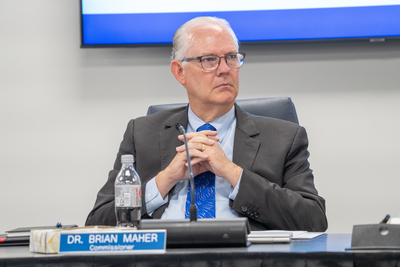
“It’s also not reflective that our work is done,” Maher said of the 2026 report. “I think, as it’s been stated many times today, in some ways, our work is just beginning.”
The commission’s approval authorized an internal executive committee to polish up the report, up to non-substantive changes, and submit it to the Legislature by the Nov. 1 deadline.
The commission will next meet in the first quarter of 2027. The legislative session begins Jan. 6.
Lincoln, NE