12th District Democrats trade barbs over candidate’s ties to the ‘blind sheikh’
May 27, 2026 | 2:48 pm ET
Description
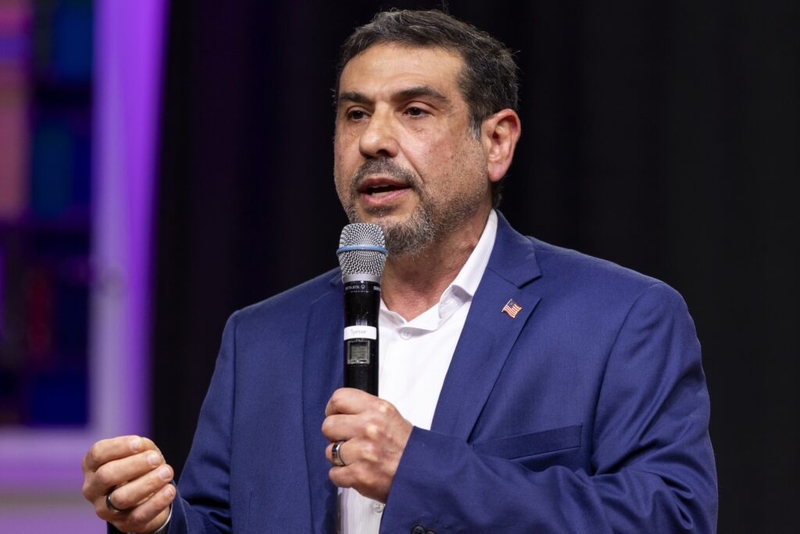
In 1995, congressional hopeful Adam Hamawy testified for the defense at blind cleric Omar Abdel Rahman’s terrorism trial. One of Hamawy’s rivals said voters should know more. (Photo by Anne-Marie Caruso/New Jersey Monitor)
A Democrat running in a crowded House primary is defending his past connection to the late Omar Abdel Rahman, the blind cleric who was convicted in 1995 of planning a bombing campaign intended to destroy the United Nations and other New York City landmarks.
Physician Adam Hamawy, one of 12 Democrats vying for their party’s nod in the 12th Congressional District on June 2, testified for the defense at Abdel Rahman’s trial, leading one of Hamawy’s rivals, Plainfield Mayor Adrian Mapp, to call Hamawy a “radical extremist.”
Mapp said voters need a fuller accounting of that relationship, and suggested Hamawy’s connection to the man known as the blind sheikh could jeopardize national security.
“The blind sheikh was not a marginal or misunderstood figure,” Mapp said in an interview. “He was a convicted terrorist, convicted of seditious conspiracy. He was connected to one of the darkest chapters in our nation’s history.”
Hamawy, a former U.S. Army combat surgeon, dismissed Mapp’s attacks as desperate and Islamophobic in an interview.
“My patriotism and my record is clear,” he said. “I think he’s desperate, and desperate people say desperate things.”
The two men are vying to succeed a retiring Rep. Bonnie Watson-Coleman in the 12th District, a district widely regarded as a safe one for Democrats in November.
Hamawy brushed off his connection to Abdel Rahman as minimal and decades-old news. He said he was young when he first encountered the blind cleric in 1991, and remembers carpooling with him and others on one occasion. Hamawy said he testified at the man’s trial out of a sense of “a civic duty.”
“I was called as a witness, and I gave my testimony under oath, and then I walked out,” he said. “It was never an issue back then, and they’re trying to make it an issue now.”
Abdel Rahman, who died in a North Carolina federal prison in 2017, was the spiritual leader of radical group al-Jama’a al-Islamiyaa. Before coming to the United States, he was tried in Egypt for instigating the 1981 assassination of President Anwar el-Sadat (Abdel Rahman was acquitted).
Abdel Rahman built a following with anti-American sermons in Brooklyn and Jersey City. He was not convicted on charges stemming directly from the World Trade Center bombing, but prosecutors said he and his codefendants were coconspirators of the men convicted in that attack.
Hamawy, who was born in Egypt and moved here as a child, maintains he had no relationship with Abdel Rahman. He noted he was in the military during the trial, and afterward was trusted to treat troops in combat in Iraq, including now-Sen. Tammy Duckworth (D-Illinois), and victims of the 9/11 attacks.
“Any Muslim is going to be called a terrorist at some point, and these tropes are outdated and worn. Unfortunately, they continue to be used right now,” he said. “These are not serious arguments, and they’re getting old.”
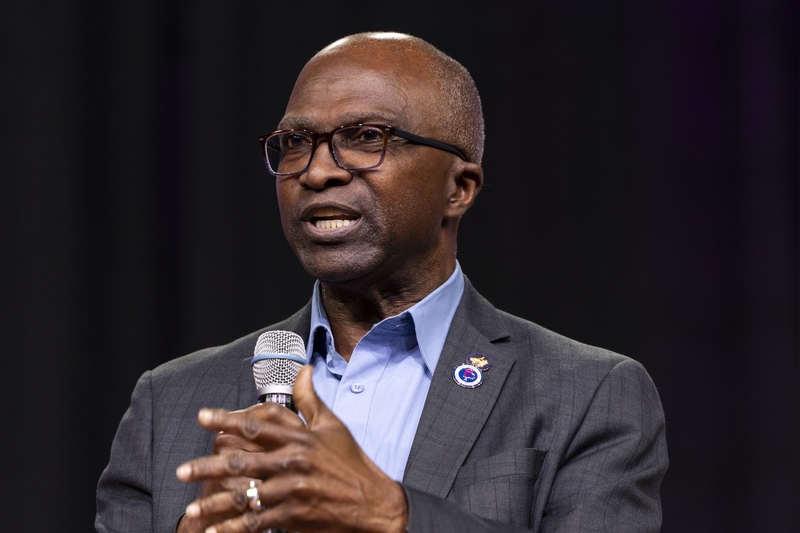
Mapp, who said his criticism is not aimed at Hamawy’s Muslim faith and said religion should “never be used as a political weapon,” said Hamawy’s military service and his treatment of 9/11 victims do not discount his past associations.
Mapp said the other Democrats in the race lack the political courage to join him in criticizing Hamawy on this issue.
“The other candidates, they want to say things but they are afraid. If you want to be a leader, you can’t lead from behind,” he said.
Micah Rasmussen, the director of the Rebovich Institute for New Jersey Politics at Rider University, said the attacks against Hamawy have largely failed to gain traction in part because they haven’t made it into paid advertising, but also because much of the district’s electorate is too young to have a visceral memory of Abdel Rahman.
“That’s always something you have to contend with. If you talk about something that happened 30 years ago, you’re missing everybody who’s under 50,” he said.
Rasmussen said a question he finds unresolved is not why Hamawy testified, but why he was drawn to Abdel Rahman in the first place, noting that the Muslim leader often spoke about jihad.
“That’s the question I don’t feel we understand enough about, why somebody who talked about jihad all the time was somebody who he felt compelled to travel with,” Rasmussen said.
Hamawy said voters are not focused on three-decade-old associations. He said no one has brought this up outside of right-wing media and “unfortunately, some of my opponents who have really nothing else to grasp on.”
“People are worried about affordability. They’re worried about healthcare,” he said. “They want to make sure that we unrig this economy, and that’s what I’m addressing.”
The winner of the Democratic primary will face Republican Gregg Mele in November. Mele is running unopposed in the GOP primary.

Trenton, NJ