These public safety laws passed the Colorado Legislature this year
May 21, 2026 | 6:00 am ET
Description
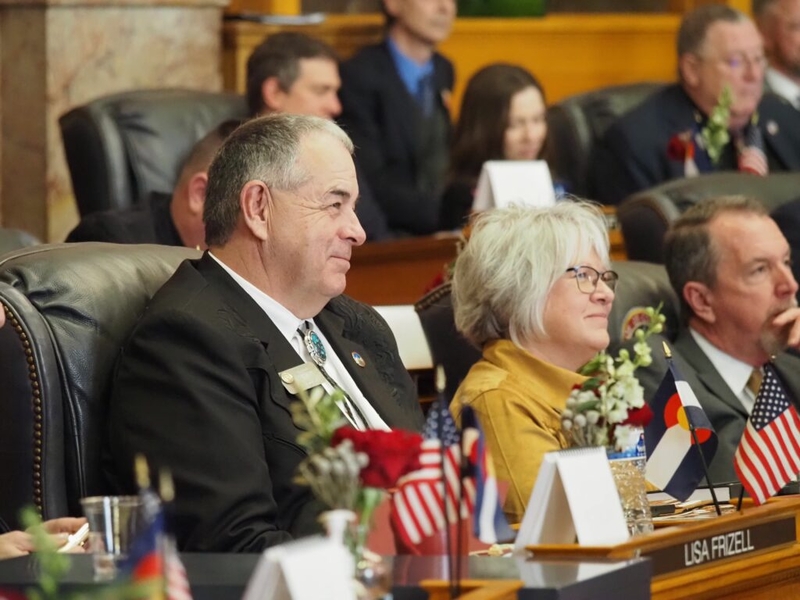
Colorado Senate Assistant Minority Leader Cleave Simpson, seen here last year at the Colorado Capitol, said this year's competency bill was a good example of "practical results instead of a partisan agenda." (Photo by Lindsey Toomer/Colorado Newsline)
Legislative leaders in Colorado from both parties praised the passage of a bill that would make a series of changes to the state’s competency process, a rare point of agreement as the two sides reflected on the most recent state legislative session.
“(Coloradans) are demanding accountability from their state government,” Senate Minority Leader Cleave Simpson, an Alamosa Republican, said at a press conference the day after session ended last week. “They’re demanding leaders focused on practical results instead of a partisan agenda. One really good example of this is Senate Bill 26-149.”
That bill is an effort to address how the state should treat people in criminal proceedings who are deemed unable, or incompetent, to understand the charges against them because of mental illness or developmental disabilities. If signed into law, it would create two new pathways for these individuals: civil commitments for people with mental health disorders and a new, enhanced protective placement for people with more serious neurological disorders.
Simpson continued: “That was a really important, bipartisan effort that recognizes a simple reality: Too many Coloradans are falling through the cracks between mental health services, public safety systems and community support. It took us almost the entire 120 days to get it done, but bipartisan support recognized a need.”
Colorado’s competency laws aim to confine defendants and provide treatment until they are no longer dangerous and can stand trial. The bill became a top issue after a pair of high profile cases in which people deemed incompetent by the court system had their cases dismissed because of current law. Judges can consider whether the defendant should be ordered to involuntary treatment, and the bill expands and focuses on that involuntary commitment.
The goal is to prevent the release of people from jail who are still extremely dangerous.
“We are addressing gaps in Colorado’s justice system to ensure people have access to the behavioral healthcare that they need and to keep our communities safe,” House Speaker Julie McCluskie, a Dillon Democrat, said in a statement after the bill passed the House. “Our legislation creates a new constitutional pathway for individuals who are unlikely to be restored and pose a risk, so they can access crucial behavioral health resources instead of being released. Modernizing treatment and coordination between agencies will improve our justice system and public safety across the state.”
Gov. Jared Polis has not signed SB-149, but he highlighted it as a success from the legislative session. He has a little over three weeks to sign bills into law or veto them. Other bills that passed this year concerning public safety include:
Lethality assessments
Another bipartisan measure was House Bill 26-1009. If signed into law, it would require law enforcement officers to consider the likelihood of serious injuries or death when responding to domestic violence calls. If they find the victim is at a high risk, the officer will need to refer the victim to a community advocate.
There is also an annual data reporting component. The bill passed nearly unanimously in both chambers.
Sexual abuse prevention in jails
House Bill 26-1123 comes after the revelation that a former La Plata County jail commander allegedly accessed surveillance footage to watch strip searches of over 100 women in the jail. He was charged with the crimes last summer, and a group of women sued the county over the issue in a federal class-action lawsuit in September.
“Recent incidents in Colorado jails have revealed serious failures to keep people in custody safe from sexual misconduct. This abuse cannot continue unchecked,” Sen. Mike Weissman, an Aurora Democrat, said in a statement when the bill passed the Senate. “This bill establishes clear standards for when strip searches can occur, restricts access to footage, and requires strict reporting. It also ensures real accountability for any officer who commits sexual misconduct. This bill is about restoring trust, safety, and accountability.”
If signed into law, the bill would require reasonable belief that a person is concealing drugs or a weapon for officers to conduct a strip search. That decision would be documented and only body-worn cameras, rather than overhead surveillance, could record the strip search. Those videos would be available to view only with sheriff approval and wouldn’t be viewable remotely.
An officer who sexually assaults someone in a jail or prison would have their certification revoked.
The bill was championed by the Colorado Coalition Against Sexual Assault.
Missing college students
Senate Bill 26-120 would require law enforcement officers to undergo missing person alert training in order to be certified. It would also require colleges and universities to immediately tell law enforcement or conduct a wellness check if they’re alerted to a missing person. If they do a wellness check and the person isn’t found after six hours, they would need to involve law enforcement.
Polis has not signed the bill.
Financial scams
House Bill 26-1110 would let banks pause transactions for additional review and notify authorities if they suspect a person is a victim of financial exploitation. FBI data shows that scammers stole more than $243 million from Coloradans in 2024, including $74 million from older people.
“Banks, credit unions and other financial institutions are well-positioned to notice when a withdrawal or transfer looks suspicious, allowing them to step in when they think their client is being scammed,” Rep. Sean Camacho, a Denver Democrat, said in a statement when the bill was going through the House. “Our bill fights back against financial exploitation, protecting Coloradans from being scammed out of their hard-earned money.”
Petition for resentencing
Under Senate Bill 26-115, there would be a three-year window for some people in prison to ask for a resentencing hearing. It would apply to people at least 60 years old who have been in prison for at least 20 years. As introduced, the bill also would have applied to people who committed a crime before they were 21 years old.
The petitioner would need to prove to a judge that they are no longer a danger to the community. There are 98 people in the state whom the bill would cover. Polis has not signed it.
Denver, CO