New Mexico ski industry eager to see if El Niño can still deliver
Nov 27, 2026 | 9:46 am ET
Description
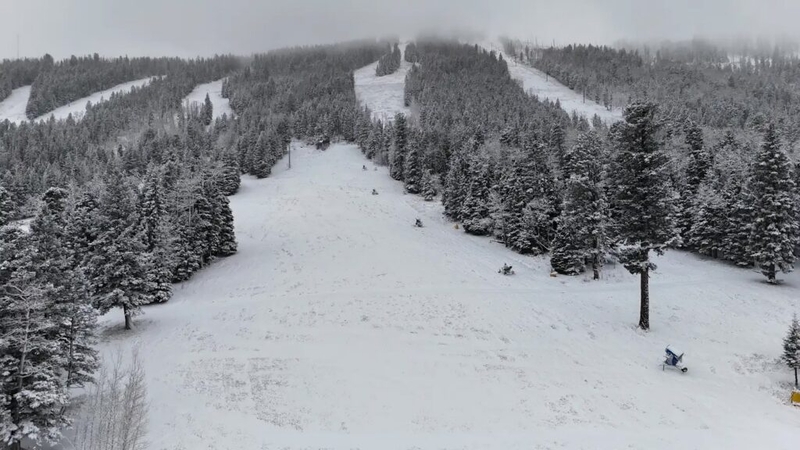
An aerial view of Pajarito Mountain after overnight snow, with freshly whitened trails cutting through snow-covered forest.
(Photo courtesy of Pajarito Mountain)
As the first dustings of snow reached New Mexico’s mountains, ski area staff, skiers and snowboarders have become increasingly optimistic about the possibilities of plentiful snowpack as they readied resorts to open on or near the Thanksgiving holiday weekend. After two lean years, ski area managers, in particular, eagerly await a change in the weather and look hopefully to what El Niño-Southern Oscillation, or El Niño, might bring. Historically, the pattern favors stormy winters in the Southern Rocky Mountains.
“Everything looks really good and everyone is agreeing that this could be a winter of winters,” said Jasen Bellomy, general manager of Pajarito Mountain Ski Area, outside Los Alamos.
But climate researchers caution that other forces in play — namely, increasing global temperatures — could tamper with how well this El Niño matches its predecessors. The results matter for ski areas looking to open terrain and lure guests with the promise of powder days, but also for everyone downstream hoping that snowpack might provide temporary reprieve from the drought that’s been wringing out the Southwest for decades.
“El Niño tends to bring wetter winters to the Southwestern U.S., but warming may change what that extra precipitation means on the ground,” Andy Hoell, research meteorologist with the National Oceanic and Atmospheric Administration Physical Sciences Laboratory, wrote in response to emailed questions. “Warmer temperatures mean more of it falls as rain instead of snow, snowpack melts earlier, and more water evaporates from soil and reservoirs.”
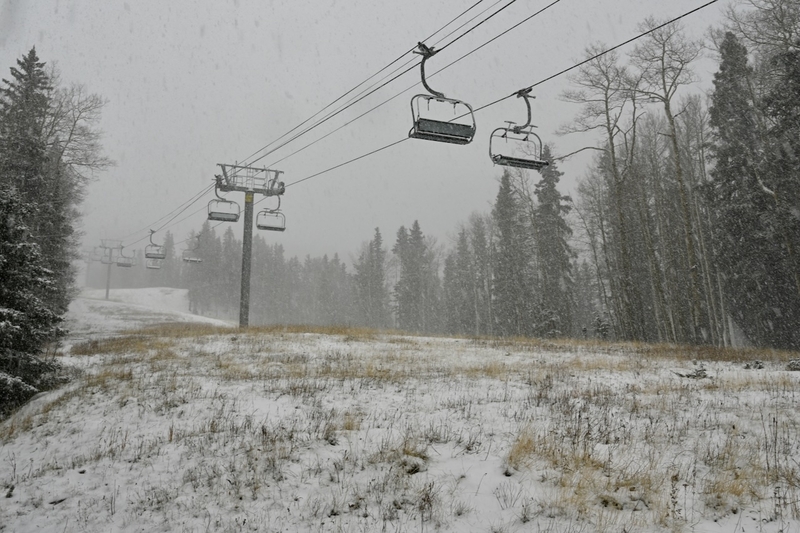
(Photo by Elizabeth Miller)
Last winter, New Mexico saw record low snowfall for the second winter in a row. A high-pressure ridge blocked moisture from reaching the mountains and allowed warm air to gather, according to Julien Ross, the New Mexico forecaster for OpenSnow, a weather service focused on connecting skiers with powder days. New Mexico reported its warmest winter on record. Rain fell in places that historically would have seen snow.
“Last year, we kept waiting for that storm, and it didn’t come and didn’t come,” Christy Germscheid, executive director of the nonprofit trade organization Ski New Mexico, said. “We couldn’t even make snow, it was so warm.”
Skiers and riders caught the news stories about no snow in the Rockies, and visitation dropped by 17% from the 2023-24 winter, according to Ski New Mexico. That meant jobs lost and tourist dollars failing to appear at local restaurants, hotels, stores and transportation services in an industry that generated $600.6 million in the record-setting 2023-24 season. So, Germscheid, who lives near Angel Fire Resort, was encouraged to see the temperature at 34 degrees Fahrenheit at 4 p.m. in early November. The October and early November rainstorms that soaked the state resembled the way El Niño drives winter storms, Ross said, a sign that the pattern was setting up as expected.
“Even when we don’t have a banner snowfall year, there’s still great skiing and it’s still great to get out in the mountains,” Ross said. “But of course, we’re all hungry for a really banner snow year and kind of hope this is the one.”
Forecasting the future relies on the past. For El Niño, meteorologists look to historical “analogs,” or previous years when conditions set up similarly to what buoys, floats and satellite data have observed in the Pacific Ocean this year. But several of the analog snow years for this season date to the 1970s and 1980s, and since 1970, average annual temperatures in New Mexico have increased by 3.7 degrees Fahrenheit. Four of the 10 warmest winters on record have occurred since 2000.
Climate models differ on whether those analog years will offer relevant comparisons or if global warming will scramble the signals, said Jeremy Klavans, a climate scientist at the University of Miami who has studied how global warming affects El Niño. NOAA’s latest seasonal temperature outlook called for near-normal temperatures in New Mexico in December, January, and February, but climate scientists still have questions about these interactions.
“The balance between global warming and El Niño, it’s going to teeter on that line,” Klavans said. “It’s really hard for us to answer that question: Is it going to be 33 degrees and everything’s going to come as rain or is it actually going to be freezing?”
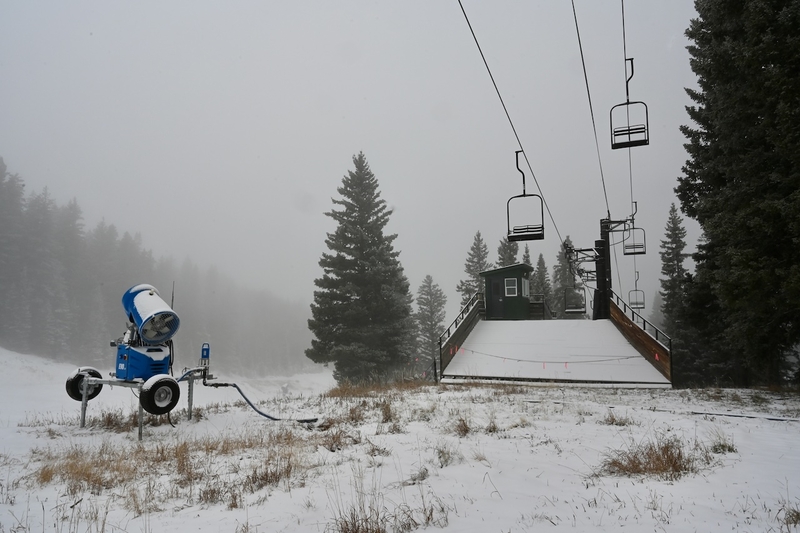
(Photo of Ski Santa Fe by Elizabeth Miller)
High elevation lowers the temperatures at several ski areas, including Ski Santa Fe and Taos Ski Valley. For lower-elevation and more southern ski areas, such as Sandia Peak Ski Area, Ski Apache and Sipapu Ski and Summer Resort, whether temperatures will be cold enough for the light powder skiers crave remains an open question.
El Niño begins changing the weather with a 0.5-degree Celsius increase in ocean temperatures. In November, the National Weather Service reported the relevant portion of the Pacific Ocean was 4 degrees Celsius warmer. The sizable temperature difference means this “super” El Niño could resemble some more recent analog years like 1983 and 1997, Klavans said. Essentially, this El Niño is strong enough to override some regional changes that are making for a hotter, drier Southwest, he said, including the shifts in wind patterns that have driven storms, and with them, moisture, away from the Southwest for the last 30 years.
But even if this winter does see heavy snowpack, the region will likely continue to see less precipitation, as it has since the 1990s. In years to come or with weaker El Niño events, global warming is poised to win.
“We’re still amidst this declining precipitation trend,” Klavans said. “When we look back 10 years from now, we’ll see a nice blip of a hopefully good ski season, a hopefully wetter winter, but it will look like a blip in that trend.”
A single wet winter won’t significantly ease longer-term impacts from drought, including low reservoir levels and depleted aquifers, said Andrew Mangham, senior service hydrologist with the National Weather Service. The region needs several years in a row of persistent summer and winter moisture to make those gains. The National Weather Service expects El Niño to linger just until March.
At this point, few ski areas in New Mexico are willing to run on faith in nature alone. Ski areas are spending between $300,000 and $500,000 each year on snowmaking equipment and infrastructure upgrades, according to Ski New Mexico, manually replacing what may no longer reliably fall from the sky. This winter, that includes Pajarito, which was able to firm up a Nov. 27 opening day in part by adding snowmaking to 11 trails. The increase is expected to double the number of days the ski area’s chairlifts run, but more critically, without it, Bellomy said, Pajarito would likely soon cease to operate.
“Obviously, the climate crisis is real and it is existential to our business, so we have to figure out how to adjust,” said Rebecca Hagler, senior resort marketing manager with Taos Ski Valley, which now has snowmaking on 99% of its beginner and intermediate terrain.
So, skiers will enjoy it while they can. Conditions look to be setting up like the 2023-24 winter, which brought 36 inches of snow to Taos Ski Valley in just 24 hours. That news has Hagler hoping to ski a favorite run that hasn’t opened in two years.
“We’re excited about the possibility, and that big, deep, light desert powder that has been sparse,” Hagler said. “The hype is absolutely very real.”
Santa Fe, NM