Mason County data center named one of biggest potential polluters in the US
Nov 27, 2026 | 6:00 am ET
Description
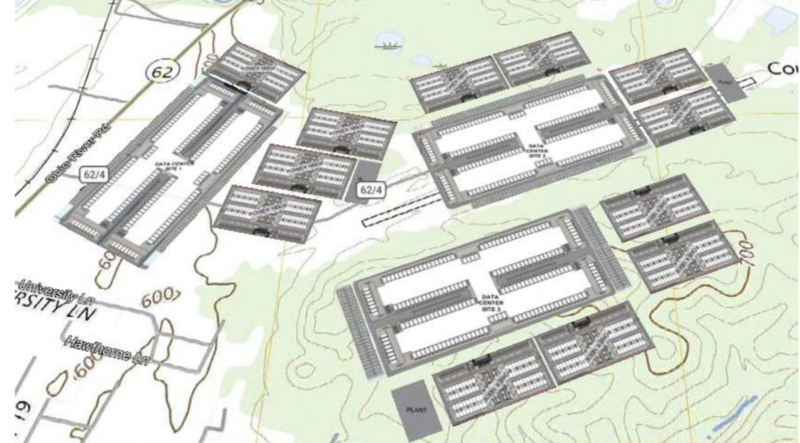
The site map for the Monarch Compute Campus data center in Mason County, West Virginia. Nscale expects the data center to be in operation in January 2027. (Photo courtesy of the West Virginia Department of Environmental Protection)
The Mason County Monarch Compute Campus could be one of the most polluting data centers in the country, according to a recently released report by the Sierra Club.
The data center, located next to a house subdivision, could produce 11 million tons of CO2, more than 600 tons of “hazardous air pollutants” and nearly 300 tons of formaldehyde, according to the report called “Artificial Intelligence, Real Pollution: How Data Centers Became a Top Climate Threat.”
Elaine Matheny, an organizer with Mason County United, said the pollution emitted from the data center could exacerbate health issues for those living in the area.
“We are concerned. The health risks are obvious,” she said. “People with asthma, people with breathing problems, COPD, they’re all going to be going to the doctor more.”
Matheny also warned that the pollution won’t be limited to the immediate area around the data center, which has already experienced flooding during construction.
“It’s going to be a very hazardous project to the area and beyond,” she said. “Ripley, Ravenswood. I don’t think the people living around here realize how it’s going to affect Point Pleasant, which is not very far.”
Nscale, the developer of the data center, did not reply to a request for comment Wednesday.
Nicholas Preservati, director of the West Virginia Office of Energy, said the emissions cited by the Sierra Club only reflect a scenario where the data center is operating at full capacity.
“The numbers in the Sierra Club report come from the maximum emissions allowed under the facility’s draft air permit, not from actual operations,” Preservati said in a statement. “Those maximums are inline and in some cases below what existing power plants already emit. Even so, the Sierra Club acknowledges there are limitations to their study.”
The Sierra Club sourced its information through air permits filed with the state and based on the assumption that the data center will be used at 90% of its capacity.
The report warns that CO2 emissions, accepted by most scientists as the cause of climate change, are projected to increase because data centers are reliant on natural gas, on-site diesel generators and coal fired plants to run.
The report predicts that if data center development keeps its pace, any gains at reducing greenhouse gas emissions over the last 15 years will be erased in the next three years.
“This report is not an argument about the ethics of AI; it is about how the machines behind it are powered and how those decisions will impact our future, unless we enact guard expediently,” the report states. “It is a call to affirmatively stop locking in fossil fuels before it is too late.”
The Monarch Campus will run on more than 800 gas-powered turbines, according to the report.
Preservati said the health concerns need to be viewed in the context of the bigger picture of health in the Mountain State.
“West Virginia has some of the highest rates of heart disease, diabetes and drug overdose deaths in the nation,” he said. “Any serious discussion about the long-term health of West Virginians must also consider the effects of poverty, unemployment and a lack of economic opportunity.”
“We can change that through economic development. More good-paying jobs mean more West Virginians can support their families and more resources to improve healthcare, provide clean drinking water and fix our aging infrastructure,” Preservati added.
Matheny said her group has been showing up at West Virginia Department of Environmental Protection hearings and speaking and monitoring the construction site to report any violations they see.
She said the data center could use less harmful power generation means, but the legal landscape created by House Bill 2014, the state’s data center law, has stripped people from pushing for that.
“There’s alternatives, but we have no right and no vehicle to even comment before this all started,” she said. “That’s really been the thing that has most people angry.”
Preservati pointed out that HB 2014 doesn’t exempt data centers from following state and federal environmental guidelines.
“Anyone who wants to build in West Virginia must still meet every state and federal environmental permitting requirement,” Preservati said. “The state has reviewed Monarch’s air quality permit application and preliminarily determined that it meets all applicable requirements. Any future projects will undergo the same thorough review.”
Matheny noted the fight against the data center has turned out people from across the political spectrum, from libertarians to liberals. And she believed that’s why the two delegates representing Mason County lost the county.
Del. Jonathan Pinson and Del. Jim Butler, who both voted in favor of HB 2014, were able to retain their seats by winning slivers of neighboring counties they represent. Following the election, Butler lamented during a presentation at the November Interim session of the Legislature that the biggest issue is communication with the public.
“I’m skeptical of all the economic development stuff, but when I see something that’s going to work and I buy into it, I’m sticking with it, and I’m sticking with the decisions we’ve made here,” he said.
But HB 2014 contributed to the wins of several Democrats across the state, including delegate-elect Lucia Valentine in Berkeley and Jefferson counties. She’s representing a district that borders the Penzance data center.
Valentine said she doesn’t have specifics at the moment, but she anticipates introducing legislation to address pollution and other issues.
“In addition to restoring local control over projects, we need protections for air quality and public health,” she said over text message.
While Republicans haven’t been vocal on the potential pollution issues surrounding data centers, a few high ranking members are beginning to second guess the legislation.
Last week, Treasurer Larry Pack announced his legislative priorities for 2027. The Treasurer included reforms to the taxation portion of HB 2014, which diverted tax monies that typically go to counties into state coffers.
He also said other portions of the bill should be revisited, too.
“There’s no question that I believe there needs to be more transparency. There needs to be local input,” Pack said.
And Tony Hodges, the co-chair of the West Virginia Republican Party, posted on X that President Donald Trump had said, “make them pay your community” in regards to data centers.
“He did not say make them pay your state. He said make them pay your ‘community.’ House Bill 2014 has a glaring mistake. It must be fixed,” he posted.
Charleston, WV