Former Kansas educator gets help with 1st Amendment lawsuit tied to support for transgender rights
Nov 27, 2026 | 8:50 am ET

Description
Attorneys representing former Edwardsville Elementary School paraprofessional Barbara Williams filed an amended First Amendment lawsuit challenging her March 6, 2026, firing for raising transgender rights issues with state Rep. Carolyn Caiharr, R-Edwardsville. (Kansas Reflector/Submitted)
TOPEKA — A national organization advocating for secular public schools joined a civil rights lawsuit against the Bonner Springs-Edwardsville school superintendent who recommended dismissal of a paraprofessional for sharing views on transgender politics with a visiting member of the Kansas House.
Former aide Barbara Williams was disciplined for criticizing Republican Rep. Carolyn Caiharr’s support for anti-transgender legislation mandating people use restrooms aligned with their sex assigned at birth when in public facilities. In the March exchange between Williams and Caiharr before classes began at Edwardsville Elementary School, Williams repeatedly told Caiharr “trans rights are human rights.” Williams also objected to the state devoting public tax dollars to private schools.
Caiharr, who serves in the House and as the mayor of Edwardsville, was at the elementary school to judge a door-decorating contest related to Read Across America. In two brief conversations that Williams estimated lasted approximately five minutes, and beyond earshot of students or parents, the paraprofessional raised the transgender and private school issues with Caiharr.
“Ms. Williams did not shout, use profanity, threaten anyone or block Representative Caiharr’s path,” the amended lawsuit says.
Superintendent Richard Moulin issued a formal letter the same day, March 6, suspending Williams without pay and recommending the school board terminate her employment. The school board voted three days later to dismiss Williams.
In the letter, Moulin said Williams was disciplined for “expressing personal opinions” to a “community guest” and the paraprofessional’s conduct was harmful because of “its impact on the integrity and reputation of the district.”
In August, Williams filed a wrongful termination lawsuit. The American Humanist Association, in conjunction with Lawrence attorney Max Kautsch, filed an amended complaint Tuesday on behalf of Williams in U.S. District Court. The revised version of the lawsuit claimed the school district violated Williams’ First Amendment right to expression and her 14th Amendment right to due process.
The updated complaint dropped Unified School District No. 204 board members from the case, but alleged the superintendent unlawfully retaliated against her and fired her for sharing opinions with a legislator before school instruction had began.
Amitai Heller, legal director with the American Humanist Association, said U.S Supreme Court precedent clarified public school employees didn’t lose all of their free speech rights by accepting a job. An off-the-clock educator has the right to express opinions on LGBTQ+ rights with a visiting legislator given the Supreme Court’s determination a public school football coach had the right to pray at the 50-yard line after a game, Heller said.
“No one should be fired for participating in the democratic process,” said Alexandria Huiskens, staff attorney with the American Humanist Association. “Telling a lawmaker how you want them to govern during your off hours is quintessential First Amendment speech. The district fired Ms. Williams because they didn’t like her message, and that’s precisely why the Constitution protects it.”
In court documents responding to the original version of Williams’ lawsuit, defense counsel Gregory Goheen said none of the plaintiff’s claims was viable.
Goheen said Williams was terminated by the school board in accordance with state law. That action didn’t trample on Williams’ freedom of speech guaranteed by the U.S. Constitution, he said.
“Plaintiffs’ rights under the First Amendment, as a public education teacher, are limited when she is acting in the course and scope of her employment,” the school district’s response said. “This action is frivolous and insubstantial, having been filed without probable cause or reasonable investigation, entitling defendant to its costs, including reasonable attorneys’ fees, incurred in defending this action.”
Williams, who defines herself as a humanist, said she believed in equal treatment of transgender people and the value of public institutions.
“In that moment this past March, in the presence of a lawmaker who has taken action to undermine my beliefs in the past, it felt morally and ethically paramount that I speak up and say something,” Williams said. “Silence was not an option. I filed this lawsuit because I don’t want to see the district punish anyone else for exercising their freedom of speech.”
Williams was employed at Edwardsville Elementary School from fall 2024 to March 2026 as a paraprofessional in a behavior support classroom program.
Caiharr, who won a full term in the Kansas House in the November election, was appointed to serve as a state representative in 2025.
During the 2026 legislative session, Caiharr voted for Senate Bill 244, which requires Kansans to use restrooms in public facilities that corresponded to the individual’s sex assigned at birth and to list their designation at birth on a Kansas driver’s license. Democratic Gov. Laura Kelly vetoed that bill, but the Senate and House, with Caiharr’s support, overrode the governor.
Caiharr also voted for House Bill 2468 to increase the cap on state tax credits obtained by making donations to private school scholarship funds. The governor vetoed the legislation.
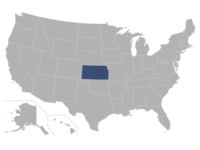
Topeka, KS