Voter turnout surged in many states in the midterms, but not in Arkansas
Nov 27, 2026 | 6:00 am ET
Description
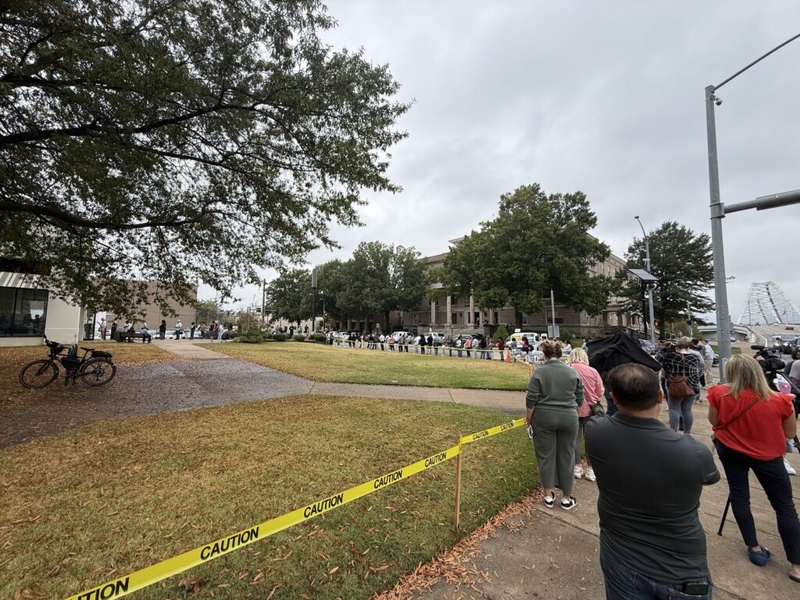
A line of voters wait to cast a ballot on the last day of early voting at the Pulaski County Regional Building in Little Rock, Arkansas on Monday, Nov. 2, 2026. (Photo by Ainsley Platt/Arkansas Advocate)
The story of the 2026 midterm elections was defined in part by increases in voter turnout, especially in the South.
Voters angry at persistent affordability issues and mid-decade redistricting that broke up several majority-Black congressional districts showed up at the polls, driving historic Democratic gains in traditional Republican strongholds like Mississippi, Texas and South Carolina.
Arkansas told a somewhat different story.
No statewide or federal offices flipped blue, with Democratic gains limited to legislative and local races. While some areas saw increases in turnout, an analysis of Arkansas’ election data shows voters generally stayed home more than they usually do during midterms, which already see lower turnout than presidential election years.
The Arkansas Advocate’s analysis used election data provided by the Arkansas secretary of state’s office. It compared turnout in 2026 to the 2022 midterm election, and the two major political parties’ share of votes in this year’s U.S. Senate race to the 2024 presidential election.
Here are three things that stood out:
Top Trump-winning counties stayed home
The drop in turnout was especially pronounced in some counties that voted for Republican President Donald Trump by the widest margins in 2024. Three of the five counties with the largest drop in turnout compared to 2022 were among the top five counties who voted for Trump by the widest margins in 2024.Searcy County, which gave Trump 85.4% of the vote in 2024, saw its midterm turnout drop from 55.5% in 2022 to 38.8% in 2026’s general election. That amounted to the largest percentage drop among Arkansas’ 75 counties, and was only 1 percentage point above turnout in March’s primaries. Primary turnout is generally lower than turnout during a general election.
Laurie Gross, the former Republican commissioner on the Searcy County election commission who was decertified by the state board of election commissioners last year due to issues with the procurement of equipment used during the 2024 election, said there weren’t many races on the general election ballot that people cared about.
Gross said she suspected county voters had little interest in the federal and statewide races. There were the national issues, such as the war in Iran, that could have been a factor, but she said locals also remained bitter over legislation signed by Republican Gov. Sarah Huckabee Sanders that restricted local government’s ability to regulate cryptocurrency mines.
“Searcy County is kind of unusual in that we are a red county, we’re very Republican, but our voters are more … independent-type voters than they are hardcore Republican voters,” Gross said.
The same could be said for many of the rural counties in hilly north Arkansas, Gross noted. But the former election official said she couldn’t say definitively why her county stayed home more than usual this year.
“There’s no way to know why somebody didn’t vote unless you ask the person who didn’t vote,” she said.
Northwest Arkansas Democrat wins accompanied by thousands of new voters on rolls
Despite earning a larger share of cast votes in every county in this year’s Senate race than they did in 2024’s presidential contest, Democrats’ gains were confined to the Legislature — though they came close to flipping U.S. Rep. French Hill’s central Arkansas congressional seat. Those gains were concentrated in northwest Arkansas, with other pick-ups in central Arkansas and Jonesboro.
Increases in voter registration could be seen in many of the areas where Democrats flipped seats. Benton and Washington counties, where tens of thousands of voters have been added to rolls since 2022, were the epicenters of Democrats’ 11-seat gain in the Legislature. The two counties saw some of the sharpest leftward swings in the state.
“We’ve had pretty much a steady growth” in voter registration over the years, said Dana Caler, a longtime elections administrator for Benton County. That was especially true in the smaller cities and suburbs.
“We were actually a little lower on our turnout this year,” she added, referring to a midterm year.
Faulkner County, the home of a Republican-held state House district that flipped blue, gained 1,449 voters over the same period. Craighead County, where Democrats flipped another seat, saw a gain of 1,212 voters.
Turnout gains in south Arkansas come with caveat
Arkansas counties along the Mississippi River were among the few that saw modest gains in turnout — though accompanied by sharp drops in the number of registered voters.
Voter turnout is calculated by dividing the number of ballots cast in a county by the number of registered voters.
Desha County was one of two counties that flipped Democratic in 2026 after voting for President Donald Trump in 2024. Forty-nine percent of the county’s registered voters cast a ballot in 2026, compared to 44% in 2022.
The former chair of the county’s Republican Party, Jamie Sims, said in an email that he was saddened by the flip. Sims, who resigned as chair in September after moving to a different part of the state, said local races for county judge and clerk likely contributed to turnout there.
But there were also far fewer registered voters in the first place.
Like many rural counties in Arkansas over the last two decades, Desha County’s population has continued to shrink, with the average age of its residents increasing from 38.3 years in 2010 to 41.6 in 2024. Since 2022, when it had 7,100 people registered to vote, the county shed more than 1,000 voters from its rolls.
But because there were only 222 fewer ballots cast in the county in 2026 compared to 2022, according to unofficial data from the secretary of state’s office, the voter turnout still moved upward.
Similar drops in voter registration, accompanied by a much smaller decrease in the actual number of votes cast, could be seen in other Delta and south Arkansas counties where turnout was higher. In Union County, voter rolls shrank by more than 2,500 — but only saw 289 fewer ballots cast.
Crittenden County lost a similar number of registered voters, but saw 231 more people cast votes in 2026 compared to 2022.
Little Rock