175 years later, researchers retrace the making of Indiana’s Constitution
Nov 27, 2026 | 5:00 am ET
Description
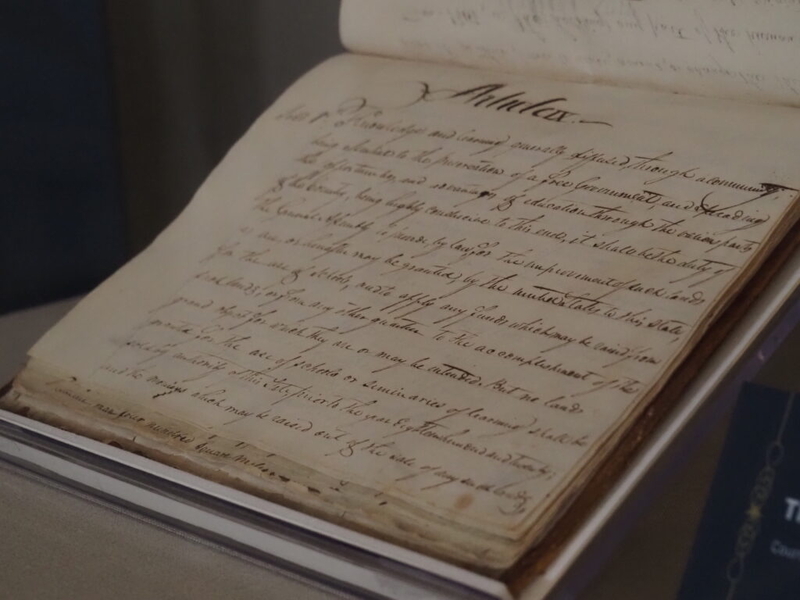
Indiana's first constitution was drafted in Corydon in 1816, ahead of Indiana's admission as the nation's 19th state. It remained in effect until voters ratified a new constitution in 1851. (Photo by Jack Forrest/Indiana Capital Chronicle)
On this day in 1850, Indiana’s constitutional delegates narrowly approved a measure guaranteeing women’s property rights — only to reverse their decision less than three weeks later.
It’s one of countless twists in the writing of Indiana’s 1851 Constitution that an international team of researchers is now reconstructing through a new digital tool.
The effort, known as the Quill Project, brings together researchers from the University of Oxford’s Pembroke College in England and Utah Valley University’s Center for Constitutional Studies to examine how constitutions and other historic documents were negotiated.
Their work in Indiana transforms more than 3,000 pages of records from the state’s second constitutional convention into an interactive timeline, allowing users to follow proposals through successive amendments, committee deliberations, debates and votes.
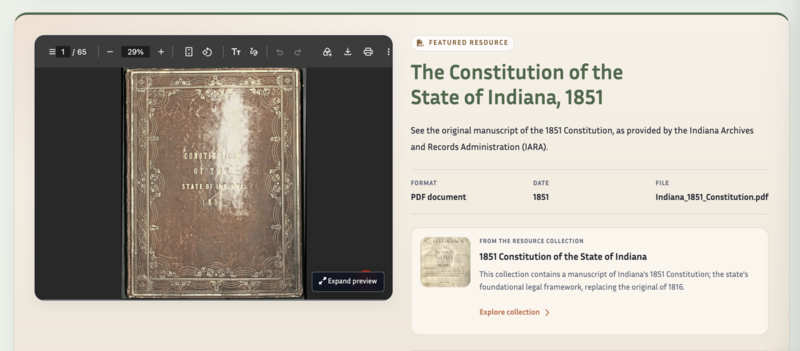
For historians, attorneys, judges and curious Hoosiers alike, the free online platform offers a way to explore not only how Indiana’s governing document came to be — but also how differently it might have read.
Researchers demonstrated an early version of the Indiana project this month at the Indiana State Archives in downtown Indianapolis as part of a constitutional symposium commemorating the 175th anniversary of the state’s second constitution.
The digital reconstruction is about 80% complete. Official publication is expected in spring 2027.
“If you’re interested in why a particular state constitution reads a particular way, this project is about letting you explore the process whereby delegates decided that a particular provision would say one thing and not another,” said Nicholas Cole, director of the Quill Project. “[It shows] the range of options they considered, and also sometimes what their blind spots were.”
Rewriting Indiana’s Constitution
Indiana was not yet 34 years old when 150 men assembled in the House of Representatives chamber of the old Statehouse in Indianapolis on Oct. 7, 1850.
The state had changed considerably since its first constitutional convention in Corydon in 1816. Its population had grown from about 64,000 to nearly 1 million, and Indiana was struggling with debts incurred through ambitious public works projects.
Between 1820 and 1847, Hoosiers made 15 attempts to call a convention to rewrite the Constitution. Voters finally authorized a new convention in 1849 and elected delegates the following year.
Of the 150 men selected, 95 were Democrats and 55 were Whigs. Farmers made up the largest occupational group, followed by lawyers. The delegates also included physicians, merchants, teachers, a carpenter and a baker, according to the Indiana Historical Bureau.
Story continues below.
Just 13 had been born in Indiana. Nearly half were born in slave states, and six were born outside the United States, according to a contemporary newspaper account compiled by delegate Schuyler Colfax.
The delegates chose George W. Carr, of Lawrence County, to preside over the convention. They initially met in the Statehouse, completed in 1835 on the site of the present-day Capitol, before relocating to Indianapolis’ Masonic Hall to accommodate the upcoming legislative session.
Over four months, delegates introduced 333 resolutions and drew inspiration from the constitutions of other states, particularly Illinois and Wisconsin.
Their work culminated in a document containing 16 articles that, among other changes, restricted state borrowing, limited legislative sessions and required lawmakers to establish a statewide system of tuition-free common schools.
The convention’s final meeting began at 6 a.m. on Feb. 10, 1851. Just 79 delegates were present as the completed Constitution was read aloud and Carr delivered his farewell address.
Two days earlier, delegates approved an address to Indiana voters: “We have completed the task assigned us; and now lay before you the results of our labors.”
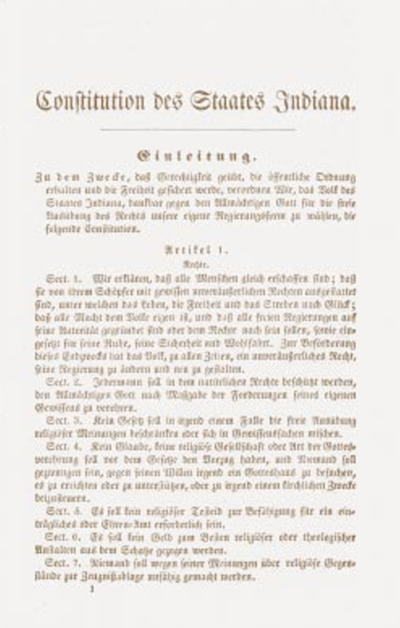
In preparation for a statewide vote, delegates ordered 50,000 copies of the proposed Constitution printed in English and another 5,000 in German.
Hoosier voters ratified the document in August 1851, and it took effect Nov. 1 of that year. It remains Indiana’s Constitution today, although voters have approved dozens of amendments — including two earlier this month concerning bail and residency requirements for local judges.
Piecing together thousands of pages
Much of what is known about the convention’s deliberations might have been lost had delegates made a different decision early in their proceedings.
Jefferson County delegate Milton Gregg objected to the expense of hiring a stenographer to record the debates. But Robert Dale Owen, a former congressman from New Harmony, argued that publishing the discussions would be of interest to Hoosiers and help explain the meaning of the new Constitution.
Delegates ultimately agreed to have their debates recorded — a decision that, nearly two centuries later, is central to the Quill Project’s work.
Researching individual clauses in those records “is kind of like reading an old choose-your-own-adventure book, where you’re having to flip between back and forth between pages,” said Bethany Jedlicka, a senior documentary editor with Quill. “They amended at one point, but to remember what that amendment is actually amending, you have to go back 100 pages earlier.”
That same provision might come up for discussion on several different days, with additional revisions in between.
Quill’s editors break those proceedings into individual events — the introduction of a document, an amendment or a vote, for example — and link them to one another and to the historical records.
Proposed additions appear in blue and are underlined, while deletions appear in red with a line through them, much like the track changes function in a modern word processor.
Sometimes, reconstructing a provision requires working backward from the final version and removing amendments one by one. Other times, editors work forward from the original proposal, only to discover that the recorded amendments don’t quite account for the language ultimately adopted.
“We are doing the legwork so that you users don’t have to,” Jedlicka said.
Indiana’s comparatively detailed records have been particularly helpful, said Maya Reilly, an Oxford-based documentary editor leading the Indiana project.
“The Indiana records have been a real pleasure to work with in comparison to some others,” Reilly said.
But the state’s drafting process also stood out. In other Midwestern constitutional conventions from roughly the same era, standing committees might have submitted 13 to 15 draft articles for consideration.
Indiana’s committees submitted 72 separate documents, Reilly said, ranging from individual sections to nearly complete articles.
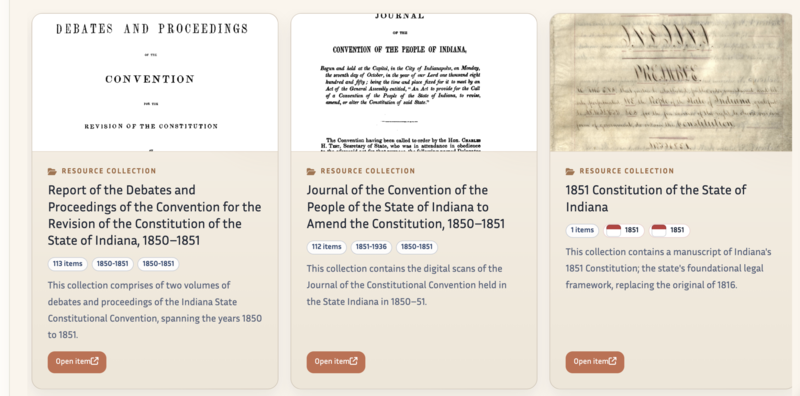
The new digital platform also brings together manuscripts of Indiana’s two constitutions, the convention journal and the recorded debates, with searchable transcriptions and downloadable copies of daily proceedings.
The constitutional protections that nearly were
Some of the most revealing moments in Indiana’s constitutional history, Reilly said, involve proposals that left no trace in the finished document.
Among them were repeated efforts to give married women greater control over their property.
Under prevailing laws at the time, husbands generally assumed control of their wives’ personal property, and married women faced considerable restrictions on their ability to independently manage their finances.
Owen emerged as a leading advocate for changing those laws during the convention.
Delegates wrestled with what kinds of property women should be allowed to retain and whether protections should extend to women who were already married or only those who married after the Constitution took effect.
The provision approved on Nov. 27, 1850, would have protected real and personal property that women owned before marriage or subsequently acquired through such means as inheritance, gifts or purchases.
It passed 66-59.
That victory lasted only 19 days, though.
On Dec. 16, delegates voted 84-43 to reconsider their earlier decision. The provision was subsequently defeated, 54-75.
The issue resurfaced in January 1851. Another proposal would have directed the General Assembly to enact laws protecting property belonging to married women, widows and orphans.
Delegates initially approved that provision, too, before reversing themselves.
In all, Reilly said, four separate proposals sought to establish property protections for women during the convention.
None made it into the Constitution.
“I think cases like this, where significant proposals were rejected from the final text and thus perhaps potentially neglected in the study of the constitution at large, are quite frequent,” Reilly said.
Decisions that still shape Indiana
Other provisions Reilly highlighted can be traced more directly to problems facing Indiana in the decades after statehood.
Among the most consequential were restrictions on state borrowing.
An extensive program of internal improvements undertaken in the 1830s — including canal construction — had left Indiana deeply in debt and pushed the state to the brink of financial collapse.
The delegates who convened in 1850 sought to prevent a repeat of that experience.
The resulting restrictions, written into Article 10 of the Constitution, generally prohibited the state from incurring additional debt, with limited exceptions for circumstances such as revenue shortfalls, interest payments on existing debt and providing for the public defense.
Using Quill, researchers can examine how the original proposal evolved and compare the language received by the convention’s revision committee with what ultimately appeared in the Constitution.
Indiana’s first constitution is home again in original state capital
But some provisions changed little over the course of the convention. Reilly pointed to Section 6 of Article 6, which addresses residency requirements for county and township officers, as an example of language that remained relatively consistent throughout the drafting process.
That same section was the subject of one of two constitutional amendments Hoosiers approved in the most recent midterm election, loosening residency requirements for city and town court judges.
Researchers can also explore provisions reflecting the racial exclusions of the era.
Although the Constitution’s first article established a broad declaration of individual rights, the original document limited voting rights to white men. Article 13 barred Black people from moving into Indiana. The provision was overwhelmingly approved by voters in a separate ballot question in 1851.
The Indiana Supreme Court declared the prohibition unconstitutional in 1866, and Article 13 was repealed in 1881.
The platform also allows users to explore the convention through its individual delegates, identifying their committee assignments and linking to debates, resolutions and amendments in which they participated.
Among them was Schuyler Colfax, who would go on to preside over the U.S. House of Representatives when it passed the 13th Amendment abolishing slavery and later serve as vice president under President Ulysses S. Grant.
Owen, the New Harmony delegate who championed women’s property rights, meanwhile, was associated with 224 events in the version of the model demonstrated earlier this month. Some delegates were associated with just two — when they joined the convention and when they left it.
Beyond the archives
Indiana’s project is part of a broader initiative supported by the National Historical Publications and Records Commission, a grant-making arm of the National Archives.
Researchers expect to publish seven projects in 2027 examining state constitution writing during the years surrounding the Civil War. Eventually, they hope to model constitutional conventions from all 50 states.
Quill’s work began more than a decade ago with the convention that produced the U.S. Constitution in 1787. It has since expanded to include federal constitutional amendments and other negotiated documents, including materials related to the Northern Ireland peace process.
Scott Paul, executive director of Utah Valley University’s Center for Constitutional Studies, said Quill’s research has already been used in federal court. A former student recently helped a federal judge in Florida examine an executive powers question by researching the proceedings of the 1787 convention.
Paul said the project can help researchers understand “what was really on the table,” rather than examining individual statements from the proceedings in isolation.
The platform assigns permanent identification numbers to individual events and documents, allowing attorneys and other researchers to cite specific portions of the proceedings. Editors are additionally developing a legal citation guide.
Utah Valley University is also developing three lesson plans aligned with Indiana’s social studies standards, primarily for eighth grade classrooms.
The Indiana project and its historical resource collections are part of Quill’s free online platform. Registration requires an email address.
Once the model is complete, users will also be able to start with the text of the adopted Constitution and work backward through the history of individual provisions.
“An amazing feature of Quill is that it not only showcases a document and its progression,” Reilly said of the platform’s ability to identify proposals that nearly became part of the Constitution. “I think when we look at an adopted text in isolation, we can perhaps be very aware of the absences and not what the conversations were internally — and that can perhaps get lost in the history of the convention.”
Indianapolis, IN