Pennsylvania food banks struggle to meet heightened Thanksgiving demand
Nov 26, 2026 | 4:29 am ET
Description
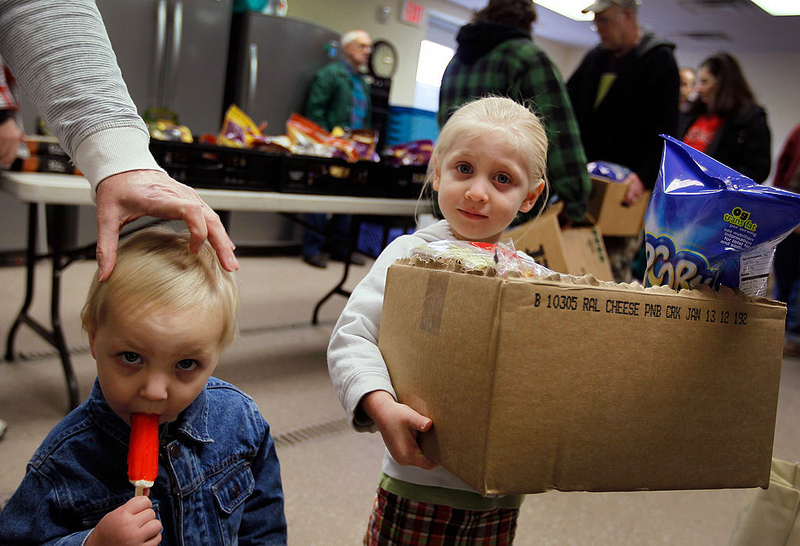
Two children help their mother pick up food from a food bank in Wilmington, Ohio. Some experts cautioned that Tuesday’s census data on poverty doesn’t reflect the effects of new federal policy changes that will be hitting households hard this year. (Photo by Joe Raedle/Getty Images)
Across the commonwealth, food banks and food pantries are helping struggling Pennsylvanians enjoy a Thanksgiving dinner.
But this year’s holiday has many organizations facing hard decisions. Cuts to federal programs like The Emergency Food Assistance Program and the Local Food Purchase Assistance Cooperative Agreement Program have made it harder for food banks to stock their shelves. And cost-of-living increases tied with cuts to programs like SNAP and Medicaid mean more people are relying on their services.
Still, for some in the charitable food system, Thanksgiving is an opportunity to provide their clients with everything they need to prepare a proper holiday meal for their friends and families.
“Just because somebody doesn’t have the means, doesn’t mean they shouldn’t be able to have the same family experiences, the same celebrations,” said George Matysik, director of the Share Food Program, which serves the greater Philadelphia region. “We want to provide the types of food that bring people together and bring people around the table. There’s no holiday that does that in the United States quite like Thanksgiving.”
Food banks across Pennsylvania are struggling to keep up in the face of SNAP cuts, economic pain
This year, the Share Food Program is providing more than 30,000 turkeys, chickens and other poultry products to households, distributed through a network of food pantries and partner organizations. Preparations began in the summer.
“I’ll tell you is it’s still not enough,” Matysik said.
For Jim Reece, executive director of Friend, Inc. CommunityServices, which serves northeast Berks County, it’s about providing dignity for people who had to make difficult choices in turning to the charitable food system.
“When [money] is so tight that the things that maybe some of us take for granted aren’t available to you, what a better gift than to at least allow these families to experience some of what we all take for granted,” he said.
Reece says Friend, Inc. focuses year-round on providing people who rely on the charitable food system dignity. One way they do that is through a self-service food pantry. Unlike many others, people can come in and select what they want off a shelf like a traditional grocery store. Reece says it both helps people feel comfortable and prevents waste.
“Asking for anything, much less asking for food, has got to be one of the most humbling things that there is,” he said. “We’re seeing people who are not destitute, but have finally gotten to a point where they’ve let their guard down. They’re between a rock and a hard place. At a lot of dual income households, that check is lasting until the beginning of the fourth week of the month.”
The Greater Pittsburgh Community Food Bank has found another way to help. For Thanksgiving, they partner with Pittsburgh television station KDKA for an annual Turkey Fund that helps pay for gift cards at local grocery stores.
“It really goes such a long way providing the level of dignity that we really strive for,” said Erin Kelly, the director of partner and distribution programs at the Greater Pittsburgh Community Food Bank. “It just speaks to the importance of people being able to have choice, and be in the primary food system buying foods that are appropriate for them and their families.”
The $25 gift cards that their clients get are meant to supplement the food they receive at food pantries or buy through traditional grocery stores.
Like others, Kelly noted that this year’s holiday is hitting at a time of increased need, driven in large part by increased costs and changes to federal safety net policies.
And that’s on top of the annual increase in traffic charitable food organizations see during the holiday season. Usually, there’s around a 27% increase between October and November, and the increased demand generally lasts through the winter.
“The reality of food insecurity is that a household’s food security status is often tenuous,” she said. “There are a lot of people who are food secure, but maybe only marginally. And then having an additional expense, whether it’s having to start heating your home, or preparing for winter holidays like christmas, or gearing up to have a bigger meal around thanksgiving — those are expensive. I think we all feel that personally.”
Kelly said the organization won’t be able to quantify the increase in households served this holiday season until around the end of the year, but they’re expecting a larger than usual number.
The organization’s on-site food pantry serves as many as 40,258 households. That’s not including the roughly 80% of the food they procure that’s sent to partner food pantries and organizations in the area.
“The current climate is just one of heightened anxiety around these safety net programs that people really rely on,” she said. “I think the current climate and changes to public benefits, especially the SNAP program, paired with increased costs of basic needs, is leaving people in a really tough spot.”
Matysik said one thing that helps is the increased awareness of food insecurity around the holidays. But he hopes that people remember hunger isn’t only a problem around the holidays.
“We need resources just as much in the summer time, when kids are home from school and not getting school meals, as they do in the holidays,” he said. “It’s just something for us to continue to work towards, having the type of attention that’s paid to it now paid year-round.”
Harrisburg, PA