State’s high court combines administration of two judicial circuits but holds off on full merger
Nov 23, 2026 | 6:41 pm ET
Description
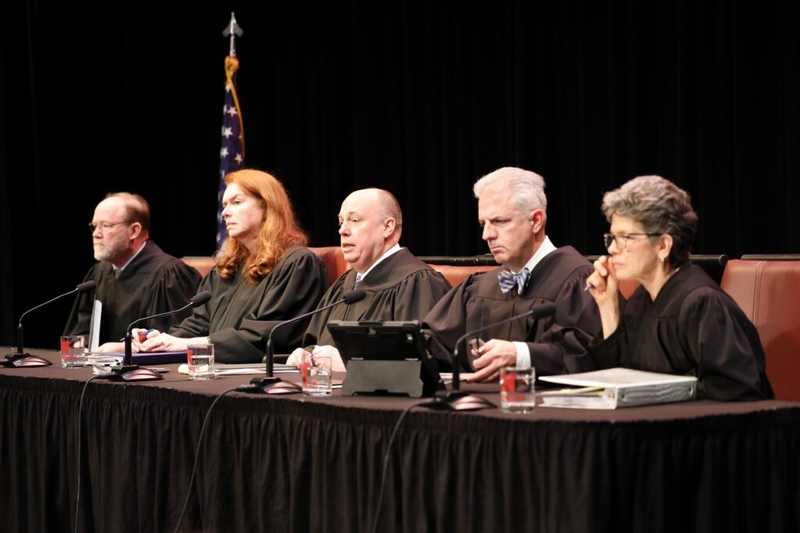
Members of the South Dakota Supreme Court hear oral arguments on March 19, 2024, in Aberdeen. On Monday, the court issued an order consolidating the administration of two judicial circuits, but holding off on a full merger. (Dave Bordewyk/South Dakota NewsMedia Association)
South Dakota’s Unified Judicial System will not fully merge two circuits to create the state’s largest by area.
At least not yet.
Instead, the borders of the 4th and 7th circuits will remain, as will each circuit’s judges, while the court system moves to consolidate administrative functions under a single team.
A state Supreme Court order issued Monday says the circuits will share a court administrator, as well as a chief clerk of courts and chief court service officer, the latter of whom will oversee two chief deputies.
The state will “continue studying” whether a more complete merger would make sense long-term, according to a press release from the State Court Administrator’s Office.
Opponents of South Dakota court consolidation say move would harm rural access to justice
The high court held a hearing earlier this month about the possibility of merging the two circuits.
The idea was first floated this summer and then discussed during local information sessions. The hope was to find efficiencies and save money on administration costs by creating a 12-county circuit to serve most of the population and cover more than half the land area on the western side of the state.
The Fourth Circuit includes eight counties. It includes the cities of Spearfish, Belle Fourche and Deadwood, but is otherwise largely rural and sparsely populated.
The 7th Circuit includes Rapid City, the state’s second most-populous city, as well as three counties with far fewer residents: Fall River, Custer and Oglala Lakota.
The latter county is within the Pine Ridge Reservation. The Oglala Sioux Tribe polices the area and has its own court system for misdemeanor crimes. Felony crimes within the borders of the tribe’s reservation are prosecuted in federal court.
At the Nov. 9 hearing, State Court Administrator Greg Sattizahn said 90% of the court business in the 12-county area covered by the proposed merger happens in Meade, Pennington and Lawrence counties. A merger could save the state $300,000 by repurposing staff, the Unified Judicial System said.
Opponents expressed reservations about the level of attention smaller counties might get in a merged circuit, and worried that smaller counties would have a weaker voice in judicial elections. Fourth Circuit Judge Eric Strawn compared resisting consolidation to “fighting smoke,” arguing that the state administrator’s office hadn’t pointed to specific inefficiencies in the current setup.
The Supreme Court’s Monday order says presiding judges in the 4th and 7th circuits “shall each continue to be responsible for the supervision, oversight, and scheduling of cases for all judicial officers and law clerks.”
The order directs the circuits to “develop a plan for implementation of uniform policies” for the clerks of court and court service officers, who will be overseen by the presiding judge in the 7th Circuit. The order says the plan should “balance workload needs and shift work as necessary between offices.”
The order also directs the circuits to “reallocate two court services officer positions through current vacancies or by attrition” to the 2nd Circuit, which includes Sioux Falls, by March 1.

Pierre, SD