NJ goes to court to defend anti-mask law targeting ICE agents
Nov 23, 2026 | 6:41 pm ET
Description
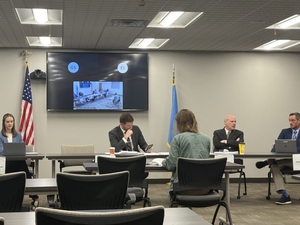
The Trump administration says New Jersey's law banning law enforcement officers from wearing masks is unconstitutional. Lawyers for New Jersey asked a judge to uphold it. (Photo by Ben Ackman/New Jersey Monitor)
CAMDEN — New Jersey urged a federal judge Monday to reject the Trump administration’s bid to block a new state law prohibiting law enforcement officers from wearing masks.
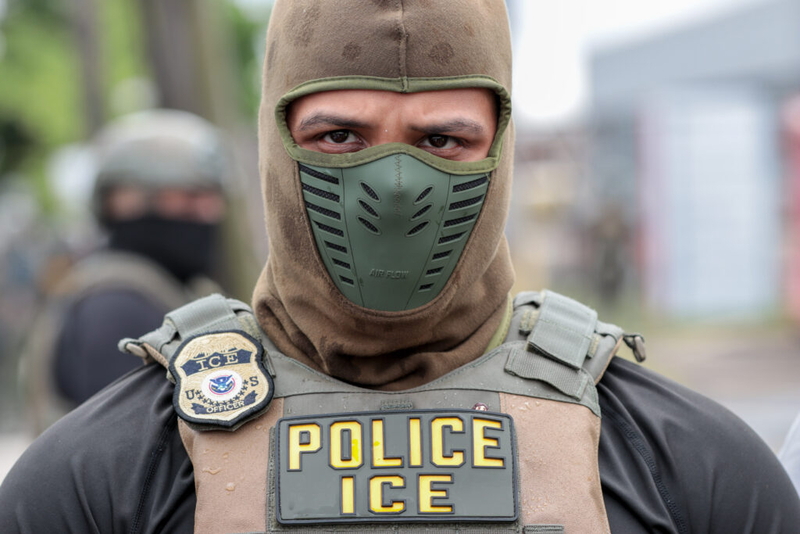
The law, which Gov. Mikie Sherrill signed in March, applies to all officers but passed last winter amid growing anger over U.S. Immigration and Customs Enforcement agents shielding their faces while carrying out President Donald Trump’s mass deportation effort.
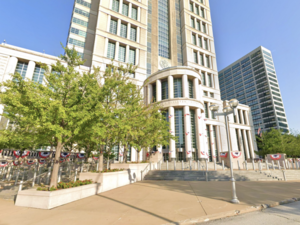
U.S. Department of Justice attorneys have argued — and did so again Monday during an afternoon hearing at the Mitchell H. Cohen Federal Building and Courthouse — that states cannot regulate the federal government. Banning federal officers from wearing masks unconstitutionally interferes with federal officers’ duties, Timothy Borgerson, counsel for the department, told Judge Renée Marie Bumb.
“The United States suffers an injury when the state attempts to write its personnel management policies for it. If the state of New Jersey was to write a law saying all federal officers have to wear pink always, that would be a substantial infringement” on the federal government’s sovereignty, Borgerson said.
That argument has proven persuasive to courts around the country, where the Trump administration has challenged similar mask bans in other states led by Democrats. Just hours before Monday’s arguments in Camden, federal judges struck down Virginia’s ban. Another judge tossed Connecticut’s ban Friday, and judges also have ruled against bans in New York and California.
With those losses looming large, New Jersey Deputy Solicitor General Stephen Ehrlich spent much of the 90-minute hearing trying to persuade Bumb that the law here is different and should stand.
He told Bumb New Jersey’s law contains exceptions for “every imaginable circumstance,” exempting officers working while undercover or on tactical operations, those who have been threatened with retaliation, and more.
“Our law is just different from the other laws,” Ehrlich said. “We have much broader exceptions than any other law that has been challenged and, frankly, narrower prohibitions.”
New Jersey officials have not enforced the law, making the feds’ April lawsuit against the law premature and preventing them from showing any “real-world harm,” Ehrlich said. Officers who argue that they have immunity from various laws typically do so after enforcement, he added.
“That’s how all immunities generally work,” Ehrlich said. “You don’t see police officers running into court and saying, ‘Give me immunity because I’m about to raid someone’s house.’”
But Bumb, an appointee of President George W. Bush, didn’t seem to be buying it.
She pushed back repeatedly on Ehrlich’s claim that the law defines “every imaginable circumstance” in which masking would be permitted, throwing out scenarios not mentioned in the law that might prompt an officer to reach for a mask. She also singled out one exception in the law that allows masking to protect officers from smoke during a state of emergency.
“That means you can’t wear a mask when you’re running into a house on fire when there’s no state of emergency,” she said.
Borgerson told Bumb the law doesn’t say who decides what constitutes a legitimate threat that would warrant masking — and federal authorities would not want state officials to be that arbiter.
Without enforcement, New Jersey’s mask ban essentially is a “policy statement put into law,” Borgerson said.
Bumb also struggled with that idea.
“It’s clear that the state has refused to disclaim enforcement of the act but demands obedience of it,” she said. “That seems to be a contradiction to me.”
Ehrlich told Bumb that while other states spelled out the penalties for violations in their laws, New Jersey legislators did not.
“You would have to ask the Legislature on that,” he said.
The law, which would make mask-wearing by law enforcement a civil violation rather than criminal, also lacks any explicit enforcement mechanism and requires the attorney general to issue a directive and guidelines for officers, Ehrlich said. That has not happened, he added.
Ehrlich had an ally in court.
Burt Rublin, an attorney with Citizens for Responsibility and Ethics in Washington, said the public good demands that Bumb uphold New Jersey’s law, saying masking emboldens officers to act with impunity because they know their anonymity will protect them from being held accountable for any misdeeds. He cited reporting by the New York Times showing that ICE agents have shot at least 25 people, killing six, since Trump’s second term began.
He questioned the necessity for masking, reminding Bumb that immigration agents did not hide their identities before Stephen Miller became Homeland Security adviser and the chief architect of Trump’s immigration crackdown.
“These statutes that require law enforcement officers to be identified and not proceed anonymously promote transparency, accountability, and oversight,” Rublin said.
The state is asking Bumb to dismiss the Justice Department’s lawsuit. It’s unclear how long Bumb might take to issue a ruling.
Trenton, NJ