What finding Nemo can teach us about life in Montana
Nov 23, 2026 | 6:31 pm ET
Description
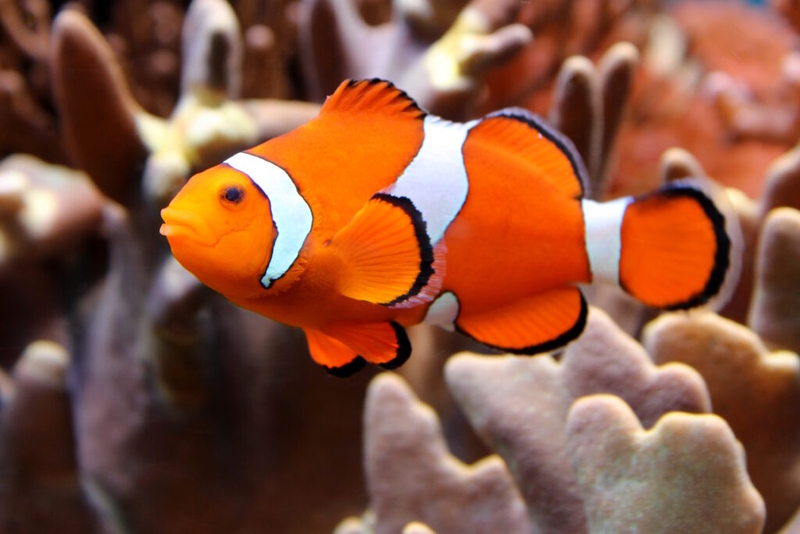
A common clownfish (Photo by Holger Krisp via Creative Commons 3.0)
Floating in a cocoon of warm water on a spring day, I watched a family of clownfish, dashing in and out of a sea anemone. They looked at me. Unimpressed and unbothered, they paid me no mind.
I marveled at their lives.
I was snorkeling on the Great Barrier Reef off the coast of Australia. It was the experience of a lifetime.
Have you done it? You should. It’s a bucket-list thing.
It is the largest living structure on earth. Larger than Italy. Around 3,000 separate reefs spread across 1,400 miles — the world’s largest coral reef system. It can be seen from space, but closer is better.
These are coral reefs. Living animals. Not plants. They are stunning beyond description. There are about 600 different species of coral, and more than 1,625 kinds of fish. Thousands of different species live in the reefs: Think mollusks, crustaceans, and other marine organisms.
It’s another universe. An explosion of colors and life forms that I couldn’t imagine even with the best tequila. Or the worst.
The diversity of creation sparked a sensory overload. It was mesmerizing. More than 2,000 marine creatures are being discovered every year around the world. Yes, every year.
Water magnifies everything. It was like looking through a magnifying glass into an imaginary world. For me, it was infinite pleasure.
The sea anemones. I remembered them from seventh grade. There was a picture of one on the cover of our science book. It’s another animal. I had no idea. I thought it was a plant.
Inhabiting the sea anemone, a colony of clownfish. Remember Nemo from “Finding Nemo?” More beautiful in real life.
Turns out sea anemones and clownfish have a Montana connection. Researchers at Montana State University discovered that bacteria living in clownfish and sea anemone mucus may help protect them against disease. Nemo’s remarkable secret could someday lead to new medical treatments for humans. And that research is being done by professors and students in Bozeman.
Sometimes I doubt the existence of God. Religious texts and theological discussions quickly bore me. Floating above a family of clownfish, I experienced something I haven’t found in church or religious texts — wonder and awe. It wasn’t just visual. It was spiritual. I gained a little more faith.
Clownfish colonies are led by the largest fish, a breeding female. That may be a lesson for us. The second largest fish is a breeding male. The rest of the fish are male, but immature. They don’t breed. But, get this. If the female dies, or leaves the colony, the breeding male becomes female. I’m not talking about gender identity. I am talking about becoming totally female and reproducing. Laying eggs.
Explain that to me. Please.
Boys are boys and girls are girls: You’ve heard some of our politicians say it. You know who. It’s a simple slogan. End of discussion.
I spent a day on the Great Barrier Reef thinking I knew a bit about our natural world. What I learned: I really don’t know very much. It’s humbling.
Biology is really complex. More complex than a political slogan.
Is biological sex really fixed at birth? How can a male fish become female and go on to lay eggs?
Ask Nemo.
When I looked at a colony of clownfish on the Great Barrier Reef, I couldn’t explain it.
Nemo taught me that the complexity of biological sex is far more than a political slogan or my understanding.
I went to the Great Barrier Reef thinking I knew a little bit about the natural world. The clownfish made me wonder how many of my beliefs I’d never really questioned.
There’s a lot about this world that I don’t know or understand. I get to enjoy it, and I have a responsibility to care for it.
What I learned from Nemo on the Great Barrier Reef is to celebrate creation. All creation.
Helena, MT