RI federal judge says HUD overstepped authority in latest homelessness funding changes
Nov 23, 2026 | 4:34 pm ET
Description
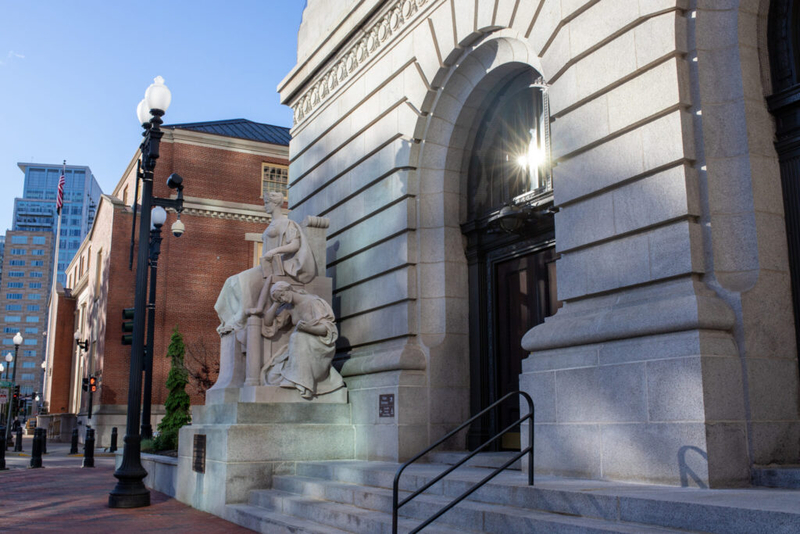
The exterior of U.S. District Court for the District of Rhode Island at 1 Exchange Terrace, Providence. (Photo by Alexander Castro/Rhode Island Current)
A federal judge in Rhode Island struck down the Trump administration’s plan to set aside $1.3 billion in homelessness funding for new transitional housing and supportive-services projects, ruling Friday that the U.S. Department of Housing and Urban Development exceeded its authority.
In a 59-page ruling, U.S. District Court Judge Mary S. McElroy found HUD and its cabinet-level secretary sidestepped congressional requirements by steering funding away from existing programs and permanent housing through its Continuum of Care grant program toward shorter-term solutions.
“Although Congress delegated to the secretary the power to create additional criteria for awarding funds, this residual clause cannot be read as allowing HUD to nullify the other congressionally established mandatory factors,” McElroy wrote.
McElroy was appointed by President Donald Trump during his first term.
A coalition of states and another group of cities and nonprofit organizations took HUD to court in July, arguing its new funding rules would upend the federal government’s longstanding emphasis on moving people into permanent housing.
Lead plaintiffs in the latter case include the National Alliance to End Homelessness and the National Low Income Housing Coalition, along with Providence-based nonprofits Crossroads Rhode Island and Youth Pride Inc. Several cities and counties across the country also joined the suit.
The coalition of plaintiffs welcomed the ruling, saying in a joint statement they would protect communities’ ability to compete for federal homelessness funding without facing penalties for their housing policies or service approaches.
“At a time when so many people are struggling to find and maintain stable housing, these resources are too important to be tied to arbitrary and unlawful restrictions,” they said.
Rhode Island Attorney General Peter Neronha, whose office joined the multistate lawsuit, also welcomed the ruling, saying the administration’s proposed funding changes could have put thousands of Americans at risk of losing their homes.
“While the Trump administration remains committed to making life harder for our most vulnerable Americans, our coalition remains committed to holding this administration accountable,” he said in a statement to Rhode Island Current.
At issue was a June 1 funding notice for HUD’s roughly $4 billion Continuum of Care program, which sought to redirect funding toward new projects, favor transitional housing and supportive services, and impose new conditions on organizations seeking federal grants.
The July lawsuits followed a similar fight over HUD’s 2025 funding competition. McElroy ruled in June that the department’s November and December 2025 funding notices were unlawful, setting them aside. In August, she ruled that HUD had again violated federal law by trying to divert $4 billion in homelessness grants away from permanent housing programs, blocking the June 1 directive from taking effect. She declined to issue a permanent injunction barring the department from making similar changes in the future.
HUD threatened penalties for programs that use harm-reduction strategies and added requirements tied to local law enforcement’s efforts to clear encampments, diversity, equity and inclusion policies, and immigration-related restrictions.
Plaintiff groups argued the changes would undermine existing homelessness programs, discourage approaches that help people secure housing without preconditions and put federal funding at risk for organizations whose practices or policies ran afoul of the new criteria.
McElroy agreed that HUD’s $1.3 billion set-aside for new projects would sideline existing programs and prevent communities from weighing their track records and local priorities in deciding how to spend federal homelessness funding.
“Defendants offer no evidence contradicting Plaintiffs’ showing that the Set-Aside distorted the application process,” she wrote.
McElroy ordered HUD to allow applicants to amend and resubmit grant applications by Dec. 1. She pushed back the funding award deadline from Dec. 1 to Dec. 31.
HUD Secretary Scott Turner, in a statement to Rhode Island Current, called the ruling disruptive to the agency’s efforts to distribute $4 billion in homelessness funding.
“The plaintiffs’ ideological agenda threatens to cause gaps in funding,” he said. “HUD reserves the right to appeal. Our ‘Treatment First’ mission will not be deterred.”
In addition to Crossroads Rhode Island and Youth Pride, the coalition of providers and local governments includes Santa Clara County, California, and King County, Washington, and the cities of San Francisco; Boston and Cambridge, Massachusetts; Nashville; and Tucson, Arizona.
The states’ lawsuit includes attorneys general from Arizona, California, Colorado, Connecticut, Delaware, Illinois, Maine, Maryland, Massachusetts, Michigan, Minnesota, New Jersey, New Mexico, New York, Oregon, Vermont, Virginia, Washington, Wisconsin, and the District of Columbia. The governors of Kentucky and Pennsylvania also filed on behalf of their states.
Providence, RI