Pa. party chairs reflect on Election Day and what comes next
Nov 23, 2026 | 4:57 pm ET

Description
The state Capitol building in Harrisburg. (Photo by Tim Lambert/Pennsylvania Capital-Star)
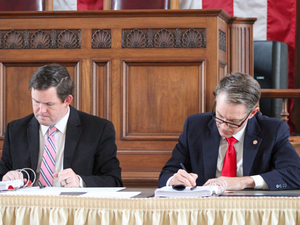
Following a decisive midterm election that gave state Democrats their first governing trifecta in decades, leaders for the Pennsylvania Democratic and Republican parties made a joint appearance to preview what comes next for the commonwealth.
Democratic Party Chairman Eugene DePasquale, said there were a few factors that boosted his party’s success: a popular governor running for reelection, good voter turnout and independents voting blue.
“We had a popular governor who had an agenda that most Democrats agree with, which I think helped us attract state legislative and state Senate candidates, even in districts that were tough for us to win because they wanted to push that agenda,” said DePasquale.

Sen. Greg Rothman (R-Cumberland), who serves as the state Republican Party chair, agreed that independents sided with Democrats, but noted that Gov. Josh Shapiro’s enormous cash advantage hardly won him any new voters when compared to 2022 numbers. Between the two election cycles, both won with over 3 million votes, Shapiro gained an additional 8,600 votes.
“If every person who had voted for Donald Trump in ‘24 in Pennsylvania had voted for Stacey Garrity, she would have won by a half million votes. That’s significant,” said Rothman. Trump received 3.5 million votes in 2024. “So why did they stay home two years later?”
Such questions will prompt some self-reflection, he added, saying donors opted not to support Republican Stacey Garrity’s gubernatorial campaign.
“She couldn’t get money early because everyone said she wasn’t going to win, and it becomes a self-fulfilling prophecy,” Rothman said.
Shapiro, who outraised Garrity 10-1, had enough cash that he could support candidates lower on the ballot.
“But, clearly, where he spent the money made a difference in those (Pa.) Senate seats,” he said, noting narrow victory margins in a handful of seats that tipped the scales. With those wins in hand, Democrats will control the upper chamber for the first time since the early 1990s.
Taking the chamber was “sort of our moonshot,” said DePasquale. For Republicans, keeping the Senate was the main objective, “but we failed miserably,” added Rothman.
“Obviously, the challenge for us moving forward … It’s now time to govern politically,” DePasquale said.
Legislative priorities
Democrats have named several priorities going into the next state legislative session: codifying abortion rights, addressing transit funding and tackling high prices for energy, housing and childcare.
But the one expected to hit Shapiro’s desk first is an increase to the state’s minimum wage, which currently sits at $7.25/hour. House Democrats have repeatedly advanced proposals increasing the rate to $15, but Republican senators opted not to advance them.
Rothman signalled an openness to discussing a hike, but said it would increase prices — a claim that supporters refute.

“That is not going to make things more affordable if you get more money … That’s not how it works. You have to have more supply, and if we don’t increase supply and we just give people more money, it actually has the opposite effect,” said Rothman. “Prices are going to continue to go up.”
“I don’t know how you create more affordability without creating more productivity and more things.”
He said he supported exemptions for small businesses, teenage employees, amusement parks and nonprofits. There was a risk that some people would lose their jobs, especially low-level positions that could be automated, he continued.
“There should be discussion about the best way to implement this, but we ran on raising minimum wage and that’s what we’re going to do,” said DePaqaule. “But it also is not the only thing we ran on.”
Data centers also played an outsized role, and have faced bipartisan pushback as proposals move forward around the state.
“I think things will calm down a little bit, and people will say, ‘Wait a minute, we need the data,’” said Rothman, who has reportedly personally profited from a data center development in Cumberland County.
Some projects generated massive protests, while others have moved forward with smaller fanfare, he noted.
“You’re using data, and if you’re using the computer and the data, we need data centers. If we’re going to have data centers, they need to be in the United States, not in China,” he continued. “And if they’re going to be in the United States, why not have them in Pennsylvania?”
“Local communities clearly want safeguards on these,” DePasquale added. “I think there was a lot of frustration if some of the bigger entities were able to — for lack of a better phrase — bulldoze their way into getting a permit. I think that’s what people want protection from.”
A call for civility
DePasquale declined to weigh in on whether U.S. Sen. John Fetterman would win a Democratic primary if he chose to run for re-election. The first-term lawmaker has taken unpopular positions and openly criticized his party, fomenting rumors that he could try to switch to the Republican Party.
“John Fetterman is a Democrat. And he has said publicly and to me privately, he doesn’t plan to switch,” DePasquale said.
“There are some issues that John Fetterman and the Republican party agree on — the border, the support for Israel — but I think that probably still 90% of the issues that are important to Republicans … he’s going to say no,” Rothman said. “I can’t imagine he wins a Democratic primary, but I don’t know if he wins a Republican primary either.”
DePasquale also demurred when asked whether Shapiro should run for president in 2028, saying the party would be focused on 2027 judicial retention races.
When asked about turning down the political temperature, Rothman said people were “cynical about politics because of the way we treat each other,” adding that “we have to do more of ourselves showing that we can work together.”
Rhetoric accusing rival parties of being fascists or communists are “not helpful,” he continued, pointing to ever-escalating attacks on politicians, including arson at the governor’s residence last year.
“We can set an example. I think that’s what we have to do. I would say that to every elected official,” Rothman said.
“There is zero place for any political violence. Period. Full stop. End of story,” DePasquale added. “There is a difference between us having a vigorous debate about a policy initiative … (and) when you call someone a bad human being.”
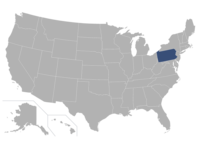
Harrisburg, PA