‘Not a time for panic’: Governor says Missouri is prepared for possible lead fallout from Iowa blast
Nov 23, 2026 | 3:41 pm ET
Description
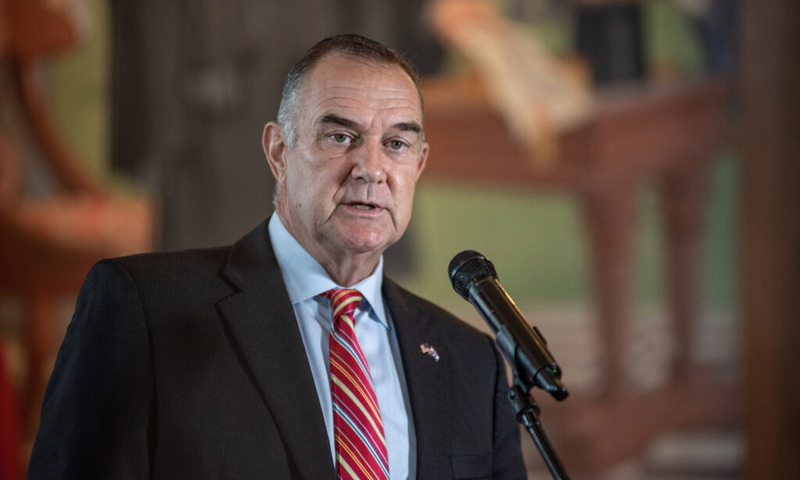
Missouri Gov. Mike Kehoe speaks to reporters on May 27, 2025 (Annelise Hanshaw/Missouri Independent).
Gov. Mike Kehoe sought Monday to reassure Missourians concerned about possible lead contamination from a planned military detonation in southeast Iowa, saying state agencies are preparing to monitor drinking water, farmland and public health but expect little risk to the state.
“This is not a time for panic,” Kehoe said during a briefing at the state Capitol. “We do not anticipate significant impacts, but we will not allow Missouri to be unprepared.”
The U.S. Army has planned to detonate about 9,700 pounds of deteriorating lead azide at the Iowa Army Ammunition Plant in Middletown, roughly 57 miles north of Missouri. The explosive material has become increasingly unstable, military officials say, and could detonate unexpectedly if temperatures fall.
Kehoe said Missouri does not control when the operation takes place and shares neighboring states’ frustration over how federal officials have handled it.
Although his administration has held calls with the White House, Army, U.S. Environmental Protection Agency and other federal officials, he said the state still has limited information.
“Based on the information we do have, we anticipate minimal impacts to Missouri,” he said.
The most specific preparations involve drinking water.
Department of Natural Resources Director Jake Buxton said 10 Missouri drinking water systems, with 13 water intakes, are within 100 miles of the ammunition plant.
The EPA is collecting samples of untreated surface water from systems within that radius before the detonation and plans to test untreated and treated water afterward. Missouri officials have contacted the 10 systems and sent sampling supplies to regional offices to prepare for additional testing.
Federal court lifts stay on Iowa explosives detonation that has alarmed Missouri officials
Buxton said the state also has been in touch with water systems in Hannibal and Louisiana, both of which draw from the Mississippi River. Earlier projections suggested any potential contamination would reach the river north of Missouri, he said, and the department did not expect the lead to affect those cities’ water intakes.
He emphasized that surface-water drinking systems already have treatment processes capable of removing lead and could adjust their operations if testing showed a need.
The extent of any fallout will depend heavily on weather conditions. Public Safety Director Mark James said a National Weather Service meteorologist and a National Guard civil support team are helping state officials model potential particle movement.
State health officials likewise do not expect a public health emergency.
Department of Health and Senior Services Director Sarah Wilson said projected lead exposure in Missouri is low and the event is expected to be brief. Her agency will continue tracking dispersion forecasts and exposure levels, she said, and anyone worried about possible contact with lead dust should consult a local health department or medical provider.
Lead can damage the nervous system, especially in young children, and poses risks during pregnancy. Whether any Missouri residents would be exposed to harmful amounts remains uncertain.
Agriculture Director Chris Chinn, whose family farms in northeast Missouri, said the state does not expect significant consequences for livestock or the food supply.
She pushed back on recommendations circulating online that farmers should move animals indoors or seal barns.
“At our family farm, we could not bring all of our cows into a barn or a shed,” Chinn said. “It just is not feasible.”
Instead, the department recommends livestock producers consult their veterinarians about precautions and possible testing. Chinn said University of Missouri Extension can test hay for lead and advised farmers concerned about visible dust after a detonation to wash down equipment.
Missouri has activated a multiagency preparedness team, but the State Emergency Operations Center will open once federal officials provide a firm detonation date and time, Kehoe said. James said response plans also cover the possibility of an accidental explosion.
The briefing took place shortly after President Donald Trump announced he had instructed the Army not to proceed without approval from the 8th U.S. Circuit Court of Appeals and agreement from Iowa Gov.-elect Rob Sand.
Kehoe said he had not yet seen the president’s statement and had not spoken with Trump since it was released. The Army had most recently scheduled the detonation for Wednesday, after postponing earlier dates.
Environmental groups sued to stop the operation over concerns that airborne lead could settle on homes, farmland and waterways. The appeals court had temporarily suspended the Army’s environmental permit, while the Justice Department argued over the weekend that the explosives posed an immediate danger and could be destroyed under separate emergency authority.
Late Monday, a three-judge panel of the appeals court lifted the stay, clearing the way for the Army to proceed with the detonation.
“We are mindful of the very real risks presented by the Army’s planned detonation,” the judges wrote, according to The New York Times. “However, we must acknowledge the realities of the situation: The degraded explosives present a risk of an uncontrolled and unplanned explosion” potentially occurring without safety measures.
Sand, a Democrat who takes office in January, said the decision belongs to the federal government and called for more transparency about the Army’s plans. It remained unclear whether Trump’s separate demand for Sand’s agreement would affect the timing of the operation.
Missouri’s Republican U.S. senators, Josh Hawley and Eric Schmitt, along with U.S. Rep. Sam Graves also urged a delay in a Friday letter to Army and EPA leaders.
They cited the “apparent lack of coordination with Missouri officials and residents” and sought detailed plume modeling, information about notifications and plans for monitoring and cleanup.
Kehoe urged residents to rely on official information rather than alarming claims circulating on social media.
“Missourians deserve to know what we know,” he said. “Our job is to ensure the health and safety of all Missourians every day.”
- 6:03 pmThis story was updated to reflect the 8th U.S. Circuit Court of Appeals decision.
Jefferson City, MO