New voter-backed trust fund could become South Dakota’s largest, state treasurer says
Nov 24, 2026 | 4:41 pm ET
Description
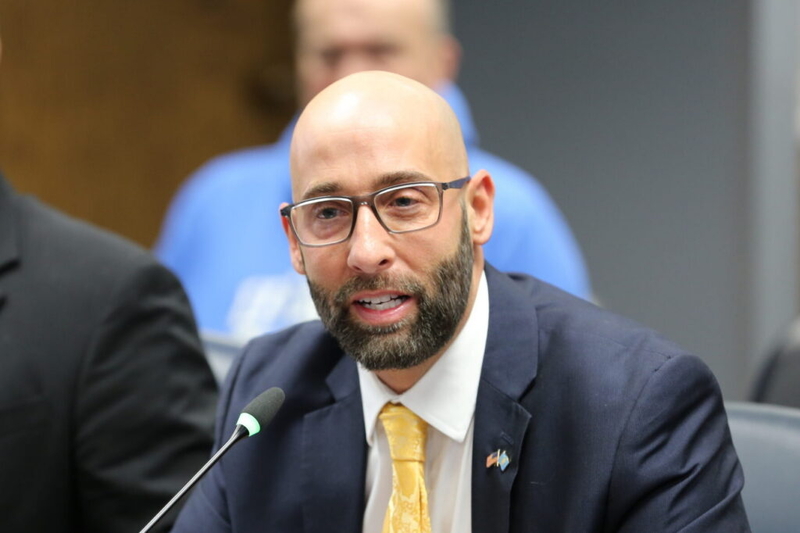
South Dakota State Treasurer Josh Haeder speaks with lawmakers at the Capitol in Pierre on Jan. 15, 2025. (Photo by Joshua Haiar/South Dakota Searchlight)
A trust fund endorsed by voters on Election Day could grow to become South Dakota’s largest, according to State Treasurer Josh Haeder.
Haeder made his comments during a recent meeting of the South Dakota Investment Council, which manages the state retirement system and trust funds that benefit schools, healthcare and the state budget. The state treasurer is a permanent member of the council, and last week’s meeting was Haeder’s last in the role. Republican Melissa Hull was elected to succeed fellow Republican Haeder, who is term-limited.
Voters endorsed Constitutional Amendment K to allow management of the state’s Unclaimed Property Trust Fund by the Investment Council, which will generate investment earnings to help fund state government.
Unclaimed property typically takes the form of unclaimed money from sources including bank accounts, stocks, life insurance payouts, uncashed checks and the contents of safe deposit boxes. If the entities holding the funds can’t find the owners within three years, the money can be transferred to the state. Anyone can claim their funds at any time, so the property is a perpetual liability for the state, but most unclaimed funds go uncollected.
Voters say yes to South Dakota Investment Council management of unclaimed property money
Haeder told the Investment Council on Nov. 17 that unclaimed property receipts for 2026 stood at $294 million. He’s proud, he said, to have pushed for a managed trust fund during his last year in office.
“That has the potential to become the largest trust fund in the state of South Dakota,” Haeder said.
The council manages four other trust funds: the Cement Plant Trust Fund, School and Public Lands Trust Fund, Education Enhancement Trust Fund, and Health Care Trust Fund. The largest by dollar amount is the Education Enhancement Trust Fund, seeded largely by money from a 1998 multi-state tobacco lawsuit settlement. That fund ended state fiscal year 2026 with a value of $842.5 million.
In a call with South Dakota Searchlight, Haeder said the reason the Unclaimed Property Trust Fund could grow to be the state’s largest is a matter of “simple math.”
More money comes in as unclaimed property every year, sometimes more than $200 million. Even after paying for marketing campaigns to convince people to collect their money and paying claims, the amount that would be transferred is likely to be significant.
In 2025, the state received $357 million in unclaimed property, according to the State Treasurer’s Annual Report, and paid out $49.6 million to claimants. That year was an unprecedented surge, but Haeder said annual receipts of $100 million or more are commonplace. That’s largely due to favorable laws and regulations that have attracted some national banks to place their headquarters in the state.
Within 10 years or so, Haeder said, the new trust fund could surpass $1 billion through annual allocations.
“It’s not a fund where we’re transferring a one-time dollar amount,” Haeder told Searchlight.
The idea behind creating the trust fund is that investing the money will do more for the state budget than gains from a small interest rate.
The investment council will use some of the money to buy stocks and bonds and make other investments, pushing returns — and the resulting amount transferred to the state general fund — to a higher level.
The other four trust funds earned year-over-year returns between 8.2% and 9.3% in fiscal year 2026, according to the Investment Council’s latest annual report.
Lawmakers passed a bill earlier this year sponsored by Sen. Taffy Howard, R-Rapid City, to put unclaimed property into a trust fund, but needed the recently approved state constitutional amendment to allow the Investment Council to put some of the money into stocks.

Pierre, SD