Oklahoma lawmakers mandated more recess at school, but now it has cut into learning time
Nov 23, 2026 | 6:29 am ET
Description
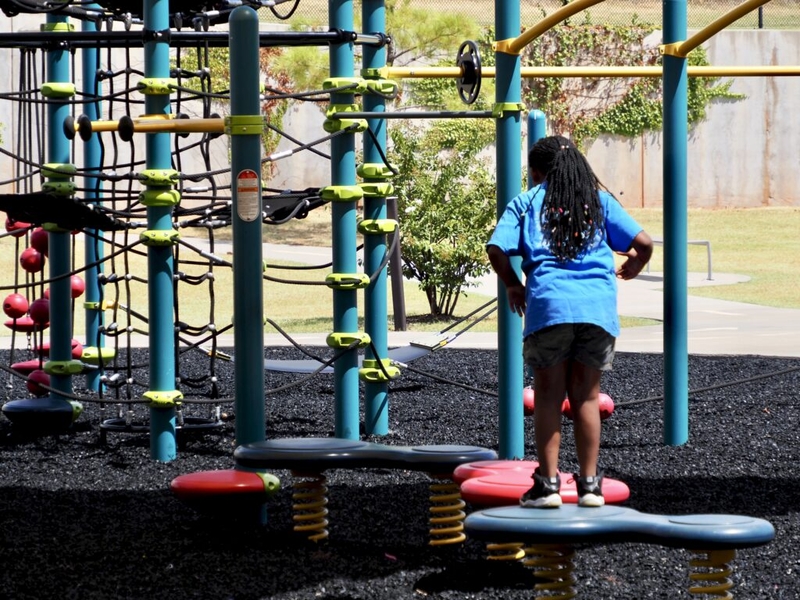
A student plays on a playground in Oklahoma City on Aug. 17, 2026. (Photo by Nuria Martinez-Keel/Oklahoma Voice)
As the parent of two elementary school-aged kids, I have found myself having a love-hate relationship with Oklahoma’s new recess law.
The law, which for all practical purposes took effect in August, requires public elementary schools to provide 40 minutes of daily recess. I love that it gives my children more time to play. Social interactions are important, and there’s a lot to be learned from them. And for one of my kids, recess is a favorite time of day.
But I also hate how the Republican-led Legislature usurped local control and forced this law upon schools without any clear acknowledgement that it would upend the school day.
To accommodate about 15-20ish more minutes of recess, my kids’ district has had to overhaul schedules. Thanks to lawmakers, my kids now have around five fewer minutes to eat lunch. School also starts five minutes earlier, which means I have almost 850 minutes a year – or over half a day – less to spend with them in the mornings before they leave home.
And I hate how lawmakers stripped teachers of one of the few remaining tools that they have long used to hold children accountable for their behavior: missing recess. Under the new law, teachers are forbidden from taking away recess as punishment.
So now if a child throws food in the lunchroom or refuses to do their school work, they are no longer required to take accountability, clean it up or face immediate consequences.
What message does that send to our children? And is a lack of consequences for bad behavior a school lesson that will set them up for success as an adult?
But mostly, I fear that this law puts elementary schools between a rock and a hard place. They’re already under enormous pressure to increase academic outcomes. Next year, if third graders aren’t reading at grade level, they will be held back.
Yet, our Legislature seems equally obsessed with requiring play time.
Wouldn’t it be better if we left it to the local districts to decide what is the best use of the school day? Aren’t they supposed to be the experts here?
For some reason we have a bunch of elected leaders, most with no education background, that feel like they’re in a position to tell schools how to best use their time. They’re not.
It turns out many elementary school teachers agree with my assessment.
The law has made it difficult for them to discipline children. Rather than quietly handling matters as they have in the past with a few minutes less recess, now teachers report having to waste time calling parents about minor disciplinary incidents and disrupt the days of everyone but the kids who got in trouble.
Plus, anyone who has ever had to get a kid out the door knows it’s never a quick process. It’s a transition. You have to get coats on and off. If you’re at school, you have to line up both inside and outside and wait for the kids who are meandering along.
So as some teachers have pointed out, this extra recess time is actually eating into instructional time that would normally be used for academics.
In Edmond – traditionally one of the state’s highest performing districts – the law has educators pondering an existential question, according to Edmond Classroom Teachers Association President Simora Davis: “What is the point?”
In addition to longer school days, teachers there lost a professional development day to help the district add 15 minutes of daily recess. Professional development days, by the way, are designed to make teachers more effective.
“I get a lot of, ‘When are they going to change this?’ I get a lot of, ‘Why do we have to do this?’” Davis told Oklahoma Voice recently. “I also get a lot of, ‘Do you know what I could be teaching right now? Do you know how much I could get done in 20 minutes of class time?’”
Supporters in the Legislature argue this law allows students to burn pent-up energy and increase their focus.
Maybe it does, but to lengthen a school day just to accommodate recess seems counterintuitive to that logic. So we have more recess, but now proportionally we have a longer school day with less learning.
There are only so many minutes a child has in school each day. Do we want our elementary schools to be playgrounds or places where our children learn their ABCs and 123s?
As a parent, I want my kids’ schools to be academic meccas that set them up for success in the years to come.
Recess has a role to play in that, and maybe some schools will want to keep 40 minutes of recess if given the option.
But our Legislature should not commandeer recess and dictate how it must happen.
It’s clear that this law is failing our elementary schools.
I appreciate that lawmakers aren’t afraid to try new things. Sometimes, like with our statewide cellphone ban, it works wonderfully.
But they also need to admit when their ideas backfire and make things worse.
The question is how long is it going to take for our Legislature to acknowledge this is a failed experiment, repeal it, and restore power back to local school boards and teachers?
With the myriad issues plaguing our schools, the last thing we need to be distracted by right now is recess.

Oklahoma City, OK