After mild blue splash, some Kentucky Democrats wonder if state party could have done more
Nov 19, 2026 | 10:38 am ET
Description
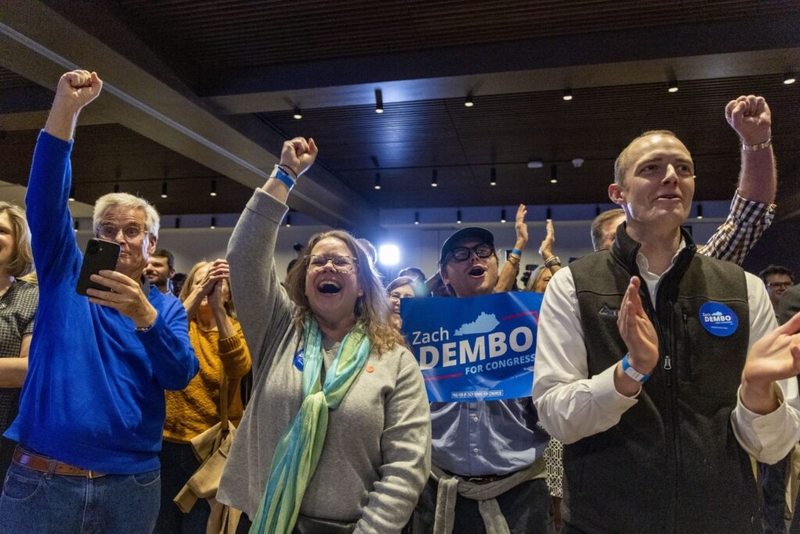
Supporters of Rep.-elect Zach Dembo, a Kentucky Democrat who flipped a Republican seat, cheer during Dembo’s victory speech in Lexington on Nov. 3, 2026. (Photo by Brian Simms for Kentucky Lantern)
After November elections brought a blue tsunami to places like Texas and North Carolina, some Kentucky Democrats are wondering where that wave was in the Bluegrass state.
Ned Pillersdorf, who ran against incumbent Republican U.S. Rep. Hal Rogers in Eastern Kentucky, took to social media last week to say Kentucky Democrats’ had “an abysmal failure” compared to other states this year. During the Nov. 3 election, Kentucky Democrats flipped control of a Central Kentucky U.S. House seat with candidate Zach Dembo and gained control of nine seats in the General Assembly in suburban areas of the state. Yet, the last remaining Democratic-held state House seat in Eastern Kentucky is now held by Republican Tanner Hesterberg. In his race, Pillersdorf lost by 46 points to Rogers.
Pillersdorf wrote on Facebook that in addition to running against Rogers, he also helped legislative candidates in Eastern Kentucky this cycle and accused party officials of slighting them. He said he and four legislative candidates were denied entry to a fundraising reception held during a party gathering in Lexington and were not discussed during the main public event later that evening, the Forward Together dinner, which was open to media. A staffer later said in a comment the event required purchased tickets.
“The good news is that thanks to the wonderful blue tsunami help is on the way from elsewhere thanks to the Democratic parties in other states who saw the blue wave coming and didn’t do what the Kentucky Democratic Party did — abandon many of their candidates,” Pillersdorf said. “As far as the Kentucky Democratic party is concerned – we might as well be in West Virginia.”
In response to Pillersdorf, Democratic officials, organizers, past candidates and more chimed in to debate how effective the party is.
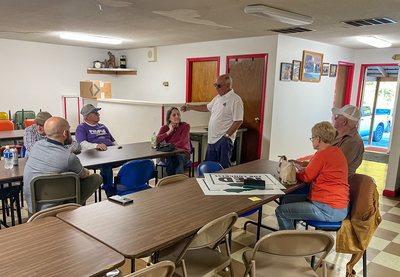
Asked more about his comments, Pillersdorf told the Kentucky Lantern that he felt like the lack of visibility for him and other candidates from the state party labeled them as non-viable candidates.
“They sent the clear signal that I was not viable,” he said. “And suddenly, all these people who were going to help me stop. My network dried up.”
On if party leadership should change, Pillersdorf said yes.
“Compare Kentucky to Tennessee or Texas. Look what happened there, and look what happened to us,” he said. “They swung and missed, and it was because they completely missed the ball.”
Another Democratic Congressional candidate, Megan Wingfield, told the Lantern that “anybody who would disagree with what Ned has to say is being disingenuous.” She challenged Republican U.S. Rep. Brett Guthrie in the 2nd Congressional District and lost by 28 points.
Wingfield said Kentucky Democrats have organizational issues in rural areas, which meant voters did not see visibility from the top of the state party in those places.
“They’ve spent, in my humble opinion, a lot of their time and resources with Zach Dembo in the 6th District,” she said. “Well, we saw how those results went, and Zach ran a good race and he did a good job, but they are supposed to be getting out to vote everywhere, and it’s really difficult for folks to feel like the party is behind them and fighting for them if they don’t even come into rooms where they are.”
‘Support isn’t always a check’
Kentucky Democratic Party Executive Director Morgan Eaves told the Lantern that “support isn’t always a check.” It can also include advice, gathering volunteers and organizers to help candidates, directing party staff to review and make campaign materials, connecting candidates with reporters and more.
“It’s no secret, I think, at the state and national level that Democrats are the party of fewer resources, particularly here in Kentucky, and that’s a consequence of being in the minority, for now, a long time, and having to be hard-scrabble about our politics. So we work within the resource allotment that we have, but we provide a lot of people power and a lot of training and a lot of other non-monetary resources to candidates.”
She added that “we provided those opportunities to Mr. Pillersdorf and candidates up and down the ballot across the state.” Emails between Pillersdorf and party officials that were reviewed by the Lantern showed discussion about his campaign as far back as the summer of 2025.
“I think it’s interesting that when party leaders deliver more Democrats going to Frankfort and to Washington than they have in over a decade, people are calling for change. I think this election cycle was a case test in exactly how strong our party leadership is,” Eaves said. “It’s not our job to tell everyone they can win. It’s not our job to run campaigns. It’s our job to create an infrastructure and to prepare candidates to do the work to flip seats.”
Kentucky once had a Democratic supermajority for decades, but lost control of the Senate in 2000 and the House in 2016 to Republicans. In July 2022, registered Republican voters outnumbered Democrats for the first time in state history.
Eaves said after losing the majority, many Democrats were “demoralized” for a while and have only restarted their work in the last few election cycles. She credited Democratic Gov. Andy Beshear for that renewal.
“The credit is at his feet. He has excited Democrats in Kentucky in a way that they have not been excited in a really long time, and he has proven that if you mobilize and you organize and you have the right message, you can win anywhere,” Eaves added.
Robert Kahne, a Jefferson County legislative district chair and member of KDP’s state central executive committee, said the party “does a lot to make hard decisions about which candidates to support, but there is a level of support that is available to all candidates, including and especially candidates in Eastern Kentucky.”
When it comes to comparing Kentucky to places like Texas, Kahne said the blue wave in Texas had “been building for a long time, and the demographics of it aren’t surprising for the people that pay attention.” That state has four of the top 10 biggest cities in the country and large demographics of voters that supported Democrats this year, including Black, Latino and suburban voters, he added. He also pointed to redistricting that favored Republican candidates.
Kahne said voting trends showed that Democrats’ “most fertile ground” was in areas like Louisville, Lexington and Northern Kentucky this year.
“You have to be judicious about where you’re going to spend your money,” he said. “And I do think that there’s a lot to be celebrated.”
Eaves said work is already underway for 2027 and 2028 election cycles. Next year, statewide offices, including governor, are on the ballot. Legislative seats will be decided again in 2028.
“We had a really strong class of candidates this year, even if we did not contest as many races as we wanted. We had an incredibly amazing class of candidates, and I think because of the work they put in and the seats that we were able to flip this cycle, and the fact that all 120 counties voted more blue this year than they did just two years ago in 2024, more people are going to run in 2028,” Eaves said, adding that people are asking now about candidate training and other steps to take.
Frankfort