Alabama Public Television commission holds first meeting with new members
Nov 19, 2026 | 5:59 am ET
Description
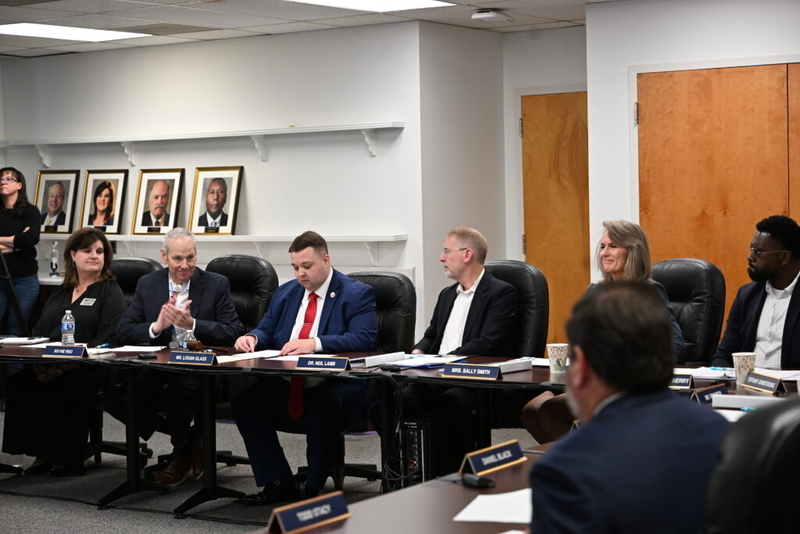
Members of the Alabama Educational Television Commission as seen on November 18, 2026. (Andrea Tinker/Alabama Reflector)
BIRMINGHAM – An almost entirely new board overseeing Alabama Public Television gathered for its first meeting Wednesday.
Logan Glass, the newly elected chairman of the Alabama Public Television Educational Commission, opened the meeting calling it “a new day for Alabama Public Television.”
“While we cannot change the events of the past, we can determine what comes next,” Glass said. “We have an opportunity, and indeed an obligation, to move forward with a renewed sense of purpose, a commitment to responsible governance, and a shared determination to strengthen this institution.”
The commission serves as a governing board to Alabama Public Television. The Code of Alabama says it is tasked with “making the benefits of educational television available to and promoting its use by inhabitants of Alabama.”
Five of the new commissioners– Wallace Gilberry, Ric Smith, Niel Lamb, Sally Smith and Samory Pruitt– were appointed to the board in early October, after Gov. Kay Ivey dismissed several board members. Anne Bloom was appointed to the commission after Commissioner Tijuanna Adetunji resigned.
Last year, former commissioners Ferris Stephens and Les Barnett, two conservative members of the board, proposed disaffiliating from the Public Broadcasting Service. The move prompted backlash from donors. At a following meeting, the AETC voted to maintain PBS programming.
During opening remarks on Wednesday, new commissioners expressed their admiration for PBS programming.
“I grew up in rural Alabama. The TV sat on top of the TV, if you guys know what I mean. So Alabama Public TV was really all we had,” Gilberry said during the meeting. “And I remember how important it was just getting that little bit of education back then as a kid and kind of turning into what I’ve done with it today.”
Members of the public also seemed satisfied with the new direction of the commission.
“You guys saw the mess it was. You know what needs to be done, and I can’t think of anybody better to take this forward,” said Pam Caruso from Huntsville.
After the meeting, Glass said APT will stay with PBS for now.
“We’ve got the contract, and for now that’s where we are, and we’re going to stay in that contract with PBS for the foreseeable future,” Glass said.
Other commissioners said they aren’t sure if disaffiliation is off the table.
“I have no idea what the future conversations will be as far as the commission goes, but I think the most important thing is that we all work together,” said Ric Smith after the meeting. “My personal experience is PBS is a huge plus because of the high-quality programming they provide.”
Pruitt, who previously worked for The University of Alabama, said after the meeting he “hadn’t gotten that far yet” on whether or not to disaffiliate.
“I’m talking to some of the commissioners to try to understand what those issues were, and to be honest, I’m not clear on what the disagreements were, (so) I want to learn more about that,” Pruitt said.
Another controversy for the AETC came when former commissioners approved using funds to pay for a hotly contested survey.
In April, the AETC voted to pay for a survey of Alabamians’ opinions toward PBS through a contract with McLaughlin & Associates, a national survey company that has mainly worked with Republican candidates.
The contract with McLaughlin & Associates fell through in late August. In a special called meeting in September, authority members voted to conduct the survey with Cygnal, a polling firm that also works mainly with Republicans.
Glass said he wasn’t going to prioritize pushing surveys unless the commission wanted to do them.
“Unless it’s a priority, I don’t intend to push that,” he said. “I think the 2,000 emails we got is pretty clear on what the consensus is. So I don’t intend to push that as chairman, but if the body of the commission (wants), I don’t have an issue with an unbiased survey.”
Montgomery