One Delaware man’s quest to raise ALS awareness, fight for other families
Nov 19, 2026 | 5:00 am ET
Description
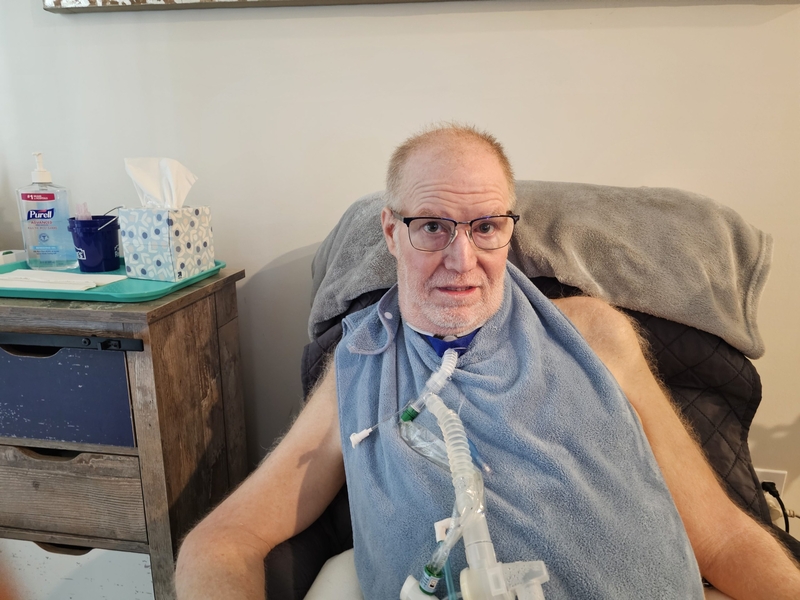
Photo courtesy of Spotlight Delaware
Why Should Delaware Care?
There is no cure for amyotrophic lateral sclerosis — also known as ALS. For all who are diagnosed with the disease, it is a death sentence. Not only that, the cost both financially and mentally drains families as they try to navigate the disease.
Bobby Himes is on a mission.
From his living room in Newark, he wants to spread awareness and hope for those with a rare disease that is a death sentence for all who are diagnosed.
Three years ago, Himes was diagnosed with amyotrophic lateral sclerosis, also known as ALS. The neurodegenerative disease impacts nerves in the brain and spine. Ultimately, ALS destroys the neurons that control a person’s voluntary muscle movement, eventually shutting down their body’s ability to breathe.
Within months of his diagnosis in 2023, Himes said he lost the ability to walk and talk. Now, he cannot do much of anything without assistance.
And while Himes can no longer speak, he still wants to make his voice heard.
He wants to improve care for not only those diagnosed with ALS, but for family members navigating the disease.
“Don’t give up,” Himes told Spotlight Delaware in October. “I hope to encourage others to keep their faith.”
Himes hopes to raise awareness for the massive financial costs that come with supporting a family member with ALS. Since 2024, Himes said he has spent close to $200,000 on his care, costs he said he would not have to pay if he qualified for Medicaid.
Himes said he has not formally applied to the program meant to pay for medical treatment and care for low-income patients, but after reviewing the qualification requirements, he said he is outside the maximum asset limit.
Himes is 64 years old and has Medicare, as well as insurance from his employer as part of long-term medical leave following his diagnosis.
His private insurance is able to pay for his medications and some medical equipment, but he said none of those insurers cover the around-the-clock care he needs to perform basic functions.
He is advocating for expansion to Medicaid eligibility for those with ALS to help subsidize the enormous costs that come with at-home support he needs to bathe, eat or even adjust his pillow.
What is ALS?
ALS is short for “amyotrophic lateral sclerosis,” which is a disease that targets the nerves on a person’s brain and spine, weakening the connections over time. The nerves typically control someone’s movement like walking, talking and most other motor functions.
As those nerves deteriorate, so does a person’s ability to function. For Himes, that deterioration was rapid. Within months, he lost the ability to walk and speak.
Himes communicates through an eye-tracking software that he uses to talk on a computer he has named “Karen.” He looks at a keypad and selects each letter, stringing together sentences that play out loud when he is done.
With Karen, he asks for help adjusting his pillow or moving his leg. Every once in a while, his wife, Iris Himes, has to use a suction tube to drain saliva from his mouth.
Most people live anywhere from two to five years following an ALS diagnosis. The mental drain is tough, not only for Bobby, but his loved ones, too.

“It’s a slow death that everyone watches happen,” Bobby said.
But life was not always like this. Bobby loved to work with his hands, fly airplanes and fish with his friends. Yet after his diagnosis, he lost the ability to do all those things.
He looks back on those years with longing, not realizing how precious they were at the time.
According to a study from the National ALS Registry, cases have been on the rise and will continue to grow into 2030.
Marianne Keuhn, the vice president of care services at the ALS Association, said the organization works to fund different research projects for treatments.
And while some research is showing promise for treatments helping some people regain some strength following a diagnosis, there are still only a handful of treatments available to the public.
Keuhn called ALS a “disease of decline.” She said many people she has spoken to have described the slow progression of losing functions that once came without a second thought.
“Wherever you are today, that’s the best you’re going to be because tomorrow is going to be another step into this prognosis,” Keuhn said.
Caretaker struggles
While Bobby may be the one with ALS, his struggle is not his own. His wife, Iris, also said she has struggled to care for Bobby.
Iris, who is also 64, said she used to be able to help take him out of the house by herself, but now, “everything hurts.”
Soon after Bobby was diagnosed, Iris said she visited a caregiver support group with the ALS Association where she heard families tell their stories. She didn’t relate initially, but years later, she understands their struggle much more.
Following an ALS diagnosis, a caregiver’s social circle becomes smaller because they no longer have time to see other people, Iris said.
Asked what she does to take time for herself, she described having time to go out to the grocery store or pharmacy when Bobby has someone at the house to care for him. She worries about going too far, in case something were to happen.
“Everything is taking care of him,” Iris said.
Early in his diagnosis, caring for Bobby was difficult but still manageable. He was able to go into the shower, go to the bathroom, and be moved about the house without any real consequences.

But all of that changed after Bobby contracted pneumonia in 2024, something he said is very dangerous for those with ALS. Pneumonia limits a person’s ability to breathe, and their lungs fill with mucus. It becomes especially threatening when combined with ALS, which causes someone to lose the power to cough up the mucus.
Bobby spent weeks in the hospital after contracting the lung infection, before returning home with a ventilator that has severely limited his ability to be moved around. Now, he spends almost all his time in a recliner in his living room.
With this time, he started a YouTube channel, where he makes videos with the assistance of artificial intelligence sharing his journey with ALS.
The Himes family still tries to find time for joy in their day-to-day life by listening to Bobby’s old records or going to different ALS fundraisers.
But outings have been made more difficult by Bobby’s ventilator, which requires Iris to rent a special van to secure his wheelchair and ventilator. Iris also says she has to be hypervigilant while they sleep because if Bobby’s lungs begin to fill with mucus or his ventilator is disturbed, she is the one who will have to fix it that late at night.
“People have to understand that they’re not the only ones going through it,” Iris said.
Managing the cost
ALS is expensive. Keuhn said between someone’s diagnosis to the time they die, it can cost families around $250,000.
She added that by the time people are diagnosed, their symptoms have usually progressed to a point where they can no longer work, meaning additional sources of income have been stripped.
One win for families, Keuhn said, is that people with ALS who qualify for social security can start collecting those benefits after their diagnosis.
Bobby currently collects that social security, and is technically still employed on long-term disability, which he said will run out in 2029. Still, the costs have already drained much of the family’s finances.
The Himes family pays out-of-pocket for Bobby’s home care treatment, which Iris said can cost up to $8,000 a month.
Keuhn said this experience is not uncommon.
Keuhn said Medicaid offers some waivers that allow people to receive in-home care, but that it is not ALS-specific. Because Medicaid is income-dependent, it opens up the door for fewer people to receive support through the federally funded insurance subsidy.
But Medicaid subsidies are not only a federal expense — they impact the state’s checkbook, too. The cost of Medicaid is split between states and the federal government, so when costs for home care go up, it means the state pays more to providers.
Delaware Public Media reported earlier this month the Delaware Association for Home and Community Care requested greater reimbursements from the state to keep rates competitive and retain home care professionals.
When those reimbursements aren’t enough for employees, the workforce struggles, and remaining caregivers face additional strain, DPM reported.
But even if those reimbursements do come through for those eligible for Medicaid, Bobby will still pay out-of-pocket for his care.
Bobby said in an email the costs have placed “tremendous financial strain” on his family. Additionally, he said once someone is diagnosed with ALS and requires around-the-clock care, they should be able to qualify for Medicaid.
Bobby hopes changes would lead to a point where families do not have to choose between support or destabilizing their finances.
“I worked my entire life trying to provide for my family and build financial security for our future,” Bobby wrote. “I never imagined that a disease could threaten everything we worked so hard to build.”

Dover