Colorado environmental groups call on lawmakers to oppose permitting overhaul
Nov 18, 2026 | 4:32 pm ET
Description
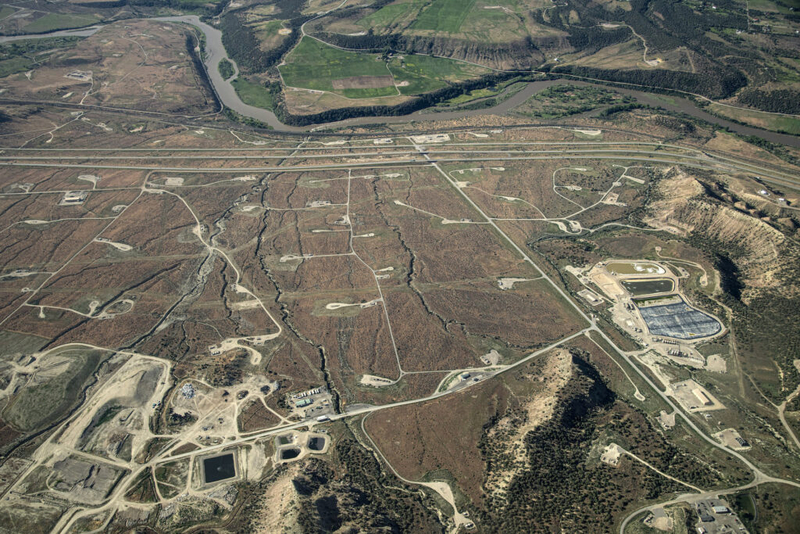
Gas wells operate near Interstate 70 and the Union Pacific railroad in Garfield County near Parachute, June 9, 2023. (William Woody for Colorado Newsline)
Colorado environmental advocates spoke in downtown Denver Wednesday to urge Congress to reject a sweeping overhaul of federal permitting laws that has split Democrats and left-leaning interest groups.
The Bipartisan American Affordability and Jobs Act, or BAAJA, has emerged as a top legislative priority for the lame-duck Republican Congress, following years of failed negotiations in Washington over how to speed up approval processes that developers say can bog down major energy and infrastructure projects in years of study and litigation.
Trade groups representing fossil fuel and pipeline companies have lobbied aggressively for the bill. But it also has the support of some influential climate and clean energy advocates, who argue it will accelerate the buildout of large renewables projects and transmission lines necessary for the energy transition.
In a press conference at Denver’s Confluence Park, however, Ellie Andrews of Environment Colorado called the bill “a Trojan horse” that would undermine “bedrock environmental laws that have protected our land, air and water for over 50 years.”
Bipartisan permitting bill in Congress could speed energy projects, but draws green critics
“BAAJA would send us backwards,” Andrews said. “It may help some renewable energy projects move forward, but it accelerates mining, it accelerates drilling, it will accelerate building pipelines.”
The bill was negotiated by two Republicans, Sen. Shelley Moore Capito of West Virginia, chair of the Senate Environment and Public Works Committee, and Mike Lee of Utah, chair of the Energy Committee, along with two Democrats, Sen. Sheldon Whitehouse of Rhode Island and Sen. Martin Heinrich of New Mexico, who serve as the ranking members on those committees.
The bill has split Democrats, including Colorado’s Senate delegation. Sen. John Hickenlooper has cast multiple votes in favor of advancing the measure this month, while Sen. Michael Bennet has remained opposed, saying in a Nov. 9 statement that he was “concerned that not all perspectives were sufficiently heard during the drafting of this far-reaching piece of legislation.”
“This bill is not the way forward to a clean energy future. It’s a destructive path that will cause irreversible harm to our public lands and the communities that depend on them,” said Taylor Luneau, Colorado conservation manager for The Wilderness Society. “We’re grateful to Sen. Bennet for opposing this bill, and we urge Sen. Hickenlooper to do the same.”
‘Locking in’ fossil fuels?
Among opponents’ top concerns are provisions in the bill relating to “project certainty,” which would curtail the power of federal agencies and courts to revoke or modify project approvals after they have been granted. Supporters frame the changes as ensuring stability across changes in administration, preventing a repeat of former President Joe Biden’s cancellation of the Keystone XL pipeline in 2021, or President Donald Trump’s cancellation of offshore wind projects.
In the view of many environmental groups — for whom the arcane regulatory and legal procedures under laws like the National Environmental Policy Act, the Clean Water Act and the Endangered Species Act have become their bread and butter since their passage in the 1970s — the changes go too far, and could “lock in” major fossil fuel projects at a time when climate scientists are urging policymakers to do just the opposite.
“To stop (a project) because somebody discovered something, that no doubt is frustrating,” Andrews said. “But the things that get discovered matter, and there’s a process for that, and it’s been hammered out over 50-odd years.”
This bill is not the way forward to a clean energy future. It’s a destructive path that will cause irreversible harm to our public lands and the communities that depend on them.
Other criticisms leveled at the bill include the charge that it would accelerate data center development, including on public lands, and further enable the rapid expansion of Immigrations and Customs Enforcement detention capacity envisioned by architects of Trump’s mass-deportation program. Tribal groups have also faulted the bill’s narrowing of tribal consultation requirements and protections for sacred and cultural sites.
The measure cleared several more procedural votes on Wednesday, with a group of about 15 to 20 Democrats, including Hickenlooper, continuing to vote in favor. It could be amended further before its final passage in the Senate sometime this week. The bill would then need to be approved by the House of Representatives before heading to Trump’s desk for a signature.
In the wake of the “blue tsunami” in the midterm elections, some of the bill’s Democratic supporters cast it as a way for the party to deliver on the affordability message that drew many swing voters to their side. Proponents also cast doubt on the possibility of a future compromise that could win support from the next Congress’ Democratic majorities while still passing muster with Trump and the handful of Senate Republicans needed to break the filibuster.
“This bill isn’t perfect. No bill is. We should continue working with Tribal Nations and environmental groups to strengthen it as it moves through the legislative process,” Hickenlooper said in a statement earlier this month. “But we have a golden opportunity to make good on our promise to voters to make energy more affordable. We cannot afford to let it slip away.”
Opponents, meanwhile, argue that Democrats’ historic victories in the midterms should leave them emboldened to take up the issue again in January, rather fast-tracking a bill through Congress in the final weeks of GOP control.
“The midterms sent a pretty clear message,” Andrews said. “I think there is definitely hope in the future for a stronger political coalition that can keep more of those voices at the table.”
Denver, CO