Government oversight committee questions Lewiston victims fund spending
Nov 18, 2026 | 4:01 pm ET
Description
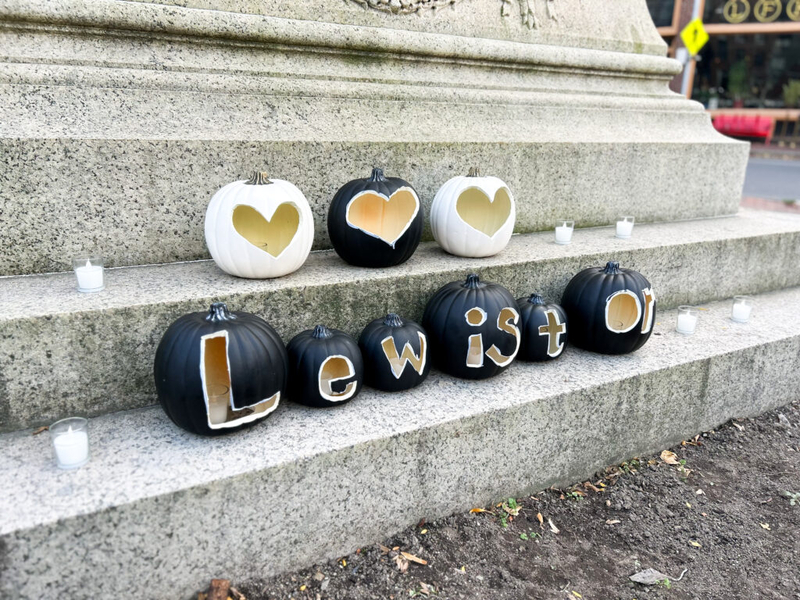
Pumpkins carved to honor the victims of the Lewiston mass shooting. (AnnMarie Hilton/Maine Morning Star)
The Maine Legislature’s government oversight committee Wednesday asked the nonprofit responsible for disbursing funds raised after the 2023 Lewiston shooting to apologize for failing to communicate clearly with victims’ families and survivors about how the money would be distributed.
The Maine Community Foundation established the Lewiston-Auburn Area Response Fund in the aftermath of the shooting, which raised about $6.6 million. Two separate funds were within the larger umbrella: The Victims and Families fund which distributed $4.2 million to 162 victims, families and survivors and the Broad Recovery Efforts and Organizations Fund which distributed $1.9 million to 29 local organizations. Donors could either choose one fund or split their contributions into both.
But victims’ families and survivors of the deadliest mass shooting in Maine history have raised issues with how the money was handled, claiming that they were originally told all funds would go to them. In a press conference last month, some of them resurfaced the issue, objecting to the fact that $1.9 million was given to local nonprofits. Some of these nonprofits, they said, did not spend the money they received to help survivors.
Maine Community Foundation President and CEO Deborah Ellwood defended her organization for more than an hour at the oversight committee meeting, repeating that she was proud of the nonprofit’s work and fundraising. After prompting from several members of the bipartisan committee, she eventually admitted that communication to victims and survivors about how the funds would be distributed could have been clearer.
Much of the committee’s questioning focused on one specific document the foundation sent to victims: a flyer with a QR code advertising the general Lewiston-Auburn Area Response Fund, saying it would “distribute 100% of donations as gifts to victims and survivors.”
“I read this document from the perspective of many victims and survivors who have told me their frustrations with this document, and it’s hard for me to say that there’s not merit in those frustrations,” Rep. Adam Lee (D-Auburn) said to Ellwood.
“I just wish there was an apology, essentially, for perhaps misleading those victims and survivors with respect to the ultimate distribution of the funds.”
Ellwood responded with “I’m very proud of the work we did.
“We served as an important conduit for charitably minded people across the world who wanted to help, and they had the choice to give between the victims fund and the broad recovery fund.” she added.
Several other legislators chimed in, taking issue with the foundation’s stance. Sen. Brad Farrin (R-Somerset) pointed out that nonprofits received about an average of $65,000, while the victims received about $29,000.
Rep. Michael Lemelin added, “I see a form of deception here — and I’m not saying that either one of you did this with malice — but regardless, the deception’s there.”
And Sen. Jill Duson took issue with Ellwood adhering to her statement that the foundation followed national best practices to set up separate funds and communicate what they each were for.
“A key piece that I still don’t hear you saying … is that as much attention was paid to assuring that donors knew where their money was going, that much attention and perhaps more should have been paid to make sure the victims and family knew where and how the money would be distributed,” she said.
Ellwood eventually acknowledged that the foundation could have been more transparent with victims.
“I’m sorry that they felt confused by this particular piece of documentation. That was not our intention,” she said. “Our intention was to provide as much information as possible for victims to be able to get the contributions that were provided.”
Amy Sussman, whose nephew was killed in the shootings, has been leading advocacy on behalf of victims who took issue with the foundation. When asked by committee members Wednesday about Ellwood’s apology, she said it was insufficient.
“When an apology is couched with ‘I’m sorry, they misunderstood.’ That is not truly an apology,” Sussman said. “‘I’m sorry you misunderstood what I said’ is not ‘I said it wrong, and I’m sorry I said it wrong.’ That would be admitting the error on their part, and it appears they are unwilling to do that.”
Maine Attorney General Aaron Frey told the committee in September that the Office of Program Evaluation and Government Accountability, or OPEGA, lacks the authority to investigate how the funds were distributed. OPEGA is an independent legislative office that often conducts probes and reports back to the committee. Frey’s office could investigate potential misuse of charitable donations, although a previous investigation conducted in 2024 did not reveal legal concerns.
Augusta, ME