Feds propose allowing seismic oil surveys to disturb polar bears
Nov 17, 2026 | 3:23 pm ET
Description
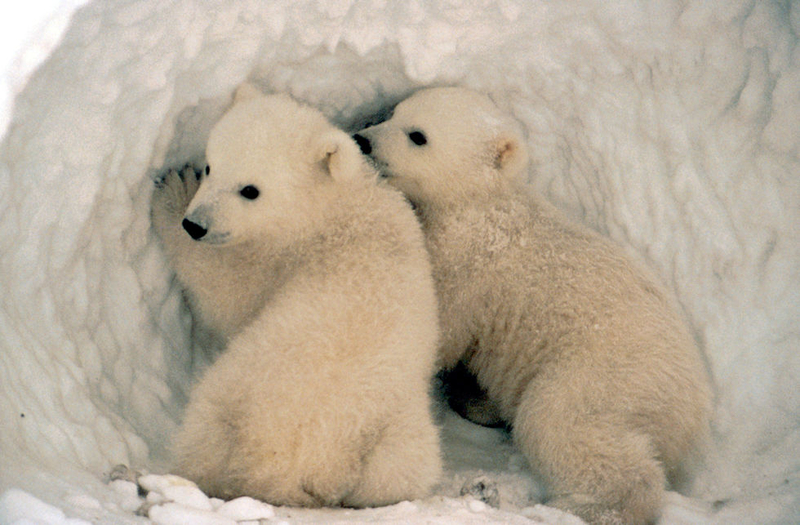
Polar bear cubs are seen emerging from their den in 2010. The U.S. Fish and Wildlife Service says a seismic survey program planned by the Alaska Industrial Development and Export Authority for the coastal plain of the Arctic National Wildlife Refuge will cause only negligible disturbance to polar bears, including denning bears. (Photo provided by the U.S. Geological Survey)
Operators of a planned seismic survey intended to help search for oil in the Arctic National Wildlife Refuge coastal plain would have permission to disturb polar bears under a proposed rule released Monday by the Trump administration.
The U.S. Fish and Wildlife Service is proposing to issue an incidental harassment authorization to the Alaska Industrial Development and Export Authority, or AIDEA, the state development agency that holds six active oil leases in the coastal plain.
AIDEA is seeking to conduct a seismic survey, through contractors, as early as this winter. The proposed incidental harassment authorizations is set to be published in the Federal Register on Tuesday, kicking off a mandatory 30-day public comment period. Incidental harassment authorizations allow for activities that disturb species like polar bears that are managed by the Marine Mammals Protection Act.
If granted, the incidental harassment authorization would bring AIDEA a step closer to actual oil exploration work in the refuge.
The refuge’s coastal plan has been the subject of a decades-long national debate between development advocates and conservationists, with different Alaska Native groups on either side.
Seismic surveys use soundwaves sent through the ground to map out geologic features and help identify potential deposits of oil and gas. The loud sounds associated with seismic operations pose potential hazards to polar bears and other noise-sensitive animals.
But the Fish and Wildlife Service, in its proposed authorization, said it has concluded that the seismic surveys planned by AIDEA will result in only minimal and short-term disturbances to polar bears.
AIDEA’s holdings in the refuge comprise six leases acquired in a January 2021 sale conducted at the end of the first Trump administration, plus three more leases the agency acquired in a U.S. Bureau of Lane Management auction in June.
AIDEA’s plan, as described in the proposed incidental harassment authorization, is to conduct aerial infrared surveys to locate polar bear dens that should be avoided, followed by on-the-ground surveys with seismic equipment and supported by worker camps.
Supporters of oil drilling in the refuge coastal plain have characterized AIDEA’s seismic program as a necessary step toward responsible development that will help the state.
AIDEA in May approved an expenditure of up to $190 million for exploration work in the refuge, mostly for the seismic program. At the time, Gov. Mike Dunleavy described it as “a major investment” in Alaska’s future.
“ANWR represents one of many opportunities to secure long-term economic prosperity for future generations of Alaskans while strengthening American energy security,” Dunleavy said in a statement released by AIDEA.
AIDEA had planned to start its survey work as early as this month, according to the Fish and Wildlife Service’s proposed authorization.
However, AIDEA now expects the program to start no earlier than January, according to a status report the development agency filed earlier this month in federal court as part of a pending legal case that seeks to block oil exploration in the refuge.
Opponents of oil development said Monday the Fish and Wildlife Service’s analysis vastly understates the impacts that seismic exploration would have on the Arctic environment.
Opponents who weighed in include the Gwich’in Steering Committee, which represents Gwich’in Athabascan tribes in Alaska and Canada, and Earthjustice.
“The Gwich’in Steering Committee is appalled by the level of industrial and human activity that AIDEA is outlining in their request,” Kristen Moreland, the organization’s executive director, said in a statement. “Seismic testing, and everything that comes along with it, would have far-reaching and devastating impacts on the Coastal Plain.”
The Gwich’in Steering Committee and a coalition of conservation groups represented by Earthjustice are plaintiffs in the pending lawsuit seeking to prevent AIDEA from carrying out its planned exploration.
Scientists with the University of Alaska Fairbanks have cautioned that seismic surveys in the refuge coastal plan will likely damage tundra and permafrost terrain and harm the area’s wildlife. Winter snow cover in the coastal plain is too patchy to provide protection from heavy equipment moving across the ground, and freshwater sources are too scarce in that part of Arctic Alaska to support temporary ice roads that are used for winter work, the scientists concluded in a 2020 report.

Juneau