‘This kiddo is struggling’: Community clinics address Oklahoma’s youth mental health crisis
Nov 17, 2026 | 6:30 am ET
Description
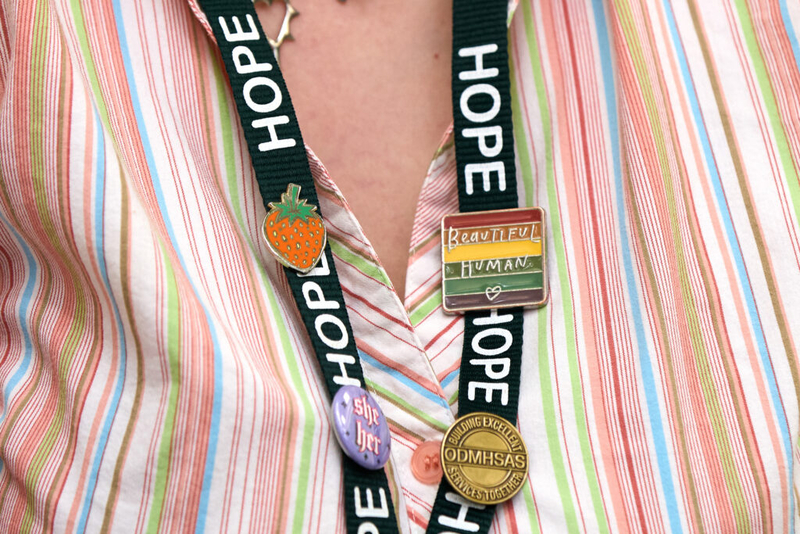
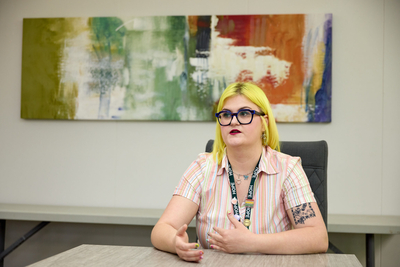
Ashley Showalter wears pins on her lanyard during an interview at on Tuesday, March 31, 2026, in Oklahoma City. (Photo by Nate Billings/For Oklahoma Voice)
Editor’s note: This story discusses suicide and mental health crises. If you or someone you know needs help, call or text 988, the U.S. suicide and crisis lifeline, or access online chat at 988lifeline.org.
OKLAHOMA CITY — In south Oklahoma City, a team of behavioral health providers spend their days in schools, working with teachers and administrators to speak with students who need help and finding time for them to participate in therapy, counseling or other interventions.
The goal: boosting students’ well-being and attendance, which makes it much easier for them to learn.
Oklahoma youth have long struggled with higher rates of mental illness than the national average, but face hurdles accessing care. Amid growing mental and behavioral health challenges, the state’s certified community behavioral health clinics are working to reach youth where they are to provide or connect them with other specialized care – whether that’s in their school, at home or through peer-to-peer support.
Oklahoma’s network of private certified community behavioral health clinics operate a plethora of youth-focused programs, providing care both in and out of schools. This federally designed healthcare model provides access to a series of core, required mental, behavioral and substance use services, regardless of someone’s ability to pay.
The hope is that by addressing youth’s challenges early on, it will help cut down on Oklahoma’s high rates of incarceration, hospitalization and emergency room visits by preventing an issue from reaching the point of an arrest or a call to 911.
People struggling with mental or behavioral health often languish in Oklahoma’s jails and prisons because of a lack of available beds at mental health facilities.
The federal government originally paid for a higher share of the cost for these nine private clinics to get them started, but that extra funding ended last year. These clinics, which serve more than 150,000 people a year, are at risk if the cash-strapped state Legislature can’t find a way to help foot the bill for the increasing cost of care.
Barriers to care
Between 2018 and 2024, the percentage of these community behavioral health clinics providing school-based services grew from 51% to 88% nationally, according to a report from the federal Office of Behavioral Health, Disability, and Aging Policy.
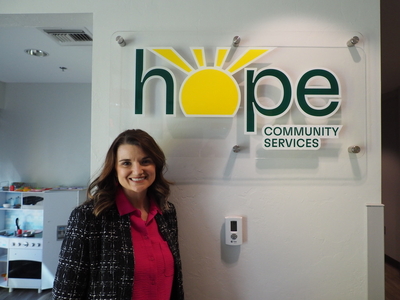
In south Oklahoma City, Family & Children’s Services, formerly known as Hope Community Services, is one of those clinics. They have 28 clinicians who work in teams across 28 different public and charter schools in what is traditionally a lower income area. Officials said they could not provide a list of the specific schools they operate in for privacy reasons.
Heather Helberg, the provider’s central region president, said embedding clinicians in schools isn’t a requirement, but these health clinics are required to respond to community’s needs, which often include providing services for schools.
Clinics in other areas of the state provide similar services, such as Grand Mental Health, which serves most of northern Oklahoma.
“We can also go out and we go into their homes and meet them where they’re at when it’s convenient for them,” Helberg said. “We also have telehealth options, so I think the school is kind of the entry point for us to find the folks, because the teachers and the counselors have said, ‘Hey, this kiddo is struggling.’”
She said that as of Aug. 31, the clinicians in Oklahoma City schools had received nearly 270 referrals since the beginning of the school year between all the sites they serve.
“We have had an overwhelming response from schools saying we need these services,” she said.
The longer people go without treating mental illness, Helberg said, the worse it becomes. So the earlier kids can get services, the better.
“Twenty years from now, we’re looking down the road and we have a healthier Oklahoma,” she said. “And so I think that’s kind of the big picture of all this — we want to do something that’s actually going to help our community in the future, not just now, but just is going to make our kiddos healthier in the long run.”
Access to youth services
More than 1 in 10 Oklahoma children, ages 12 to 17, had serious thoughts of suicide in 2024, according to an annual report from Mental Health America.
Nationally, there’s been a sharp rise in preteen suicides over the past decade, often attributed to stressors such as COVID-19, social media use, bullying, overexposure to media and restrictions on accessing healthcare like gender-affirming care.
‘Somebody stepped in and helped’: Advocates press to keep Oklahoma’s mental healthcare ‘safety net’
For nearly a decade, the federally designed certified community behavioral health clinic model has provided healthcare services hundreds of thousands of Oklahomans. Oklahoma was one of the first states to pilot this program.
During the pilot years, which lasted from 2017 through most of 2025, the federal government paid for a larger portion of the program. But, as expected, it shrunk by about 23%, leaving the state responsible for tens of millions of extra dollars.
Brittany Hayes, senior vice president of policy at Healthy Minds Policy Initiative, an Oklahoma nonprofit, nonpartisan policy group that researches mental health and substance use, said common barriers for youth include transportation, scheduling or not knowing where to start. These community providers have been helpful in breaking down these obstacles, she said.
“They are designed to be a no-wrong-door access point, so families in need can show up or call and get what they need, regardless of what that is,” she said.
Community clinics have also developed partnerships with schools, which helps staff know how to help students get help in moments of crisis, Hayes said.
The number of children and adolescents served by certified community behavioral health clinics increased by 24% in the first five years of the program, according to a report issued by the federal Office of Behavioral Health, Disability, and Aging Policy.
Youth services can extend beyond a child’s 18th birthday and be offered through their early 20s.
Tiffany Scott, the youth program director at the Oklahoma City provider, said that by embedding clinicians, young people and parents have a starting point to reach out for help. Otherwise, many just don’t know whom or where to turn to.
While the number of students seeing clinicians varies by site, she said, the ultimate goal is to have a team of clinicians assigned to each school.
At one of the schools where clinicians have worked since January, Scott said they’re seeing about 24 kids. The frequency depends on the level of need — whether that’s weekly, biweekly or monthly. At newer sites where relationships with school staff, teachers and students are still growing, clinicians are seeing around six to 10 students, but those numbers are climbing along with the number of referrals.
The clinicians work with teachers and administrators to meet the culture and needs of the school to find time to meet with students in a way that does not disrupt academics, Scott said.
While the reasons students work with clinicians vary by situation and school, Scott said that in elementary schools, they’ve seen a lot of disruptive behavior or kids not understanding classroom structure. In middle or high school, clinicians are more often working with children struggling with depression, anxiety, suicidal ideation or self-harm.
Oklahoma City Public Schools said in a statement that they are “grateful” for the partnership and have worked to build a network of partners to provide mental health resources to students and families.
“These partnerships complement the work of our OKCPS Mental Health Specialists and school teams, helping us provide a more comprehensive, wraparound approach to supporting students,” the spokesperson said in a statement. “We value this collaboration and welcome opportunities to expand access to mental health support across the district.”
‘Envisioning a future’
The work goes beyond the walls of schools.
Ashley Showalter has been a youth case manager with Family & Children’s Service for two years and is also a certified peer.
As a “certified peer,” she is able to share her own experiences with clients, which often helps build trust and relationships. Showalter said she is bipolar and has post-traumatic stress disorder, anxiety and attention-deficit/hyperactivity disorder, so she is able to talk about recovery and treatment with clients who have similar diagnoses.
Showalter works with teens and young adults, typically aged 16 to 24, in things like learning healthy coping skills, rehabilitation, finding housing and creating goals. She helps them learn life skills, such as creating a resume, filling out job applications, budgeting and building a support system.
“I can encourage and offer suggestions,” she said. “But at the end of the day — I like to use this metaphor when I explain the program to kids — I might be driving the car, but you’re telling me where to turn. I’m not going to turn anywhere without your permission, but I’ll help guide you.”
Showalter has been working with Layla Broeker, 18, to prepare the teen for her future. That assistance has included finding work study programs to pay for housing in college, looking for scholarships and exploring major programs.
Broeker said she wasn’t able envision a future or create substantial goals for herself when she was suicidal and struggling with major depressive disorder.
After spending time at an inpatient facility, the 18-year-old was referred to an Oklahoma City certified community behavioral health clinic for outpatient care. The support and independence she learned there sparked a change, Broeker said.
“I think if I look back at my goals initially, there wasn’t really a foreseeable future in my perspective,” she said. “And I really came here because I had to. But then over time, I did realize that having agency and having support, I was able to do things independently and I was able to actually have my own goals and have goals to begin with.”
Broeker said she was assigned a therapist, case manager and peer services. This year, she was accepted to the University of Oklahoma and offered a scholarship.
“Eventually, it shifted from just not having any goals to just even minor things,” Broeker said. “Like, my grades last year were terrible; I didn’t do anything in school. But now I even look forward to things like school, which are generally mundane tasks, and I feel like my goals now are more practical rather than emotional.”
Oklahoma Voice is part of the Mental Health Parity Collaborative, a group of newsrooms that are covering stories on mental health care access and inequities in the U.S. The partners on this project include The Carter Center and newsrooms in select states across the country.
Oklahoma City, OK