Insufficient wellness funding is a common hurdle in supporting Native students, researchers find
Nov 15, 2026 | 6:00 am ET
Description
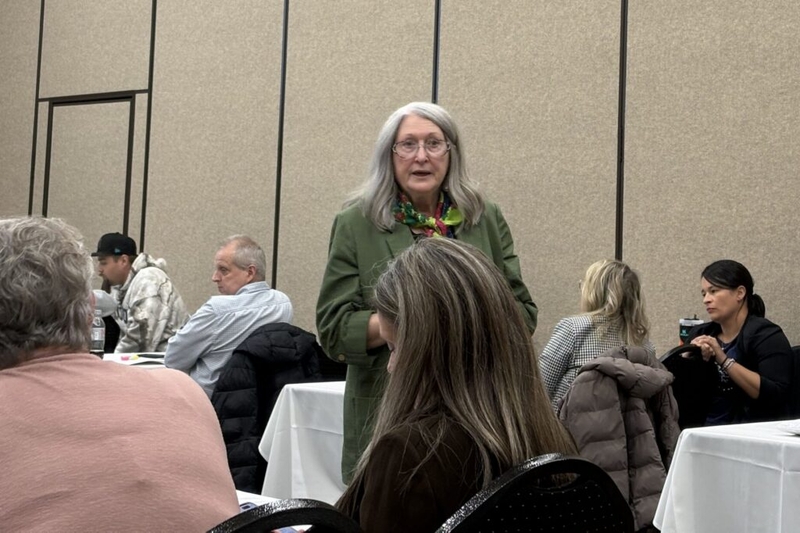
Dorothy Aguilera-Black Bear speaks to attendees during a breakout session at the annual Indian Education Summit in Pierre, South Dakota, on Nov. 12, 2026. (Photo by Meghan O'Brien/South Dakota Searchlight)
Listen to an audio version of this story by reporter Meghan O’Brien. Broadcasters: See below for a downloadable version with a host intro script.
The need for mental health and other wellness services among Native American students outpaces what’s available with existing funding, according to data collected earlier this year and presented recently to South Dakota educators.
Dorothy Aguilera-Black Bear and Brooke Rumper, of the Central Comprehensive Center, asked South Dakota principals whose schools have at least one Native American student to identify the needs and available resources for those students. Of the 673 asked to participate in the survey, Aguilera-Black Bear and Rumper got responses from 157.
The pair shared their findings Thursday at the annual Indian Education Summit in Pierre. Federal grants helped fund the research, and the project is in partnership with the state Department of Tribal Relations and state Office of Indian Education.
“The capacity for schools to have those consistent needs be supported is really difficult,” said Aguilera-Black Bear.
‘We can do it’: A rural school near two Native American reservations nearly doubles its attendance
They’re bringing their findings to tribal education directors to dig deeper into the data, “because they’re very close to what’s going on in the schools that serve their tribal citizens,” said Aguilera-Black Bear. With the feedback from Thursday’s presentation, her team is hoping to help educators create action plans to address their students’ needs.
Nearly 60% of the survey respondents said their schools don’t have enough funding to provide the mental health and reproductive health education and access that students need. Some respondents also mentioned a lack of student access to community elders and knowledge keepers, and a struggle to hire staff with culturally relevant or trauma-informed training.
The survey also showed that many Native students in South Dakota lack access to secure housing, reliable food sources outside of school, and clothing and hygiene products.
Martina Moves Camp is a transition specialist at Crazy Horse School in Wanblee, on the Pine Ridge Reservation. She said her students experience challenges that are reflected in the data, including struggles with basic needs like food and clothing, but seeing the collaboration of researchers and educators gives her hope for finding solutions.
“We’re meeting that need, but we aren’t where a lot of other schools are,” Moves Camp said. “And I can’t wait for the day for our school to be where we are creating those culture-bearers, where they are able to be teachers to their next generation.”

Pierre, SD